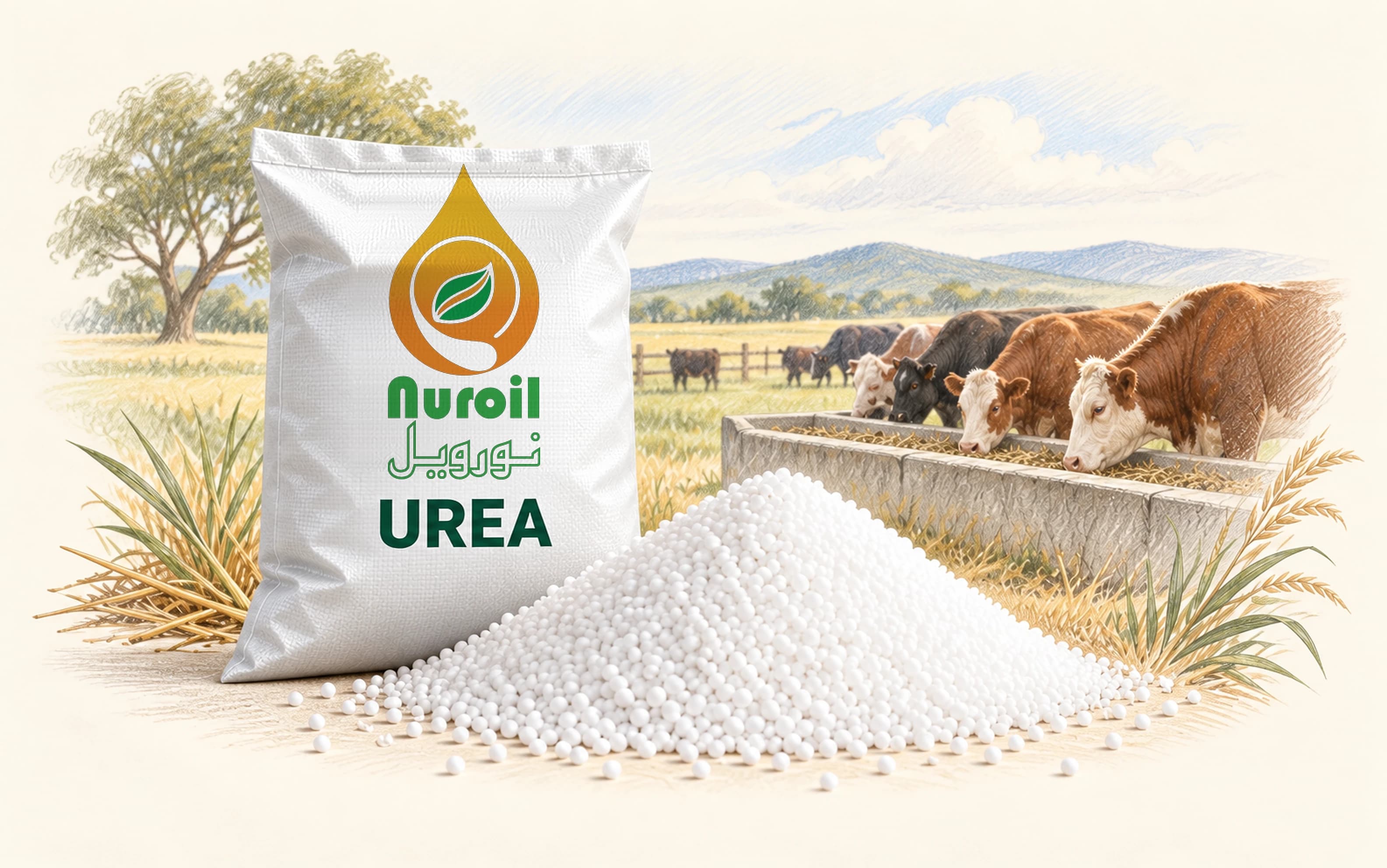
Cattle, sheep, goats and buffalo grazing dry pasture or living on crop residues are often short of nitrogen. The rumen microbes that digest fibre need ammonia to grow, and low-protein forage cannot supply enough. Urea-molasses multinutrient blocks (UMMBs) are a simple way to provide that nitrogen, together with energy and minerals, in a form animals take in slowly through the day. The technology has been promoted by FAO for decades and is used from village scale to commercial production.
Why a lick block works
The block's purpose is to control intake. Animals lick rather than bite a properly made block, so urea reaches the rumen in small amounts over many hours. That keeps rumen ammonia at a steady, useful level instead of producing the spike that leads to urea toxicity. Molasses adds fermentable energy so microbes can capture the ammonia, while bran and minerals add phosphorus, salt and other nutrients often missing from poor forage. Field studies collected by FAO report better forage intake and digestibility, and improved growth and reproduction, when blocks are used during the dry season.
A typical cold-process formula
Early blocks were made by heating molasses, which was costly and needed fuel. The cold process, developed and tested under FAO projects, sets the block with a binder instead. FAO's basic formula for 100 kg of mix is shown below; local versions substitute other fillers and binders.
| Ingredient | Approximate share | Role |
|---|---|---|
| Molasses | 45 kg | Energy, palatability, trace minerals |
| Feed-grade urea | 10 kg | Non-protein nitrogen for rumen microbes |
| Wheat bran or other filler | 30–35 kg | Absorbs moisture, gives structure, adds nutrients |
| Cement or quicklime | 5–10 kg | Binder that sets the block |
| Common salt | Up to 5 kg | Salt supply and intake control |
| Water | About 4 litres | Hydrates the binder |
The earliest cold-process recipe tested by FAO used 50% molasses, 25% bran, 10% urea, 10% quicklime and 5% salt, and more than 70 variations were trialled before suitable local formulas were chosen.
Making the blocks
FAO's practical guidance describes a straightforward sequence. Most makers combine molasses and urea first so the urea is dispersed through the liquid. The binder goes in next, sometimes pre-wetted to reduce dust. Bran or filler follows, and finally water with the salt dissolved in it is added slowly. The mix is right when a squeezed handful forms a ball with no free water on its surface. Moisture in bran and the fineness of cement vary, so the water addition is found by trial and then recorded for repeat batches.
Mixing can be done by shovel on a clean floor or in a small concrete mixer run slowly so the material tumbles. FAO notes that screw mixers designed for dry farm feeds generally do not handle the sticky mix well. The mix is then pressed into moulds.
Hardness is a safety setting
A block must be hard enough that animals have to lick it. If it is too hard, intake is too low to help. If it is too soft, animals can bite off pieces and eat too much urea too quickly, which risks poisoning. Hardness is adjusted through the recipe: more molasses or less binder gives a softer block. Getting this right takes some trial, and FAO describes block making as a skill learned by doing.
The block is designed to ration urea through the day. A soft cake eaten in minutes defeats that purpose.
Curing, storage and use
Blocks can usually be handled after three to eight hours, but they need to harden further before animals use them or before transport over rough roads. Drying rate depends heavily on climate: in hot, dry conditions blocks may be ready within days, while in cold or very humid seasons they may not harden properly. Store finished blocks in a ventilated, roofed shed out of direct sun and protect them from rodents and birds. Molasses is heavy, close to 1,500 kg per cubic metre, so tanks and vehicles designed for water should not be filled to the brim with it.
The usual urea rules still apply: blocks are for ruminants with a working rumen, animals should have forage available, and they should be introduced gradually. A nutritionist or veterinarian should approve the formula for the species and conditions.
Sourcing urea for block making
Use urea sold for animal feed, not fertilizer, and keep it dry because lumps will not disperse in molasses. Ask for nitrogen content, biuret, moisture and particle size on the certificate of analysis. Nuroil supplies feed-grade urea in bags suitable for block producers and feed mills, with a CoA for each delivery. Contact us through our contact page to discuss quantities.