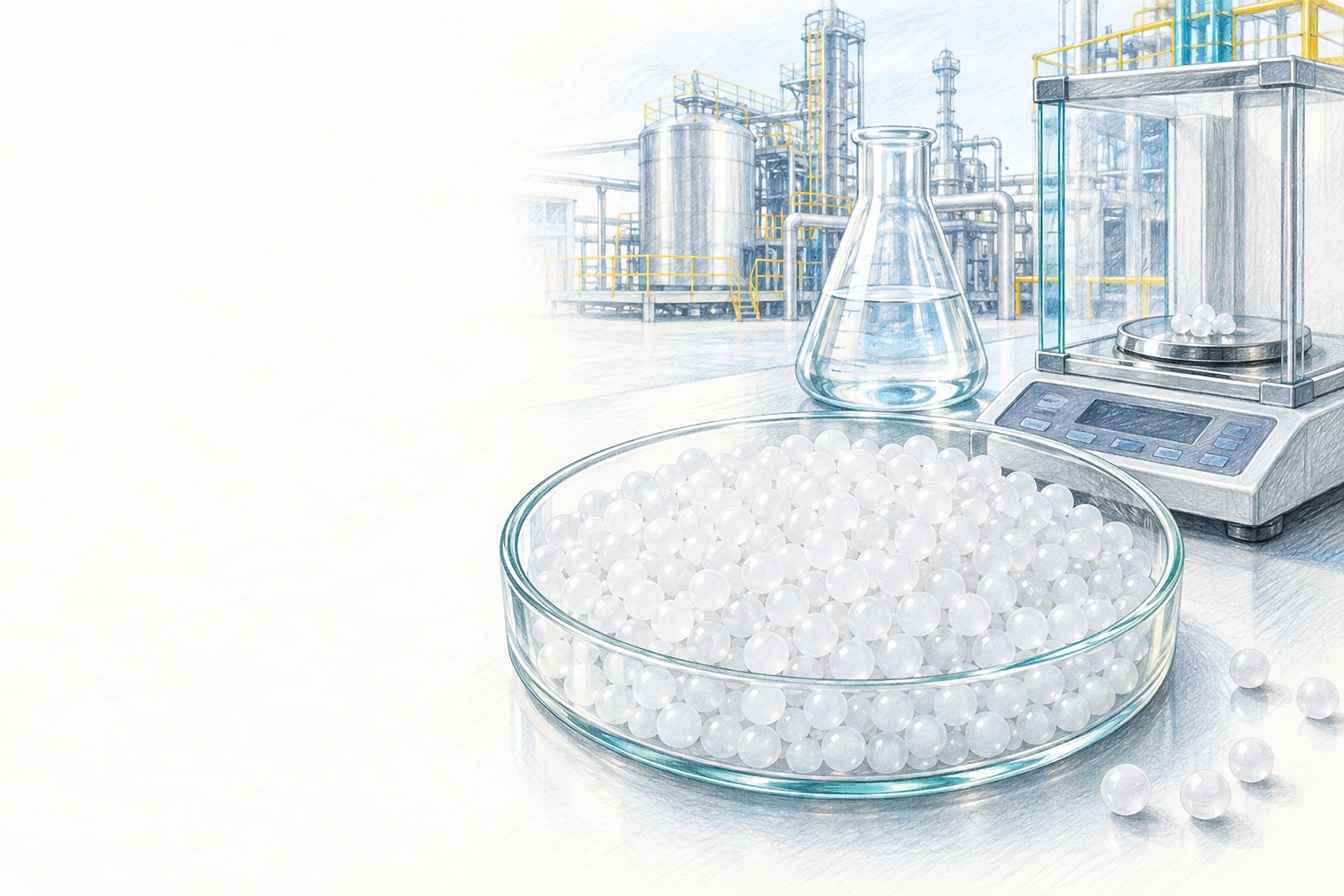
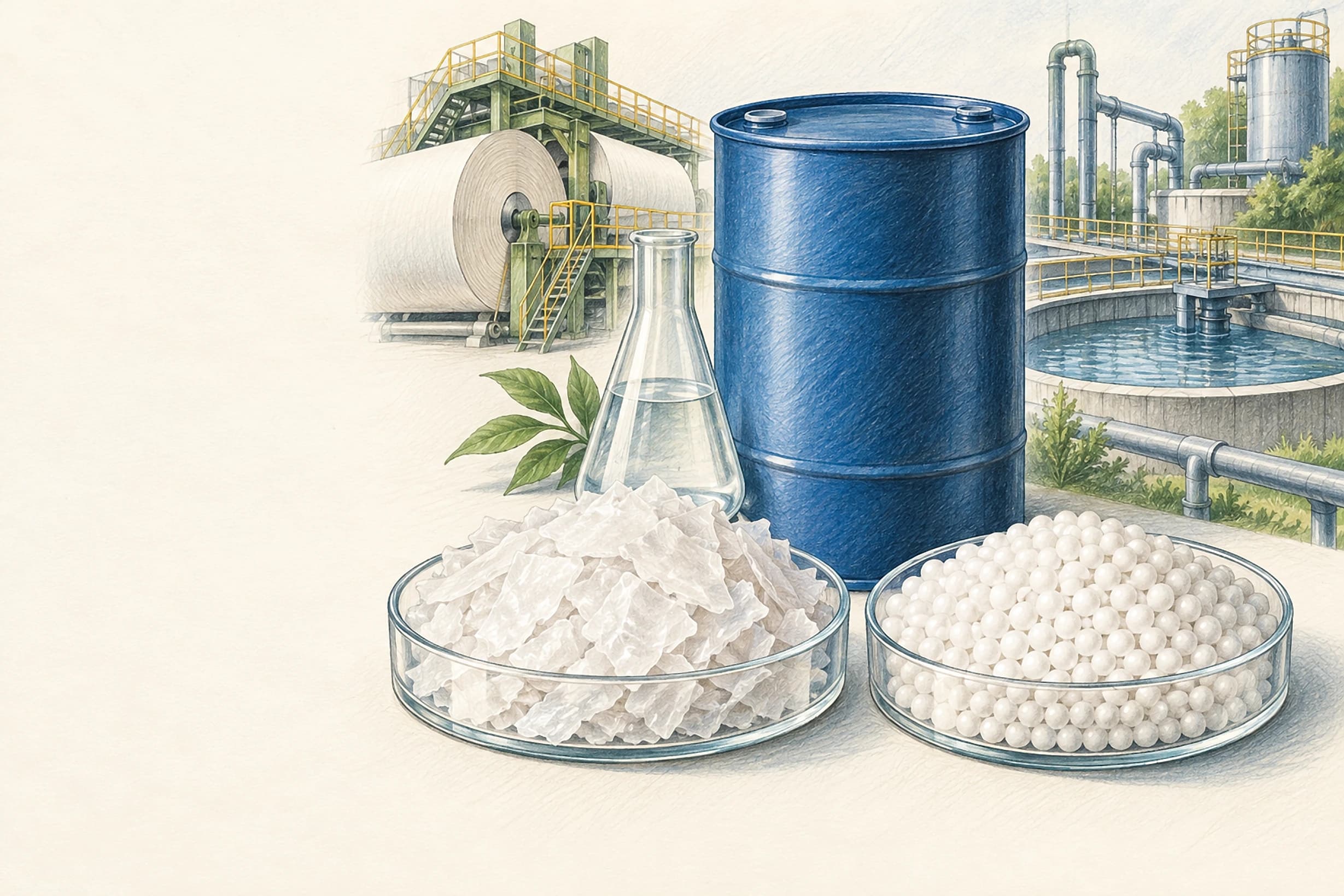
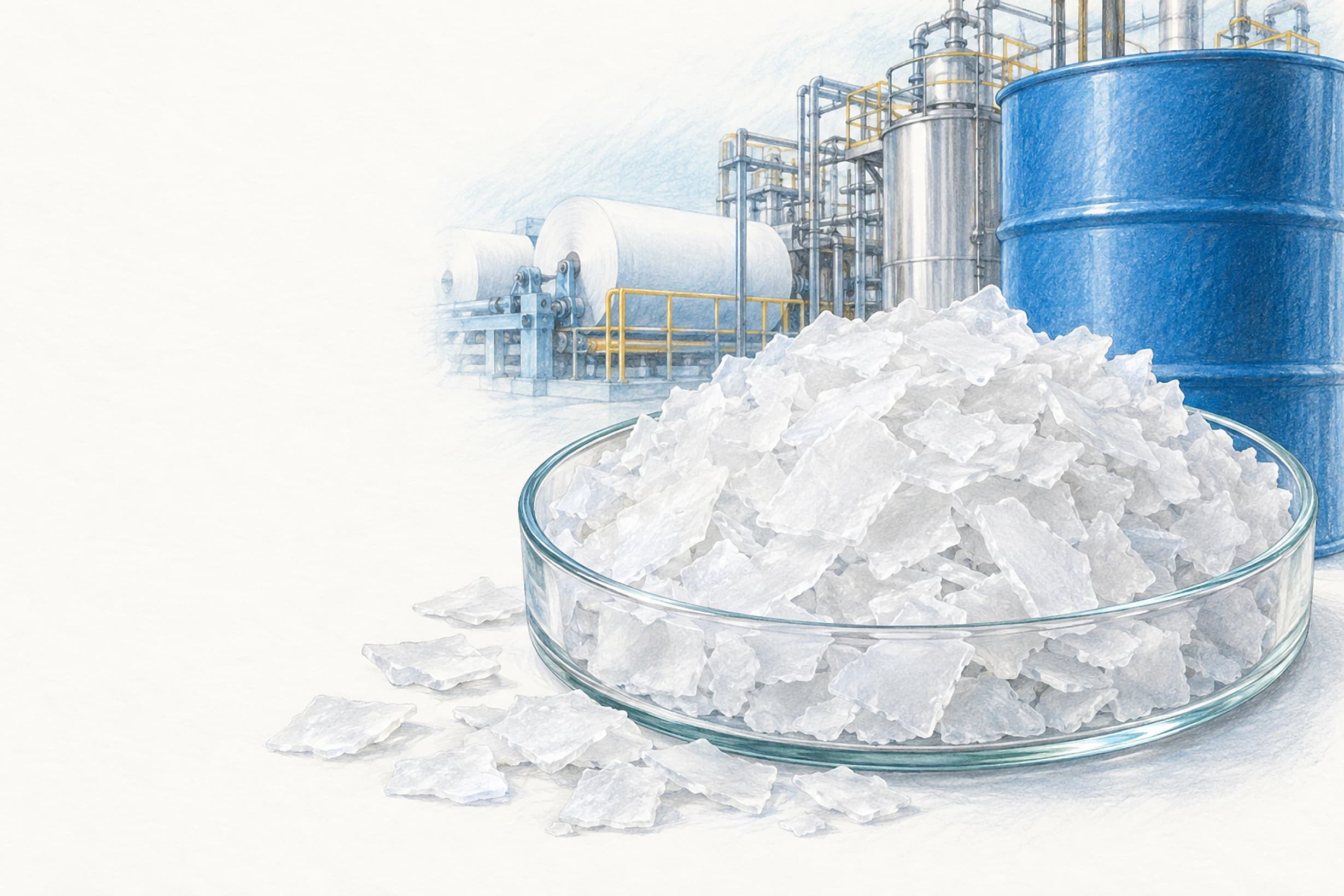
Caustic soda pearls, also called beads, prills or microperls, are small spheres of anhydrous sodium hydroxide, typically under about 1 mm across. Producer data show they dissolve markedly faster than flakes of the same chemistry. For plants that make up caustic solution several times a shift, that speed translates into shorter batch times and fewer undissolved lumps. This article explains where the difference comes from and how to make the most of it.
What the test data show
One large producer compared its anhydrous grades under identical laboratory conditions: a 5% solution at 10 °C with constant magnetic stirring. Pearls dissolved in about 15 seconds. A coarse ground grade took about 20 seconds, and two flake grades took around 41 to 44 seconds. In a plant tank the absolute times are much longer, but the ranking holds.
Why pearls are quicker
- Small, uniform size. Dissolution happens at the particle surface. A sample of fine spheres presents a large total surface for its weight, and because the size is uniform, there are no large pieces left behind after the rest has gone.
- They stay suspended. Small spheres are carried by the circulating liquid instead of settling flat on the tank floor. Flakes, being flat and larger, tend to sink and stack.
- No hydrate layer on the bottom. When solid caustic piles up on the bottom of a poorly stirred tank, it forms a layer of hydrate that dissolves slowly. That layer can overheat and cause violent spurting. Pearls that remain in suspension are much less prone to this.
- Free flow. Pearls pour evenly and can be metered steadily, so caustic enters the water at a controlled rate rather than in clumps.
Heat is the limiting factor
Faster dissolving also means faster heat release. Sodium hydroxide gives off roughly 1,000 kJ of heat per kilogram dissolved, whatever its form. With flakes the slower dissolving spreads that heat out a little; with pearls, adding a large charge at once can make the temperature climb very quickly. In practice the rate of addition, not the dissolving rate, should set the pace:
- Start with water at moderate temperature, around 27 to 38 °C, as one producer recommends, not hot or very cold.
- Add pearls slowly onto the surface of a well-agitated liquid, using a propeller agitator or a recirculation pump.
- Do not use air sparging for mixing; it adds carbon dioxide and raises carbonate.
- Watch the temperature and pause additions if it rises towards the limit of the tank or liner.
Factors that slow pearls down
| Factor | Effect | Remedy |
|---|---|---|
| Moisture pickup in store | Pearls stick into lumps that dissolve like coarse flakes | Keep packs sealed and dry; use stock in rotation |
| Weak agitation | Pearls settle and form a hydrate layer | Size the agitator for the tank; check impeller position |
| Cold water | Slower dissolving, then sudden temperature surge | Use lukewarm make-up water |
| Strong target concentration | Dissolving slows as the solution approaches saturation | Make up at moderate strength, then adjust |
| Fines from abrasion | Dust when tipping; can cake in hoppers | Handle gently; fit a dust filter on transfer systems |
Where speed pays off
Quick dissolving matters most where solutions are made up often and in small batches: cleaning-in-place stations, bottle washers, laundries, small water treatment skids, laboratories and soap or biodiesel producers making catalyst solution. It also matters in dry-blended products, where the pearl dissolves quickly when the end user adds water.
Pearls dissolve faster because they are small, uniform and stay in suspension. Let the rate of addition, not the dissolving speed, control the batch.
Buying pearls
Ask for the particle size range alongside the chemical analysis, because size is what you are paying for. Specify packing that keeps the pearls dry, usually 25 kg lined bags or bulk bags with liners. Nuroil supplies caustic soda pearls with a certificate of analysis for each lot; send your requirements through request a quote.