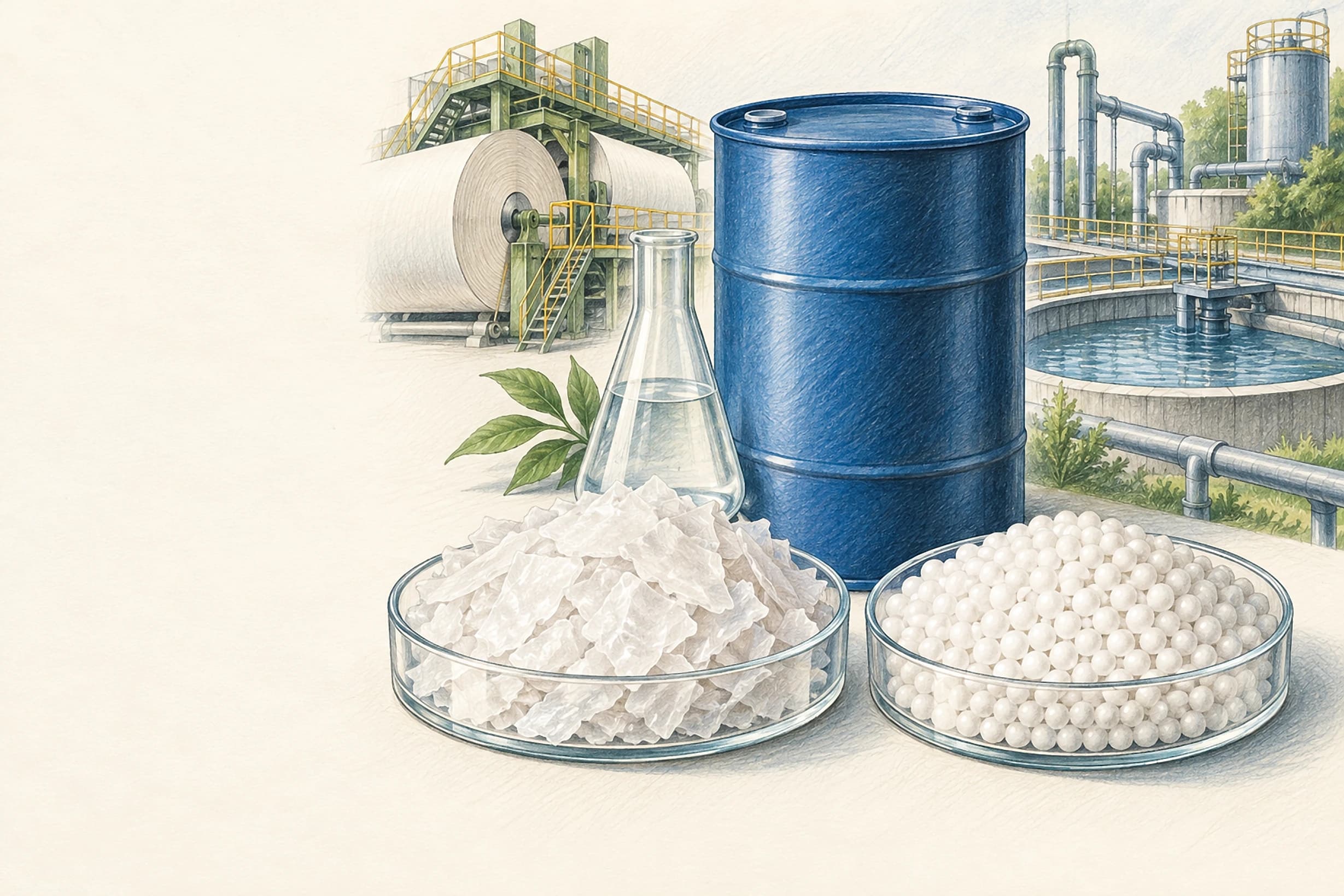
The same pearl of sodium hydroxide can be sold as a technical product, a food additive, a pharmacopoeial excipient or a laboratory reagent. What changes between these grades is not the chemistry but the impurity limits, the testing and the paperwork behind each lot. Buying the wrong grade can mean a failed audit or a rejected product even when the caustic itself works perfectly. This guide outlines the main grades and how to tell them apart.
Technical grade
Technical or industrial grade pearls are made for general manufacturing: detergents, cleaners, chemical synthesis, textiles, metal treatment and effluent neutralisation. The specification typically covers NaOH content, carbonate, chloride and iron, plus particle size. There is no regulatory monograph behind it, so limits are agreed between buyer and seller or follow a national industrial standard.
Food grade (E 524)
Sodium hydroxide is an approved food additive, identified in Europe as E 524, used as an acidity regulator and processing aid. Typical food applications include peeling of fruit and vegetables, pretzel and bakery surface treatment, cocoa processing, olive curing and cleaning of food-contact surfaces. Food grade product must meet a published purity specification. In the European Union that is Commission Regulation (EU) No 231/2012; elsewhere buyers commonly refer to the Food Chemicals Codex or the JECFA specifications. These set a minimum total alkali content, commonly 98% or more expressed as NaOH, and limits for carbonate and toxic elements such as arsenic, lead and mercury.
Beyond analysis, a food grade supply usually needs evidence that the producer runs a food safety management system and that packing and transport keep the product free from contamination.
Pharmacopoeial grade
Pharmaceutical manufacturers use sodium hydroxide to adjust pH and to form salts of active ingredients. They require product that complies with a pharmacopoeia monograph, such as the European, British or United States pharmacopoeia. Monographs prescribe identification tests, assay and limits for carbonate, chloride, sulphate, iron and heavy metals, and the supplier is expected to work under appropriate good manufacturing practice with full lot traceability.
Reagent and analytical grade
Laboratory suppliers sell pearls, often called micropearls, for analysis. Their certificates list a high assay and very low limits for a wide range of impurities, which matters for titrations and trace analysis. These products come in small packs and are rarely relevant for bulk buyers, but they illustrate how far impurity limits can be tightened.
Grades at a glance
| Grade | Reference document | Main extra requirements | Typical buyers |
|---|---|---|---|
| Technical | Supplier or national industrial specification | NaOH, carbonate, chloride, iron, size | Detergent, chemical, textile and metal plants |
| Food | EU Regulation 231/2012, Food Chemicals Codex, JECFA | Limits on arsenic, lead, mercury; food safety controls | Food processors, food ingredient makers |
| Pharmacopoeial | Ph. Eur., BP or USP monograph | Monograph tests, GMP, full traceability | Pharmaceutical and personal care producers |
| Drinking water | Standards such as EN 896 | Limits on substances relevant to water quality | Water utilities |
| Reagent | Laboratory supplier specification | Very low limits on many impurities | Laboratories |
A higher grade is about proven limits and documentation, not about stronger caustic. Buy the grade your regulator or customer requires, and no higher.
Documents to request
For any regulated grade, ask for a certificate of analysis that names the standard or monograph the lot complies with, the safety data sheet, a statement of compliance and, where relevant, food safety or GMP certification of the producer. Clarify packing too: food and pharmaceutical grades are normally supplied in new, lined bags or drums dedicated to that grade. Nuroil sources caustic soda pearls from established producers and provides a certificate of analysis with every delivery, with other documents on request; contact us to confirm what is available for your grade.