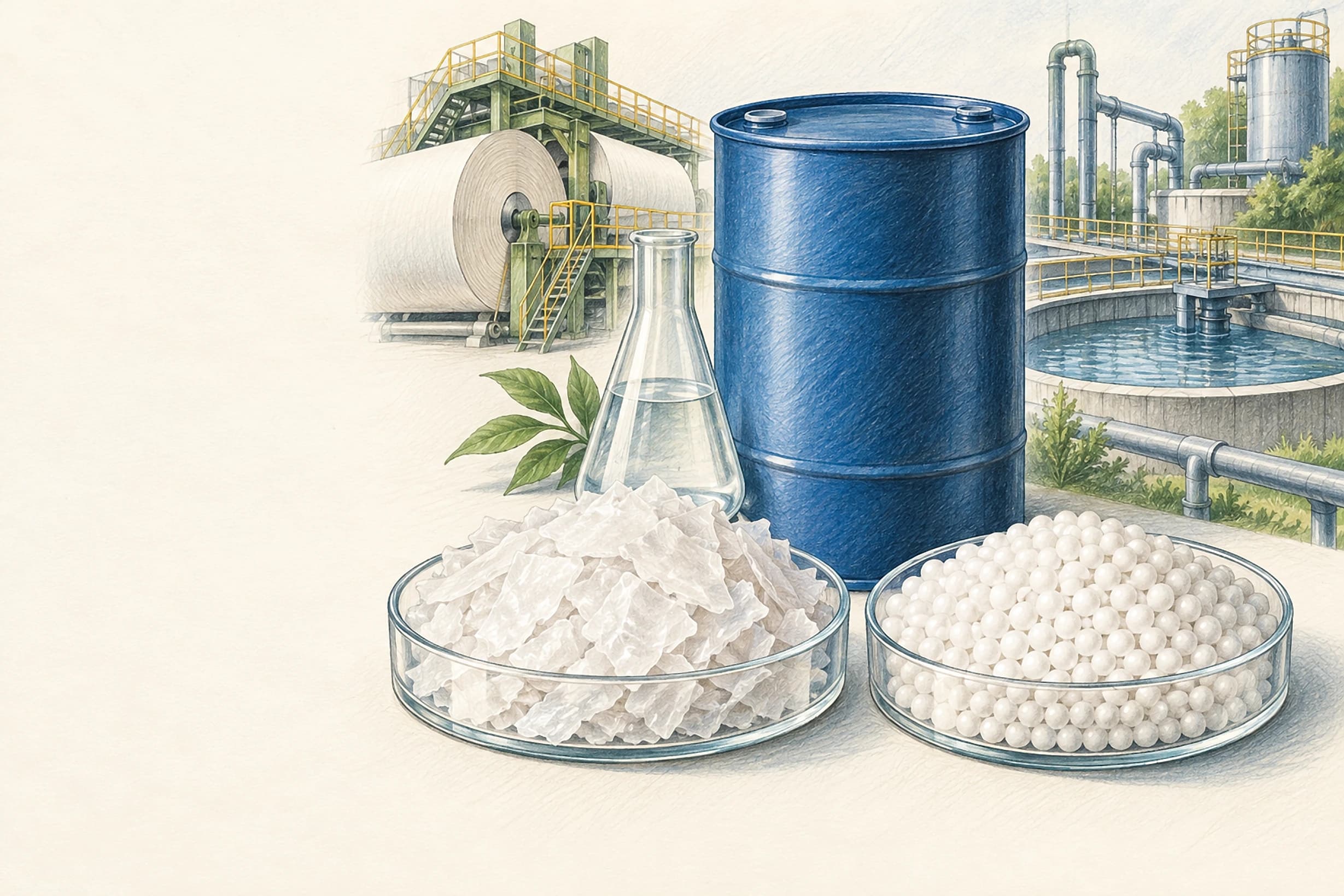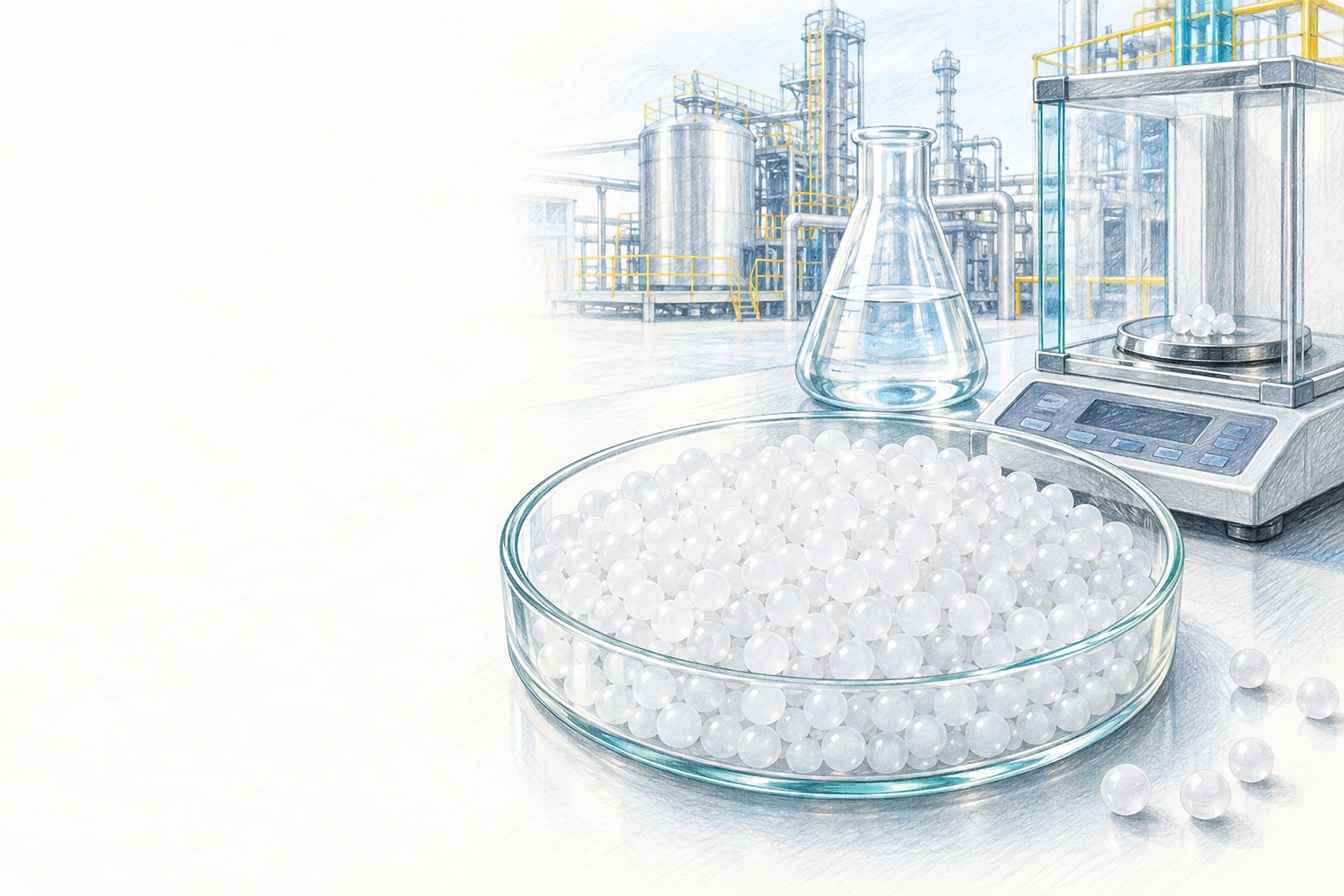
Caustic soda pearls are chemically the same as flakes, so their certificate of analysis looks familiar: NaOH, carbonate, chloride, iron. What sets pearls apart, and what you pay for, is their size and shape. A pearl specification that ignores particle size leaves out the property that makes the product useful for dry feeding, blending and quick dissolving. This guide covers both halves of a sound specification.
How pearls are made
Pearls are produced by spraying molten, water-free caustic soda into the top of a prilling tower. The droplets cool as they fall through rising air and solidify as spheres. Tower design, nozzle size and operating conditions set the size range. Fine grades are sometimes sold as microperls or microprills; producers of these describe a consistent diameter below about 1 mm.
Typical size ranges
Size is usually reported as a sieve analysis: the percentage of a sample retained on, or passing through, a stack of standard sieves. One producer reports that, for its beads, typically more than 80% of the particles lie between the US No. 20 and No. 40 sieves, that is between about 0.85 and 0.42 mm. That range was chosen to match common granular grades of soda ash, silicates and phosphates.
| US sieve number | Aperture (mm) | Typical role in a pearl specification |
|---|---|---|
| No. 16 | 1.18 | Oversize limit; little or no product should be retained |
| No. 20 | 0.85 | Upper bound of the main fraction |
| No. 30 | 0.60 | Mid-point check of the distribution |
| No. 40 | 0.425 | Lower bound of the main fraction |
| Pan (passing finest sieve) | – | Fines limit; high fines mean dust and caking risk |
Producers set their own sieve points, and many use ISO metric sieves rather than US numbers. What matters is that the specification states the sieves used and limits for oversize, main fraction and fines.
Why the size range matters to users
A narrow size range is what gives pearls their practical advantages. In dry blends, pearls that match the other granular ingredients stay evenly mixed in the pack instead of separating during transport. In volumetric feeders, a consistent size gives a consistent bulk density and therefore a steady dose. In dissolving tanks, small, uniform spheres stay suspended and dissolve quickly. Too many fines work against all three: they generate dust, absorb moisture faster because of their larger surface, and fill the spaces between pearls so that the product cakes more readily.
Chemical parameters
- NaOH content: usually 98% or 99% minimum. Ask whether the figure is true NaOH or total alkalinity including carbonate.
- Sodium carbonate: reflects carbon dioxide pickup during production, packing and storage.
- Sodium chloride: indicates the electrolysis route; low chloride suits stainless steel systems and sensitive processes.
- Iron: affects colour in soaps, detergents and clear products.
- Other metals and impurities: needed for food, pharmaceutical, laboratory and electronics grades.
The widely used test methods for these parameters are titrations for alkalinity and carbonate, with methods such as those in ASTM E291.
Physical parameters worth adding
- Appearance: white, free-flowing spheres, free from visible foreign matter.
- Fines: a maximum for material passing the finest sieve.
- Bulk density: useful when calibrating volumetric feeders; agree the method, as loose and tapped values differ.
- Packing: lined bags or lined bulk bags, with the liner sealed.
Testing particle size without spoiling the sample
Caustic pearls absorb moisture during sieving and can stick to the mesh, distorting the result. Sieve quickly in a dry room or under low humidity, use a closed sieve stack with a lid and pan, keep shaking times consistent, and wear full protective equipment because the dust is corrosive. Clean and dry the sieves straight afterwards.
A useful pearl specification states sieves and limits for oversize, main fraction and fines, alongside the usual NaOH, carbonate, chloride and iron.
Putting it in your enquiry
State the particle size range your equipment or formulation needs, the chemical limits, the end use and the packing. Ask for the sieve analysis to appear on each certificate of analysis. Nuroil supplies caustic soda pearls from established producers and can arrange third-party inspection on request; send your specification through request a quote.