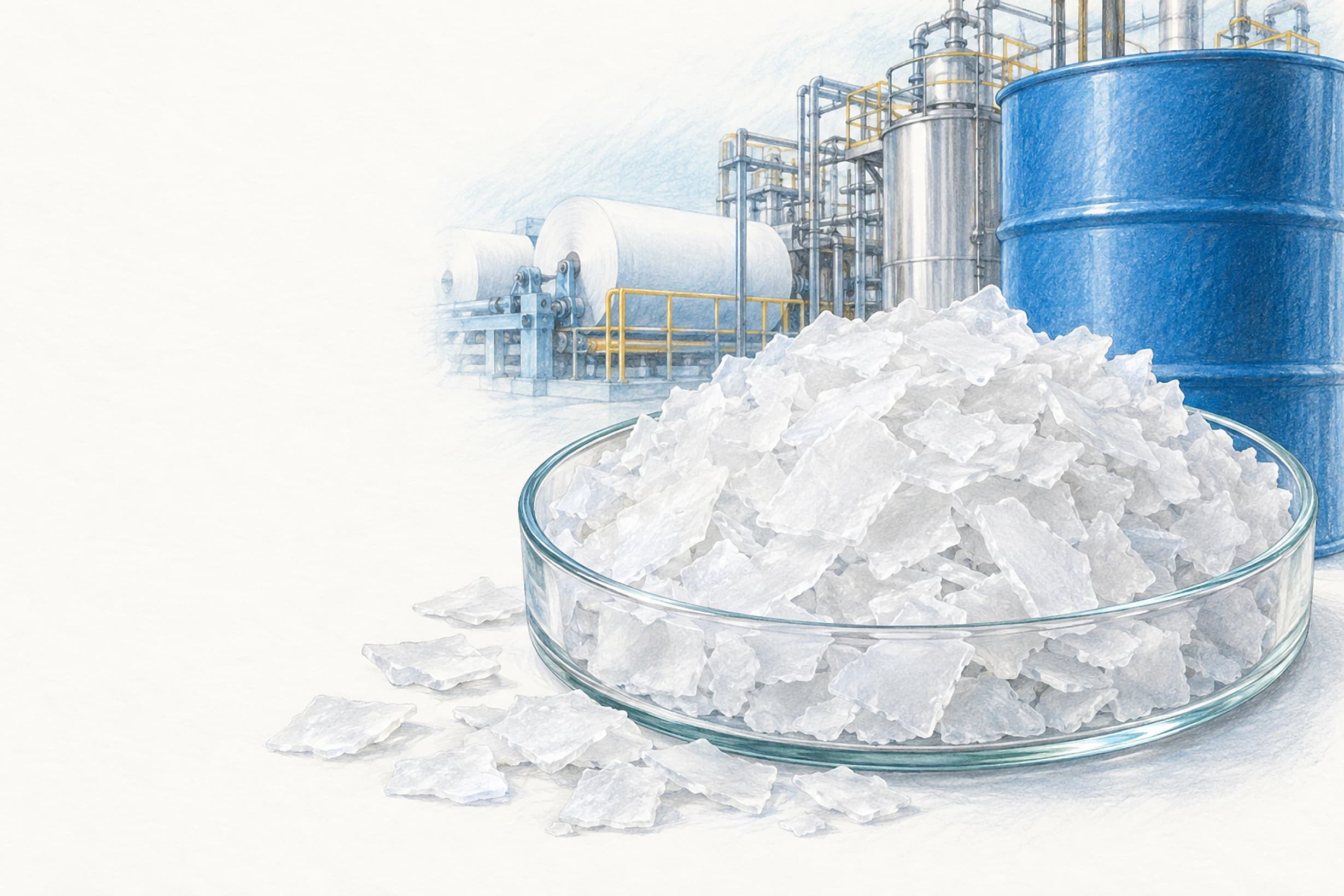
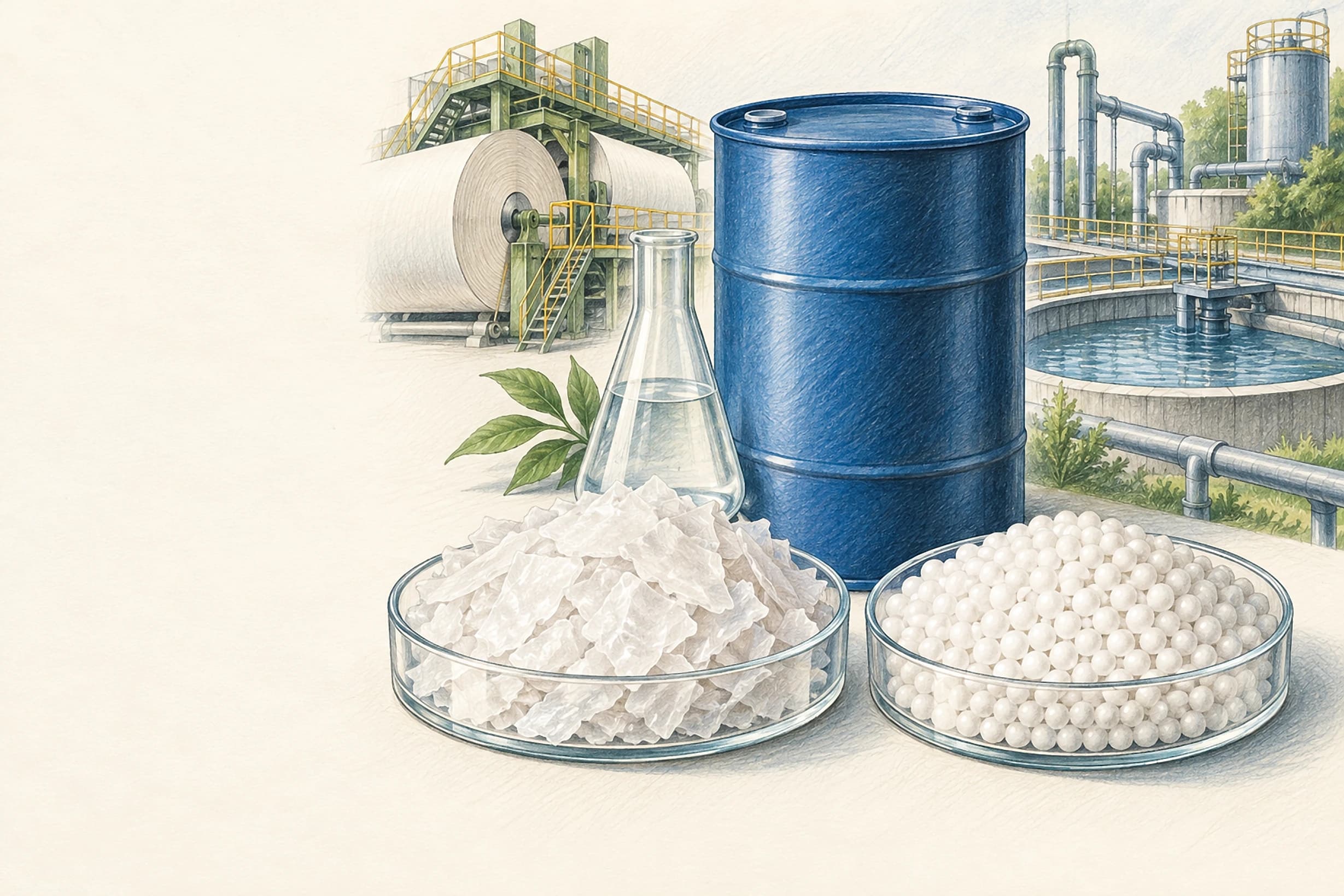
Caustic soda flakes leave the flaking rolls dry, brittle and free-flowing. Months later, a bag opened at the customer's plant may hold a solid block with a white, crusty surface. Both effects come from the same cause: solid sodium hydroxide reacts with the air around it. Understanding the chemistry helps buyers set realistic storage practices and judge whether a caked lot is still fit for use.
Moisture: the cause of caking
Anhydrous caustic soda is strongly hygroscopic. It pulls water vapour out of air and forms a film of concentrated caustic solution on the surface of each flake. Where flakes touch, that film acts as a liquid bridge. As conditions change, the bridges partly dry or crystallise as hydrates, and the flakes are cemented together. Repeated cycles of humid days and cooler nights make the bond stronger, which is why bags stored in hot, humid warehouses near the coast tend to cake faster than bags in dry inland stores.
Pressure adds to the problem. Bags at the bottom of tall stacks are compressed, flakes are pushed into closer contact and more bridges form. Thin flakes also break during handling, and the fines fill the gaps between larger pieces.
The moist surface also matters for safety. The semi-liquid film is fully corrosive and attacks aluminium and zinc, releasing flammable hydrogen. Damp caustic should never be held in aluminium or galvanised containers.
Carbon dioxide: the cause of carbonate
Sodium hydroxide also reacts with carbon dioxide in the air to form sodium carbonate and water:
2 NaOH + CO₂ → Na₂CO₃ + H₂O
Each molecule of carbonate formed consumes two of hydroxide, so the NaOH assay falls while the carbonate figure rises. The reaction is faster when the surface is wet, so moisture pickup and carbonate formation go hand in hand. The white crust often seen on the outside of a caked lump is largely carbonate. Producers also warn against agitating caustic solutions with compressed air for the same reason: blowing air through the liquid feeds it a steady supply of CO₂.
How much does it matter?
| Effect | What you notice | Practical impact |
|---|---|---|
| Light caking | Lumps that break by hand or with a light knock | Slower emptying; usually no quality change |
| Heavy caking | Solid block, bag has to be cut away | Handling risk, slow dissolving, possible local overheating in the tank |
| Carbonate rise | White crust, higher carbonate on retest | Lower effective alkali; carbonate can cause scale or interfere in some processes |
| Moisture gain | Wet or sticky feel, damp bags | Assay below specification; corrosive liquid can leak from packs |
For most uses such as general neutralisation or cleaning, a slight carbonate increase only means dosing a little more product. For processes that are sensitive to carbonate, such as some chemical syntheses or applications where it forms scale with calcium, a lot that has aged badly may fall outside the purchase specification.
Preventing caking and carbonate formation
- Specify robust packing: woven polypropylene bags with a sealed polyethylene liner, or drums for long storage.
- Keep stock in a dry, covered, ventilated store, off the floor on pallets, away from acids and away from water lines.
- Limit stack height and rotate stock first in, first out.
- Keep containers shrink-wrapped or covered until unloading, and avoid leaving bags in direct sun where heating and cooling drive moisture cycles.
- Reseal part-used bags immediately, or decant into a closed, labelled container of compatible material such as steel or polyethylene.
Using a caked lot safely
Do not break hard lumps with heavy blows while unprotected; fragments fly. Wear the protective equipment given in the safety data sheet, including a face shield. Large lumps dissolve slowly and can sit on the bottom of a tank, overheat locally and cause spattering, so feed them gradually into a well-stirred solution. If in doubt about quality, take a sample from the interior of a lump and from the crust and have both tested for NaOH and carbonate.
What to ask your supplier
Request the production date and packing specification with your offer, and a certificate of analysis showing NaOH and Na₂CO₃ for the lot. For long sea voyages or long storage, ask for lined bags or drums. Nuroil can arrange third-party inspection at loading on request; see caustic soda flakes or contact us with your requirements.