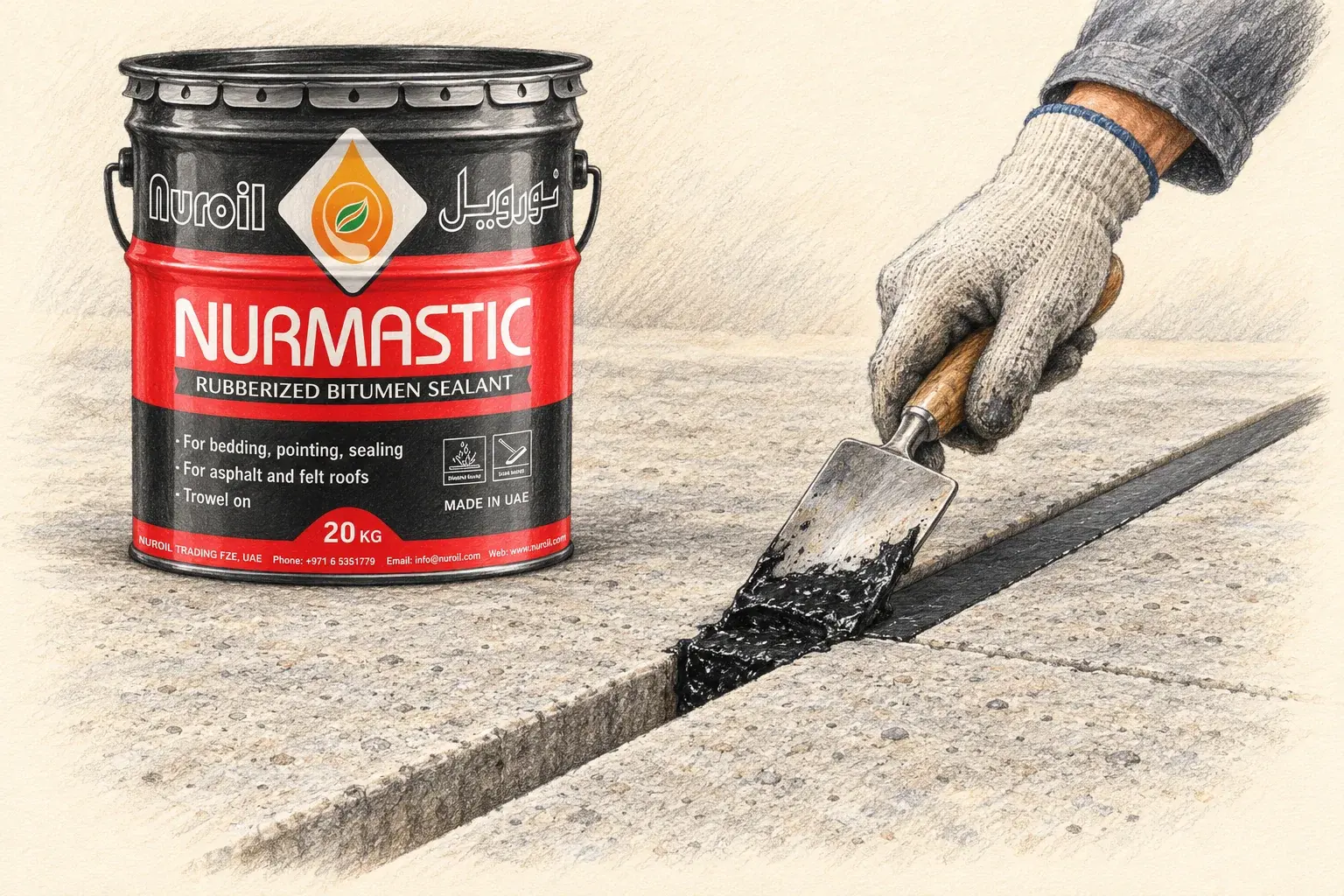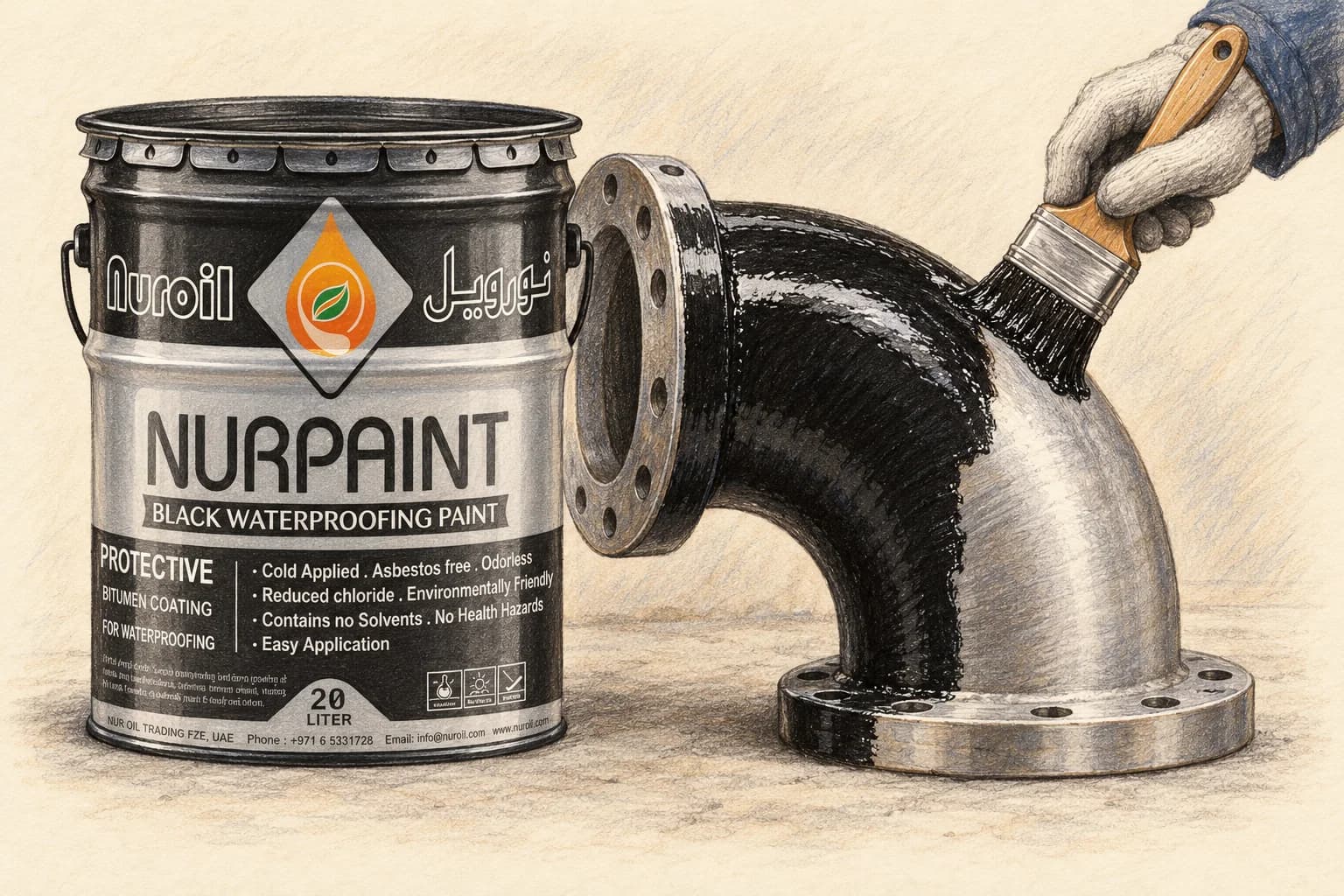
Alongside membranes and heavy coatings, two smaller bitumen products appear on nearly every construction and maintenance site. Bitumen paint is a thin black coating that protects and damp-proofs surfaces. Bitumen sealant fills joints and cracks so water cannot get in. Both are simple, but using the wrong one, or estimating too little, causes avoidable problems. This guide covers the basics.
Bitumen paint: what it is for
Bitumen paint is bitumen dissolved in a solvent, or emulsified in water, to make a brushable liquid. It dries to a black, water-resistant film. Typical uses include:
- coating the buried faces of concrete foundations, retaining walls and manholes for damp-proofing
- protecting steel and cast iron items such as gutters, railings, fence posts and pipework
- coating the inside of tanks and troughs that do not hold drinking water (only use products specifically certified for potable water contact)
- refreshing old bitumen roof surfaces and flashings
Bitumen paint is a damp-proofing and protective coat, not a substitute for a waterproofing membrane where water is under pressure. It also does not stop rust by itself: bare steel should first be cleaned and treated with a suitable rust-inhibiting primer, as manufacturers advise.
Bitumen paint coverage
Manufacturers' data sheets give quite consistent figures. On smooth metal, a litre usually covers about 8 to 10 square metres per coat. On concrete and masonry, which absorb more, coverage falls to around 4 to 6 square metres per coat, and less on very porous surfaces. A minimum of two coats is commonly recommended.
| Surface | Typical coverage per coat | Litres for 100 m², two coats |
|---|---|---|
| Smooth steel or metal | About 8 to 10 m²/L | About 20 to 25 L |
| Concrete, masonry, fibre cement | About 4 to 6 m²/L | About 35 to 50 L |
| Very porous block or old concrete | Below 4 m²/L; prime first | Check data sheet |
These are planning figures only. Always use the data sheet for the specific product, and on porous surfaces consider a bitumen primer first, which improves bond and reduces paint consumption.
Bitumen sealants: what they are for
Bitumen sealants are thick, often rubber-modified compounds that stay flexible after application. They come in two broad forms:
- Cold-applied sealants and mastics in cartridges or tins, used for sealing laps and edges of membranes, around roof penetrations, flashings, gutters, and small cracks in concrete or asphalt.
- Hot-applied sealants melted in a heated kettle and poured into joints and cracks in concrete and asphalt pavements. In the US these are specified under ASTM D6690, which covers several types of hot-applied joint and crack sealant for roads and airfields.
Hot-applied products must be heated indirectly, with agitation, and kept within the manufacturer's temperature range. Overheating can make the sealant gel or fail in the joint.
Estimating sealant quantity
Sealant is consumed by volume. For a rectangular joint, a simple estimate is:
Litres per metre of joint = width (mm) x depth (mm) / 1,000
For example, a joint 10 mm wide and 10 mm deep uses about 0.1 litre per metre, so a 310 ml cartridge fills roughly 3 metres. A 20 x 15 mm joint uses about 0.3 litre per metre. Add a margin for waste and uneven joints. For hot-pour sealant, convert litres to kilograms using the product density on the data sheet.
- Clean joints of dust, loose material and moisture before sealing.
- Use a backer rod in deep joints to control depth and save sealant.
- Do not overfill: leave the sealant slightly below the surface so traffic does not pull it out.
Paint protects surfaces; sealant closes gaps. Neither replaces a membrane where water is under pressure.
Safety and storage
Solvent-based paints and sealants are flammable and need ventilation. Hot-applied sealant can cause serious burns. Store products sealed, away from heat and frost, and follow the SDS for handling and disposal.
What to put in an enquiry
For bitumen paint, state solvent or water-based type, intended surfaces, area, pack size and quantity. For bitumen sealant, state cold or hot-applied, joint dimensions, total joint length, pack type and any standard the project requires. Ask for data sheets, a CoA, and the SDS. Nuroil can combine these items with membranes and primers in one shipment.