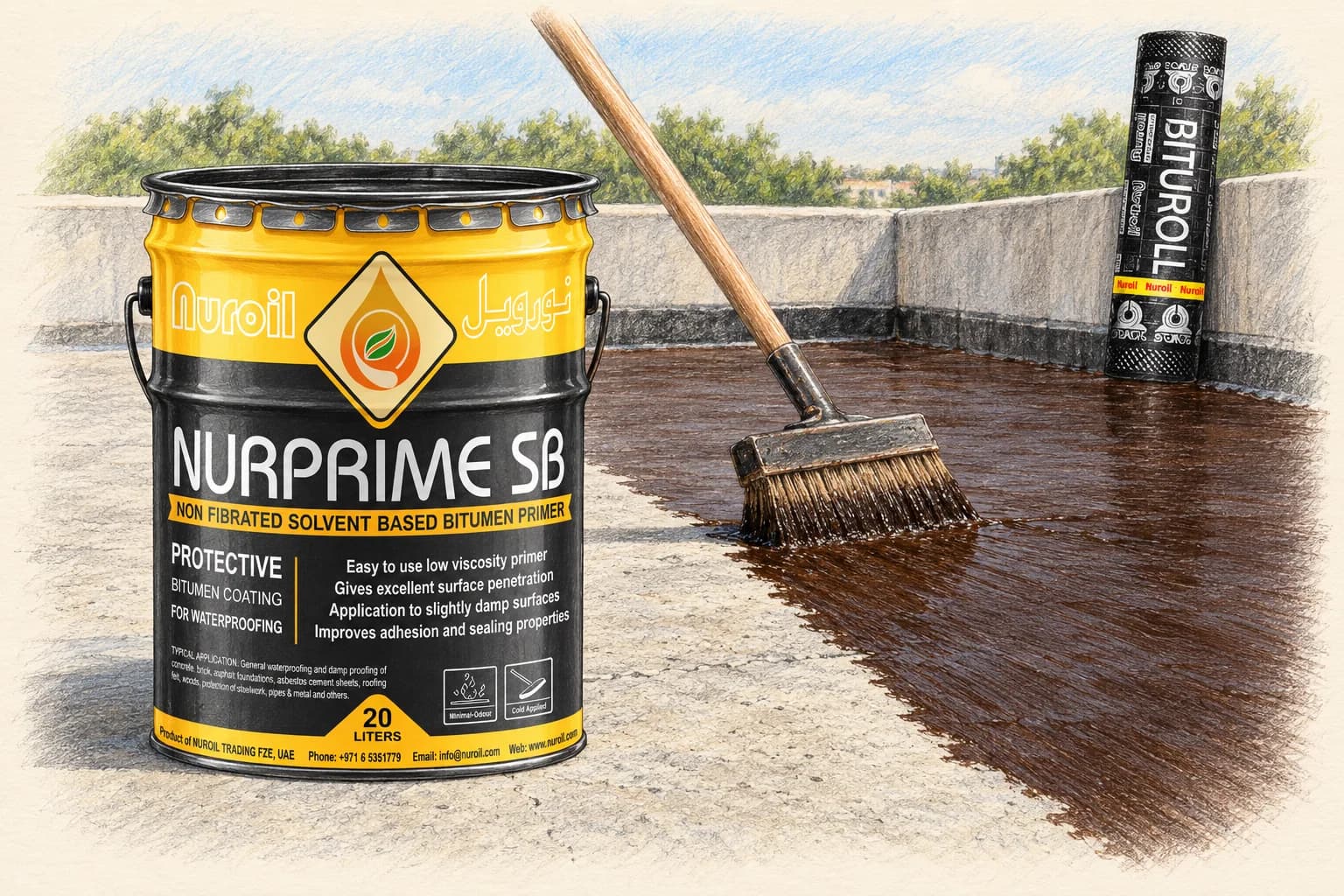
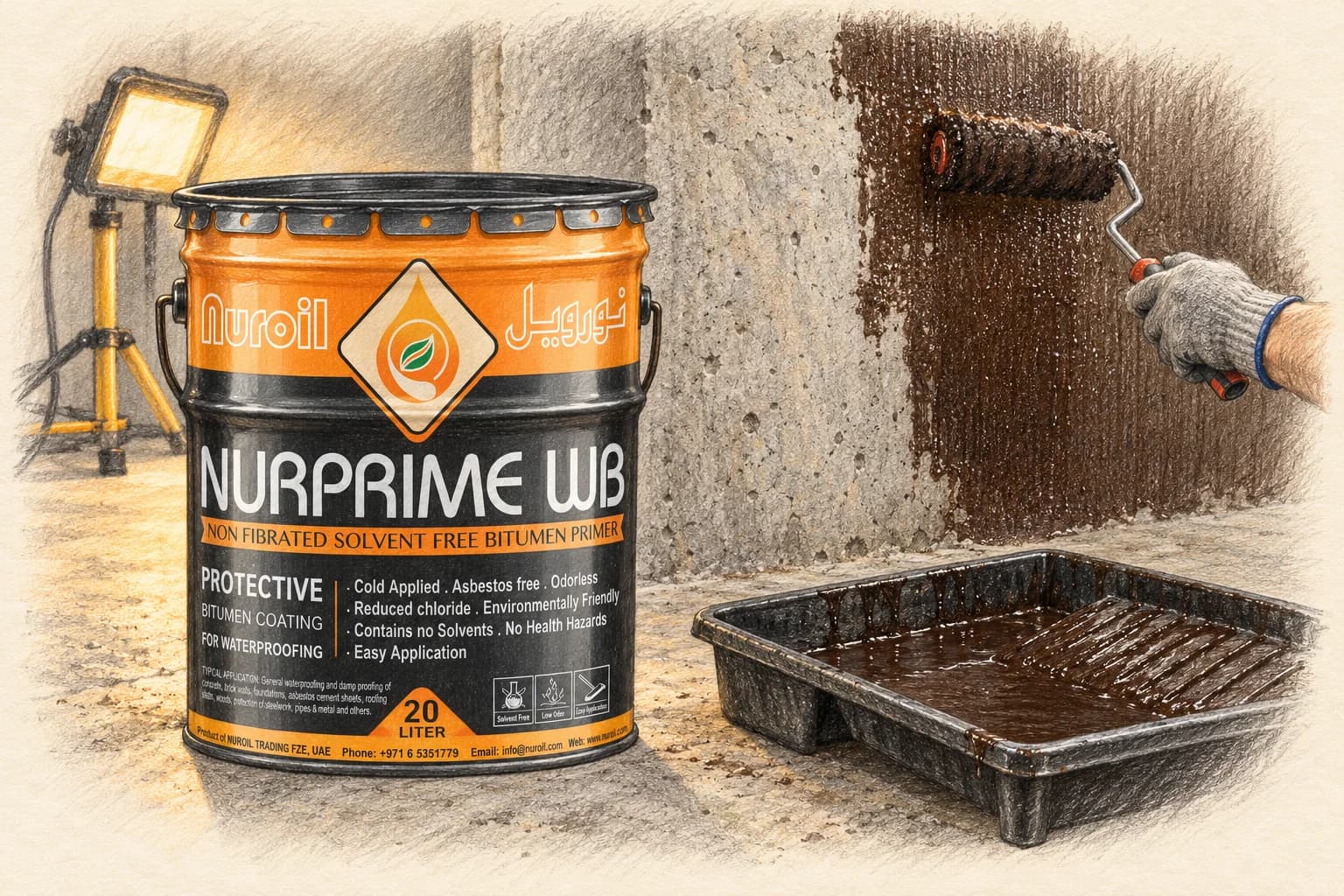
A bitumen primer is the first coat in almost every bitumen waterproofing system. It soaks into porous surfaces, binds surface dust and leaves a thin bitumen film that membranes and coatings can bond to. There are two broad families. Solvent-based primers are bitumen dissolved in a petroleum solvent. Water-based primers are bitumen emulsions, with fine bitumen droplets dispersed in water. Both do the same job, but they behave differently on site.
Solvent-based primers
Because the solvent is thin and wets surfaces readily, solvent-based primers penetrate deeply into concrete pores and bind dust well. They dry by evaporation and usually become ready for the next layer faster than water-based types in normal conditions. Some can be applied at lower temperatures than water-based primers, because there is no water to freeze.
The trade-offs are flammability and vapour. Solvent primers give off flammable fumes as they dry, which matters both for workers in enclosed areas and for torch-applied membranes: the primer must be fully dry before any flame comes near. Containers must be kept closed and away from ignition sources.
Water-based primers
Water-based primers are generally non-flammable when wet and have little odour, which makes them suitable for basements, inside buildings and occupied areas where solvent products are discouraged. Many are diluted with water before use, as stated on the data sheet. Some products are designed for damp concrete, though not for standing water.
The limits are temperature and humidity. Water-based primers need above-freezing conditions to dry, dry more slowly in cold or humid air, and must be protected from rain until set. Frost can damage the emulsion in the container, so storage matters.
Side-by-side comparison
| Factor | Solvent-based | Water-based |
|---|---|---|
| Carrier | Petroleum solvent | Water (bitumen emulsion) |
| Penetration and dust binding | Very good | Good |
| Drying | Fast in most conditions | Slower in cold or humid weather |
| Flammability | Flammable liquid and vapour | Generally non-flammable when wet |
| Odour and enclosed spaces | Strong; needs ventilation | Low; suits interiors |
| Cold-weather use | Possible at lower temperatures, per data sheet | Needs above-freezing conditions |
| Storage | Away from heat and flame | Protect from frost |
| Typical uses | Under torch-on membranes, roofs, exposed decks | Basements, interiors, under cold-applied coatings |
Coverage and quantity
Coverage depends on the product and, above all, on how porous and rough the surface is. Published data sheets for solvent-based bitumen primers commonly quote roughly 4 to 10 square metres per litre on concrete. That is a wide range, and porous or rough concrete sits at the lower end. For estimating:
- use the data sheet rate for the exact product, not a general figure
- work from the lower end of the range on old, dusty or open-textured concrete
- allow extra where the substrate is very absorbent and may need a second coat
- check whether a water-based primer's rate is quoted before or after dilution
Choosing the right primer
- Match the membrane. Some membrane makers only approve specific primers under their products. Check compatibility first.
- Consider the space. Enclosed or occupied areas favour water-based types.
- Consider the weather. Cold or very humid conditions favour solvent-based types, if the data sheet allows.
- Consider the substrate. Damp but not wet concrete may need a primer designed for it. Metal surfaces may need a different primer from concrete.
Whatever the type, a primer only works on a clean, sound surface, and it must be dry to the stated condition before the next layer goes on.
Safety
Solvent-based primers are classed as flammable and may irritate the skin and airways. Water-based primers are milder but still contain bitumen and additives. Read the SDS before use, wear gloves and eye protection, ventilate enclosed spaces, and keep solvent primers away from flames, including roofing torches.
Ordering primers
Specify the type (solvent-based or water-based), the membrane or coating it will sit under, the area to be primed, pack size (pails or drums) and quantity. Ask for the data sheet with coverage, drying time and application temperature range, and the SDS for transport and storage. Nuroil supplies solvent-based and water-based primers with a CoA on every shipment.