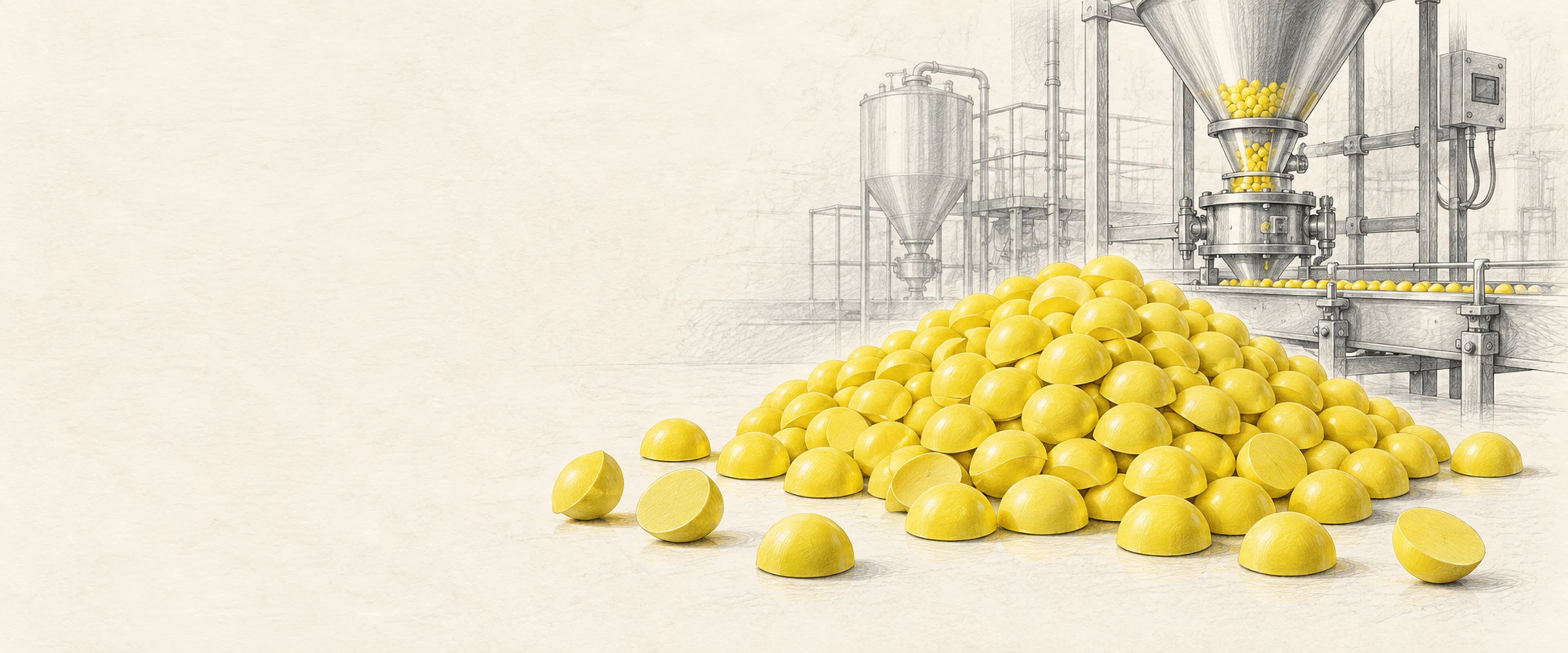
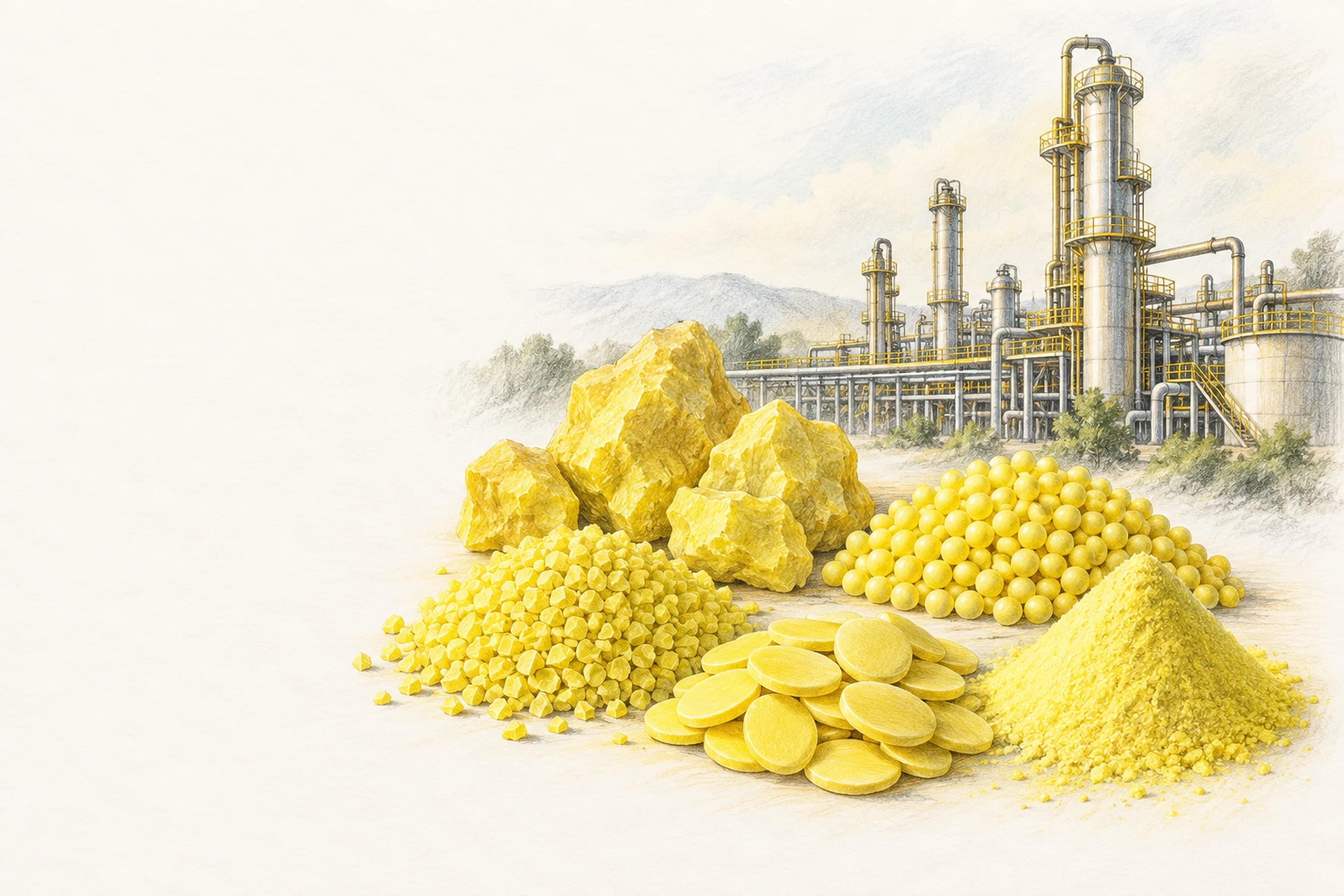
A bentonite sulphur pastille looks like a small, hard, yellow-grey dome. In the bag it is meant to stay intact; in the field it is meant to fall apart. That double life is the whole point of the product, and understanding how it happens helps agronomists and distributors set realistic expectations with growers.
What is inside the pastille
Agricultural sulphur pastilles are made by mixing dry, finely powdered bentonite clay into molten sulphur and then forming the mixture into pastilles on a cooled belt. The most common commercial grade carries about 90% elemental sulphur, with the balance mostly bentonite. Patent literature on the process describes bentonite additions in a range of roughly 1% to 15%, with a preference for clays rich in montmorillonite, the mineral that gives bentonite its ability to swell.
Because the clay is dispersed through the solidified sulphur rather than coated on the outside, every part of the pastille contains small pockets of clay surrounded by sulphur. This internal structure is what allows the pastille to break into very fine fragments later.
Step one: swelling and dispersion
Once the pastille lies on or in moist soil, water reaches the clay through cracks and pores. Montmorillonite clay absorbs water between its layers and expands considerably. As the clay swells it pushes the surrounding sulphur apart, and the pastille gradually crumbles into small particles of sulphur mixed with clay.
Product designers aim for those fragments to be very fine, because the finer the sulphur, the more surface it presents to soil microbes. Some developers specify fragment sizes below about 100 microns after disintegration. In practice, the degree of breakdown varies between products and conditions, and research has shown that a pastille that does not disperse properly can sit in the soil for a very long time with little change.
Step two: oxidation by soil microbes
Plants take up sulphur as sulphate, not as elemental sulphur. The released particles therefore have to be oxidised, a job done mainly by sulphur-oxidising bacteria such as Thiobacillus species, with other bacteria and fungi also involved. These organisms need oxygen, so oxidation stalls in waterlogged soil, where hydrogen sulphide may form instead.
Several factors control the speed of this step:
- Particle size. This is the dominant factor. Older extension work found that coarse sulphur of 5 to 10 mesh oxidised by less than 3% in a month, while fine material of 120 to 170 mesh oxidised by around 82% over the same period.
- Moisture. Oxidation runs fastest near field capacity and slows when soil is either dry or saturated.
- Temperature. Warm soils speed the process; an optimum range of roughly 27 to 35 degrees Celsius is often quoted. Cool-season applications oxidise slowly.
- Contact with soil. Particles mixed through the soil oxidise faster than those concentrated in a band or left on a dry surface.
What the research says about speed
Field and laboratory studies agree that bentonite pastilles are a slow-release source. In one study comparing sulphur sources for wheat and canola, the oxidation rate modelled for 90% elemental sulphur pastilles was far lower than for phosphate fertilizers fortified with finely divided elemental sulphur, and the pastilles contributed very little to crop uptake in the season of application. Canadian trials with a 90% bentonite product found that a broadcast application could eventually match ammonium sulphate, but only about two years after application, and that banded or seed-placed pastilles performed poorly.
Bentonite sulphur pastilles are a build-up and maintenance product. They are not a quick fix for a crop already showing sulphur deficiency.
Practical implications for users
- Apply well ahead of the crop's peak demand, ideally into warm, moist soil.
- Broadcast and, where practical, incorporate, so the fragments are spread through the topsoil rather than concentrated.
- Where a crop needs sulphur this season, pair pastilles with a sulphate source.
- Keep pastilles dry until application. Bentonite that swells in the bag or store causes caking and loss of flow.
What to ask your supplier
When buying bentonite sulphur pastilles, ask for the elemental sulphur content, the bentonite content, the pastille size range and moisture on the certificate of analysis, and ask whether the producer has a dispersion or disintegration test result for the lot. Nuroil supplies pastillated sulphur with a CoA on every delivery, and the MSDS and third-party inspection can be arranged on request through a quotation enquiry.