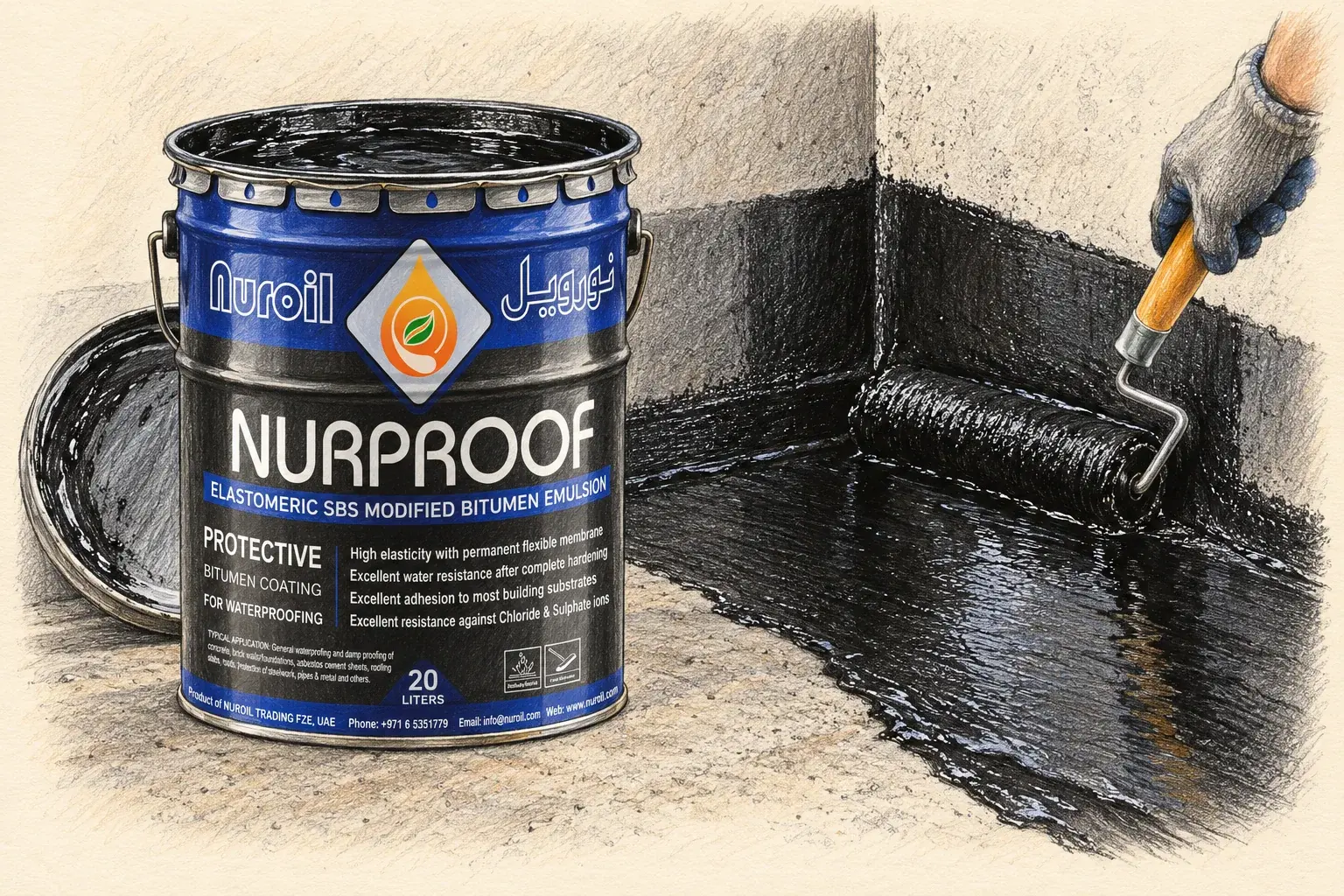
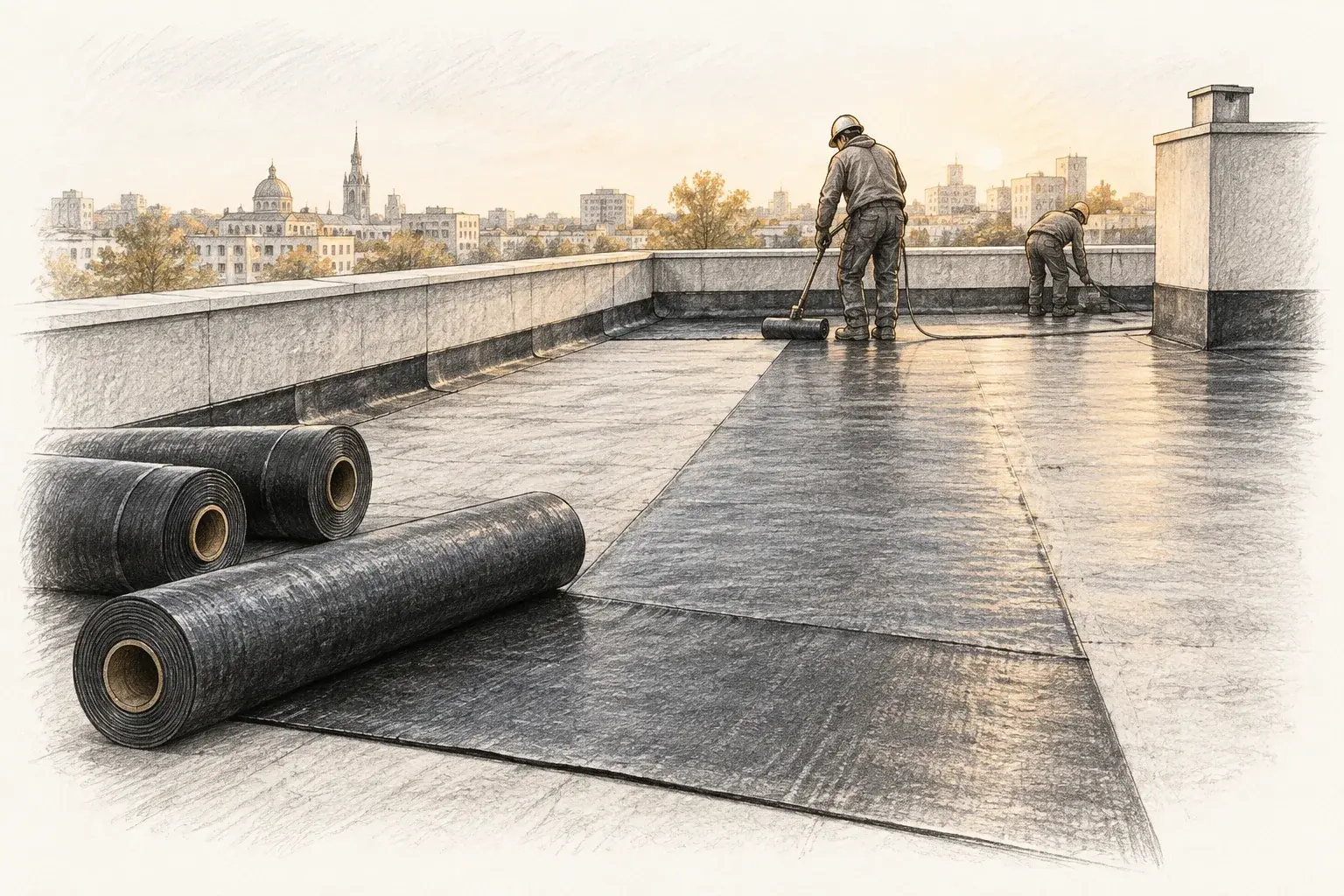
A liquid-applied elastomeric SBS bitumen coating becomes a waterproofing membrane only on site, coat by coat. The same product can give a durable layer or a weak one depending on preparation, film thickness and drying. This guide sets out a sound sequence for water-based SBS coatings on concrete and masonry. Always follow the specific product data sheet where it differs.
1. Prepare the surface
- Concrete should be cured and sound. Remove laitance, loose material, oil, release agents and dust.
- Fill honeycombing, tie holes and large voids with a repair mortar.
- Round off sharp edges and form fillets at wall-to-floor junctions so the coating does not thin at corners.
- The surface may be slightly damp for a water-based product, but there should be no standing water.
2. Prime
Most water-based coatings are primed with the same product diluted with clean water, or with a dedicated bitumen primer. The primer penetrates pores, reduces pinholes and improves adhesion. Allow it to dry until it no longer transfers to the touch before the next step.
3. Reinforce details
At cracks, construction joints, corners, pipe penetrations and drains, embed a strip of polyester or glass fabric into a fresh coat and then cover it. This spreads movement over a wider band and adds thickness exactly where films tend to thin.
4. Apply the main coats
Apply at least two full coats by brush, roller or spray, the second at right angles to the first. Each coat must be dry before the next. Two thinner coats give a more even, pinhole-free film than one heavy coat.
5. Control the thickness
Specify the required dry film thickness (DFT), not only the consumption per square metre, because coverage changes with surface roughness and porosity. During work, check wet film thickness (WFT) with a comb gauge: press it into the fresh coat, and the reading lies between the last tooth that is wet and the first that is not. Take readings in several places, as application is rarely uniform.
The link between wet and dry thickness depends on the solids content of the product. As a rule of thumb, dry thickness is roughly the wet thickness multiplied by the volume solids fraction. A water-based coating with about half its volume as solids loses about half its wet thickness on drying, so the wet target must be set accordingly.
| Step | What to check | Typical tool |
|---|---|---|
| Before priming | Clean, sound, no standing water | Visual, scrape test |
| Each coat | Wet film thickness | Comb gauge |
| Between coats | Dry to touch, no transfer | Touch test, recoat time on data sheet |
| After cure | Dry film thickness, continuity | Cut sample or calibrated gauge |
| Before covering | No blisters, pinholes or damage | Visual inspection |
6. Let it cure
Water-based films dry by evaporation, so temperature, humidity and air movement set the pace. Surface drying may take a few hours in warm weather, but full cure through the film takes longer, often days. Protect fresh work from rain until it is dry; data sheets often advise not to coat outdoors if rain is expected within a day or two. Avoid coating in direct midday sun in hot climates, and do not apply when frost is possible.
7. Protect the finished coating
SBS bitumen coatings are generally not designed for long-term UV exposure or traffic. Below ground, place a protection board or drainage sheet before backfilling. In wet areas, follow with a screed or tile bed. On roofs, cover with screed, ballast or a compatible reflective topcoat as the data sheet allows.
Ordering the right quantities
Work out the area, add detailing and wastage, and convert the target DFT to litres using the product's solids content or the coverage table on the data sheet. In your enquiry, give the area, target DFT and number of coats, and ask for the data sheet, safety data sheet and batch certificate. Nuroil supplies elastomeric SBS bitumen coating in pails and drums; send details through request a quote.