
Technical document

· PDF

Tell us who you are and the document downloads straight away. We use these details only to follow up on your requirement.

Samples & documents

What can we send you?

Tick what you need
Request a quote
Guide3 min read4 sections

Knowledge centre · Waterproofing & construction

APP modified membrane specifications and test methods explained

A reference to the properties declared for APP modified bitumen membranes, the EN and ASTM tests behind them, and what to look for.

Written by the Nuroil trade desk, Sharjah

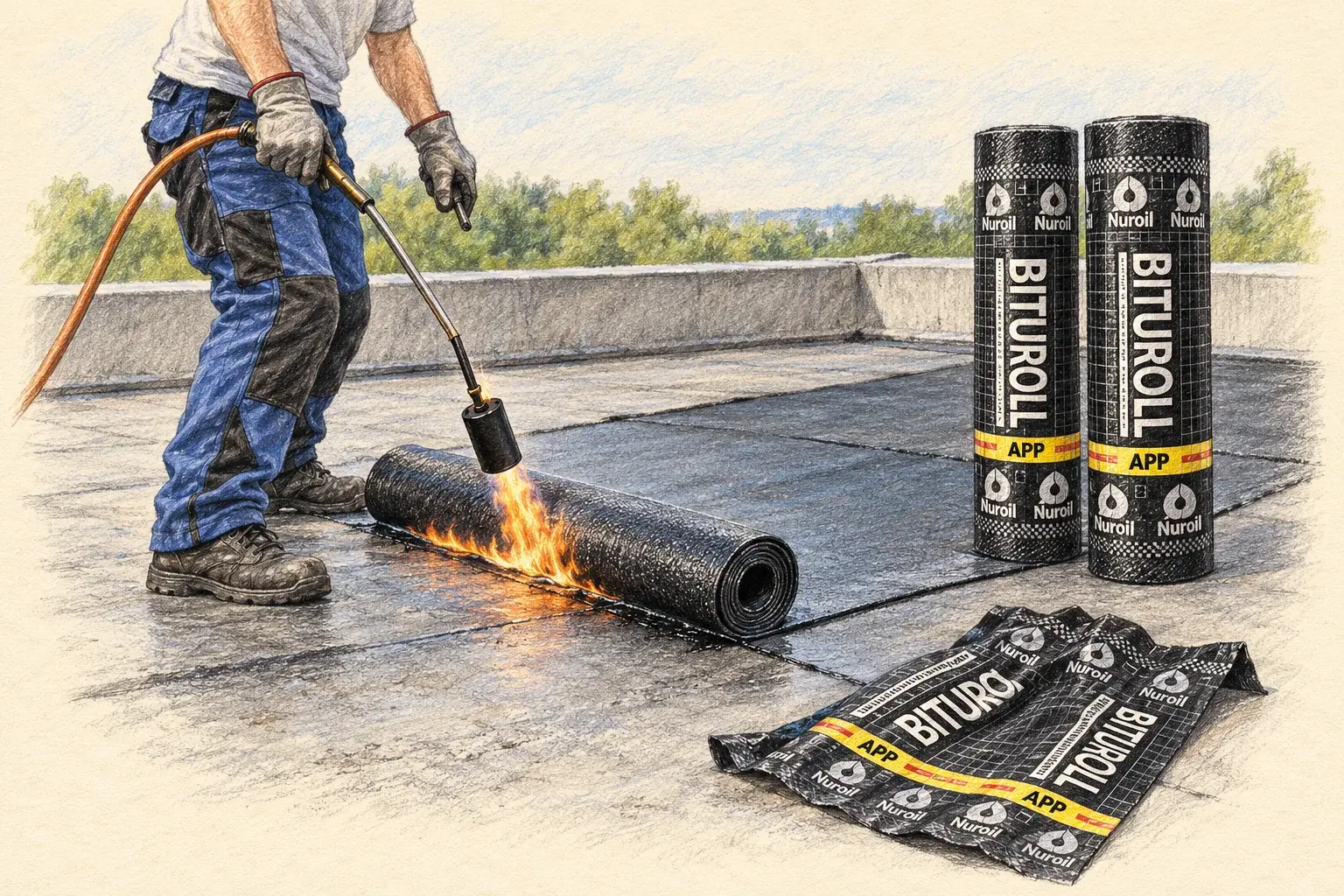
Pencil sketch of a membrane roll on a roof
On this page · 4 sections
  1. 01Standards that apply
  2. 02Main parameters
  3. 03Reading APP data sheets
  4. 04Turning this into an enquiry

APP modified bitumen membranes are sold against data sheets that list physical properties and the tests used to measure them. Comparing two offers properly means knowing what each property means and which values carry most weight for APP specifically. This guide covers the main European and North American frameworks and the parameters to focus on.

Standards that apply

01

Europe

reinforced bitumen sheets for roof waterproofing are covered by EN 13707, which lists the characteristics a manufacturer must declare and refers to individual EN test methods. Other product standards apply to sheets for below-ground tanking and other uses.
02

North America

APP sheets are covered by ASTM material specifications by reinforcement type. D6222 covers APP sheets with polyester reinforcement, in Type I and Type II and in granule-surfaced (Grade G) or smooth (Grade S) versions. Related specifications cover glass fibre and combination reinforcements. D6222 states that its values are minimum properties and that it does not address roof design aspects such as fire resistance, uplift or impact performance of the completed roof.

Main parameters

ParameterEN methodWhy it matters for APP
Flow resistance at elevated temperatureEN 1110APP's main advantage; shows resistance to sliding in heat
Flexibility at low temperatureEN 1109APP's weaker side; sets the cold limit for handling and service
Tensile strength and elongationEN 12311-1Mostly set by reinforcement; polyester gives more elongation
Tear resistanceEN 12310-1Resistance to tearing at fixings and details
Dimensional stabilityEN 1107-1Shrinkage after heating; affects laps on torched sheets
Joint peel and shearEN 12316-1, EN 12317-1Strength of torched laps
WatertightnessEN 1928Basic waterproofing function
Thickness and massEN 1849-1Compound quantity; compare like with like
Ageing behaviourEN 1296, EN 1297Retention of flexibility and flow resistance over time
Granule adhesionEN 12039Important on APP caps, where granule loss is a known issue

The ASTM specification adds properties such as compound stability, granule embedment, water absorption, moisture content and low-temperature unrolling, together with dimensional checks on roll width, area, selvage width, thickness and the thickness of coating on the bottom side.

Reading APP data sheets

01

The working window

The gap between the cold flexibility temperature and the flow resistance temperature describes the usable range of the compound. APP sheets typically sit higher on both ends than SBS: better in heat, less flexible in cold. Make sure the cold end suits the coolest conditions during installation and service.
02

Aged results

Ask for values after artificial ageing, especially flow resistance and cold flexibility. Retention after ageing is a better predictor of performance than initial results.
03

Bottom coating thickness

On torch-applied sheets, the compound below the reinforcement is what melts to bond the sheet. ASTM D6222 includes a requirement for it; a sheet with thin bottom coating leaves little margin for torching.
04

Mineral stabilisers

APP compounds may include mineral filler. This is normal, but filler content affects mass per square metre, so do not compare sheets on weight alone.
05

Typical versus limit values

Some data sheets show typical test results; others show the guaranteed limit. A typical tensile strength may look better than a competitor's limit value while offering no more assurance. Ask which basis is used, and for batch certificates that show actual results against the declared limits.
For APP, look first at flow resistance and cold flexibility after ageing, then at reinforcement-driven properties.

Turning this into an enquiry

State the standard you are buying against, the parameters and minimum values your design requires, the test condition (new or aged), and the surface finish. Ask for the product data sheet, the declaration of performance where EN 13707 applies, and a certificate of analysis for the supplied batch. Nuroil provides a CoA with every delivery and can arrange third-party inspection on request; use our quote request form.
PRODUCTS IN THIS GUIDE
KEEP READING

More from the Knowledge Centre.

STILL HAVE A QUESTION?

Ask the people who trade it every day.

Our trade managers answer technical and commercial questions about grades, specifications, packing and shipping.

LET’S TALK ABOUT YOUR REQUIREMENTS

Your next shipment starts here.

Request a quote