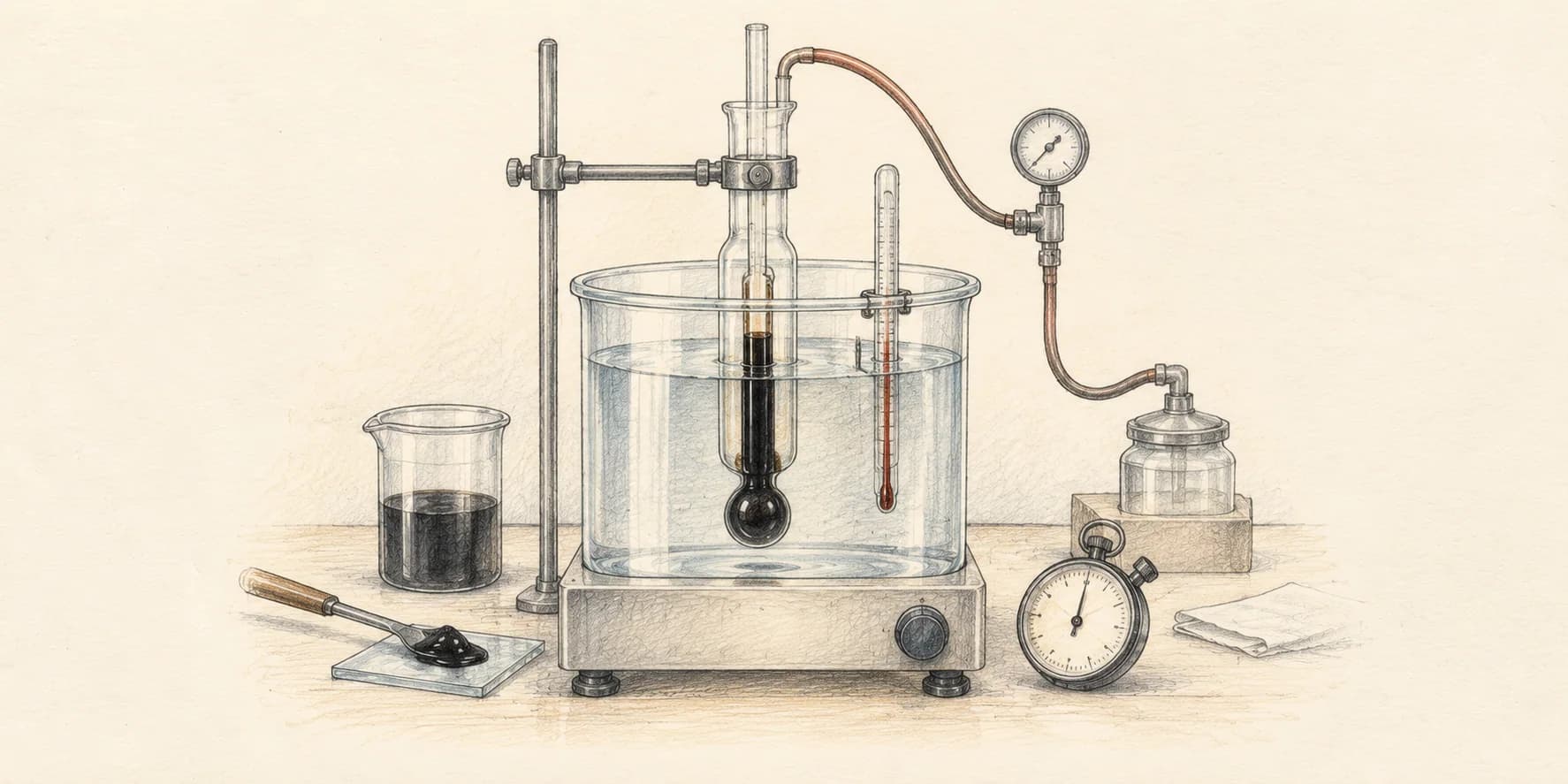
Paving bitumen is sold under several classification systems. Viscosity grading, shown as VG-10, VG-20, VG-30 and VG-40, is used widely in South Asia and in many road specifications elsewhere. It classifies bitumen by how resistant it is to flow at a temperature that represents a hot road surface, rather than by a needle test at room temperature.
Why viscosity instead of penetration
Penetration grading measures how far a standard needle sinks into bitumen at 25°C. It is simple and cheap, but it describes the binder only at one moderate temperature. Two bitumens with the same penetration can behave quite differently on a hot day, because their stiffness changes with temperature at different rates.
Viscosity grading addresses this by measuring a fundamental property at temperatures that matter in service and in construction:
- Absolute viscosity at 60°C, in poise, which approximates the maximum temperature of a road surface in summer and relates to resistance to rutting.
- Kinematic viscosity at 135°C, in centistokes, which relates to how the binder will behave during mixing and compaction.
The grade number rises with stiffness, so VG-40 is the hardest and VG-10 the softest of the common grades.
Typical requirements
The table below summarises the main limits in the Indian standard IS 73:2013 for paving bitumen. Other national specifications follow a similar idea but may use different limits, so always check the edition named in the project documents.
| Property | VG-10 | VG-20 | VG-30 | VG-40 |
|---|---|---|---|---|
| Absolute viscosity at 60°C (poise) | 800–1200 | 1600–2400 | 2400–3600 | 3200–4800 |
| Kinematic viscosity at 135°C (cSt, min) | 250 | 300 | 350 | 400 |
| Penetration at 25°C (0.1 mm, min) | 80 | 60 | 45 | 35 |
| Softening point (°C, min) | 40 | 45 | 47 | 50 |
| Flash point (°C, min) | 220 | 220 | 220 | 220 |
The standard also sets limits on the residue after the rolling thin film oven test, which simulates hardening in the mixing plant. The ratio of 60°C viscosity after and before ageing must not exceed 4, and minimum ductility values apply to the aged residue. These checks screen out bitumens that harden excessively during production.
How the grades are used
As a general pattern, softer grades such as VG-10 suit spraying applications, surface dressing and cooler regions, while VG-30 is a common general-purpose paving grade. VG-40 is chosen for hot climates and highly stressed locations, such as heavy-traffic corridors, intersections and toll plazas, where rutting is the main concern. The final choice always rests with the road authority's specification and the mix design.
Because the grades are defined by ranges, two lots of the same grade can sit at different points within the band. A VG-30 near the top of its viscosity range will behave more like a soft VG-40 than one near the bottom. For critical work, compare actual test values on the certificate rather than relying on the grade label alone, and check consistency between successive shipments.
Comparing VG with penetration grades
Buyers often ask for an equivalent between systems. There is no exact conversion, because the systems test different properties. Very roughly, VG-30 is often compared with 60/70 penetration bitumen and VG-40 with 40/50, but two products meeting those labels will not necessarily behave identically. Where a project is written around one system, supply should be tested and certified against that system.
A viscosity grade tells you how the binder behaves on a hot road; a penetration grade tells you how it behaves at room temperature. Neither replaces the other.
What to specify when buying
State the grade, the standard and its edition (for example IS 73:2013), the quantity, and the packing, such as drums, jumbo bags or bulk. Ask for a certificate of analysis covering both viscosities, penetration, softening point, flash point and the thin film oven residue tests, and consider third-party inspection at loading for large lots. Nuroil supplies viscosity grade bitumen alongside penetration grades, so offers can be matched to the specification in your tender.