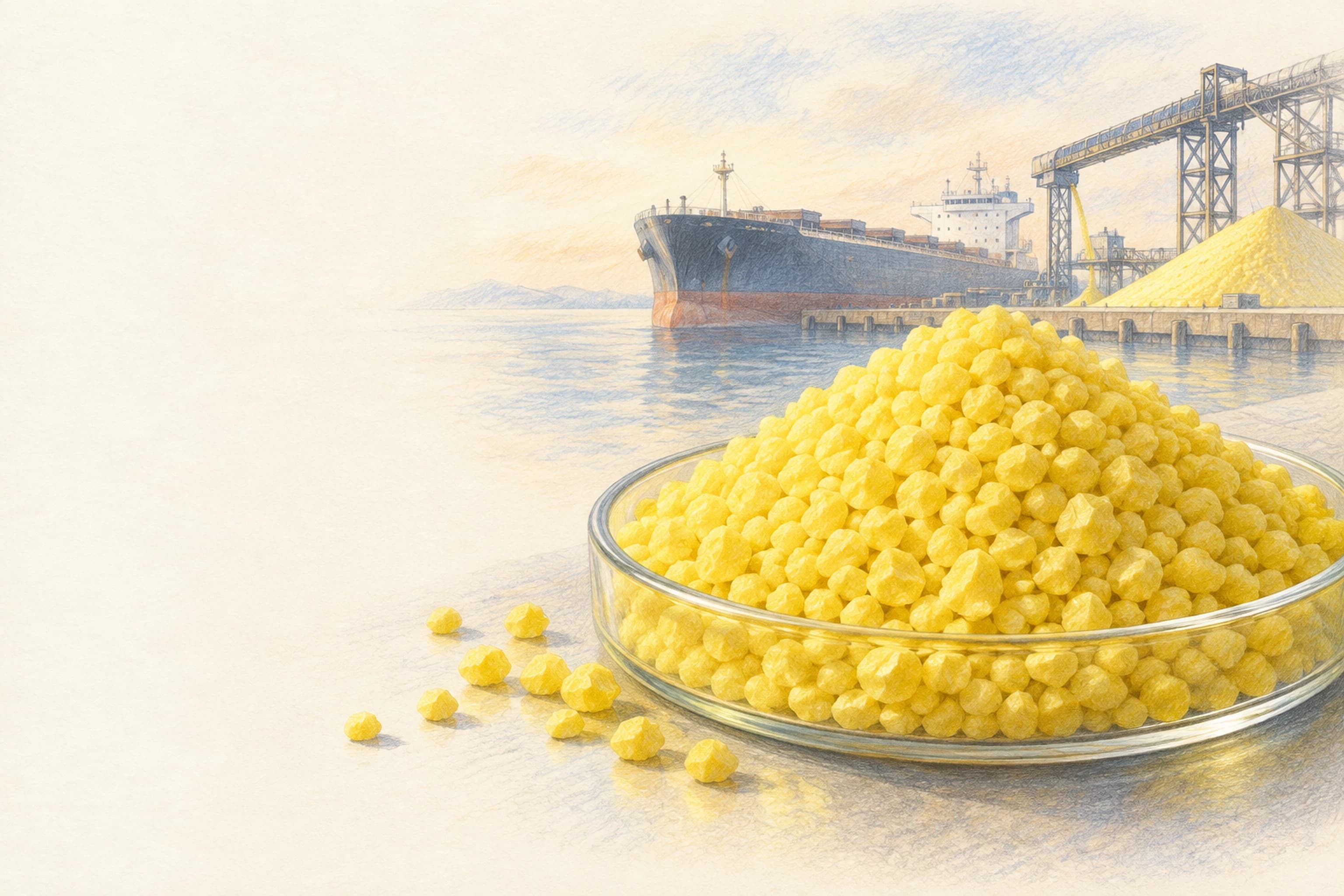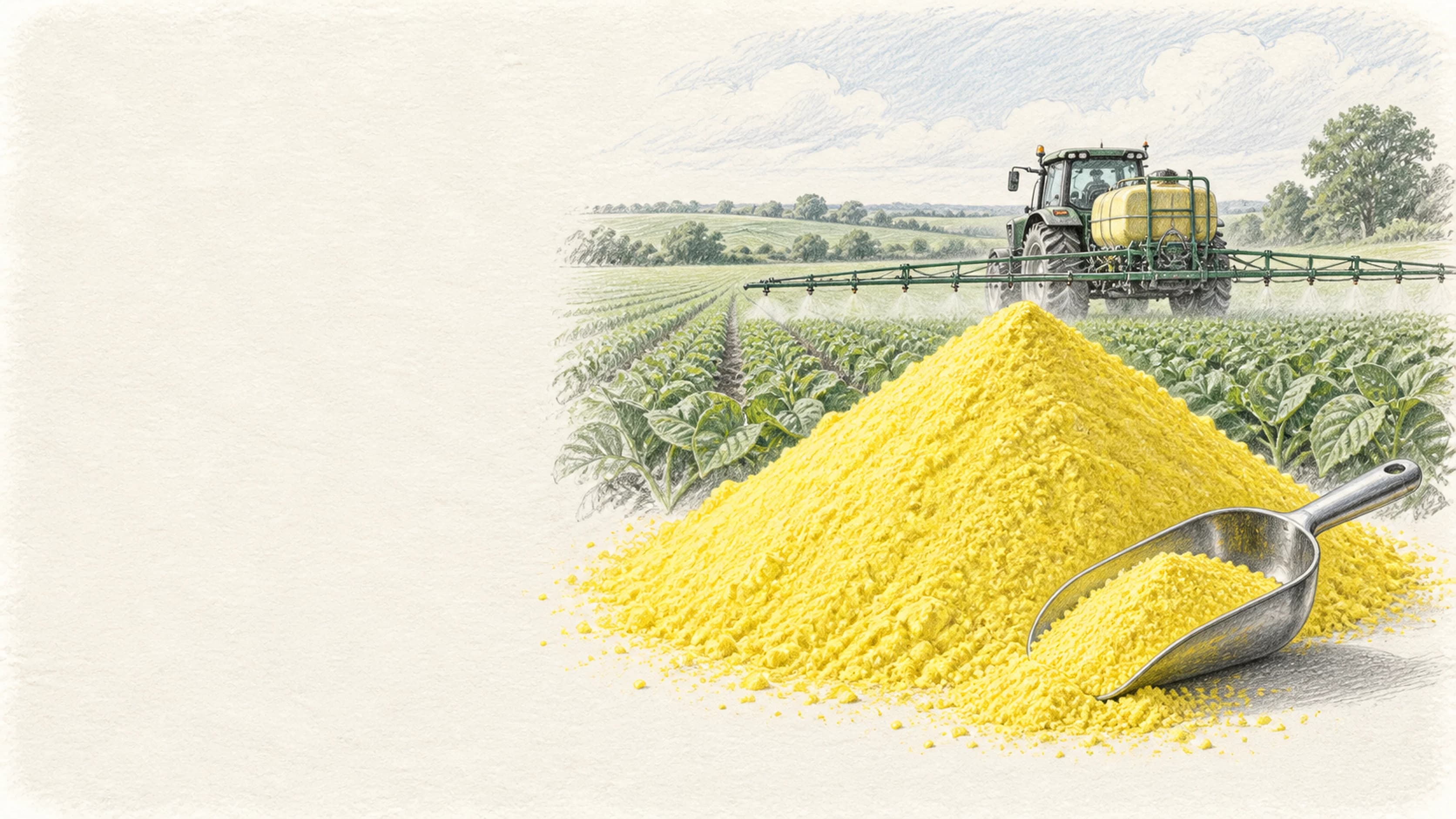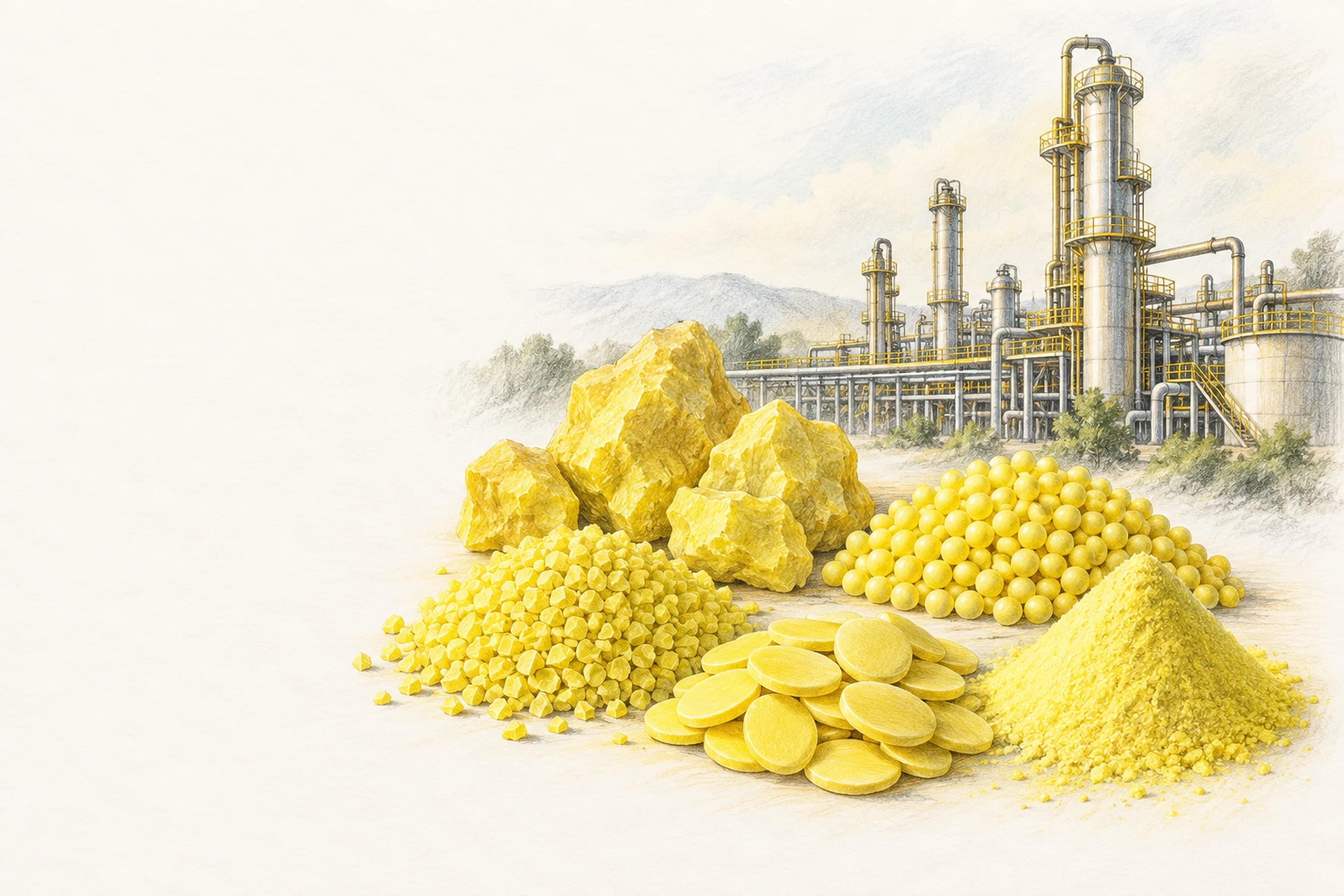
A sulphur certificate of analysis usually runs to fewer than ten lines, but each line tells the buyer something about how the sulphur will behave in their process. This guide explains the common parameters, what they indicate and the ranges typically seen in published specifications for refinery and gas-plant sulphur. Exact limits vary between producers and contracts, so always agree them in writing before shipment.
Purity
Purity is the elemental sulphur content, normally expressed as a weight percentage on a dry basis, meaning after moisture has been excluded. Sulphur recovered from oil refining and natural gas processing is inherently pure, and published refinery specifications typically guarantee 99.8% to 99.9% minimum. A 99.5% minimum is common in more general industrial or rubber-grade specifications. Because purity is calculated on a dry basis, it must always be read alongside the moisture figure.
Ash
Ash is the residue left after a sample is burned and is a measure of inorganic contamination such as sand, rust, scale and salts. Most of it is picked up after production, in storage yards, trucks and holds, rather than in the sulphur plant. High ash clogs filters in melting systems, can block burners and wears equipment. Refinery specifications commonly limit ash to between about 50 ppm and 0.05% by weight.
Carbon or hydrocarbons
Carbon content, sometimes reported as organic matter or hydrocarbons, comes mainly from traces of oil carried over from the process or contamination during handling. In acid plants it burns to water and carbon dioxide, contributing to acid mist and dark acid. A typical limit is 0.05% maximum, and some buyers ask for tighter values.
Acidity
Acidity is expressed as sulphuric acid equivalent. Sulphur in contact with water and air slowly forms weak acids, so acidity tends to rise with moisture, time and fines content. Acidity is the main driver of corrosion in storage tanks, conveyors and ship holds. Published limits range from around 30 ppm to a few hundred ppm.
Moisture
Moisture includes surface water from rain, dust-suppression spray or wet forming processes such as prilling. Sulphur itself does not absorb water, so moisture sits on particle surfaces and in fines. Specifications commonly set a maximum between about 0.3% and 1% for bulk formed sulphur, with tighter limits for bagged and powder grades. Moisture adds weight that the buyer pays for, so contracts often price on a dry basis.
Trace elements and physical properties
- Arsenic, selenium and tellurium. Important for food, pharmaceutical and fertilizer chains. Many refinery specifications report them as below a few ppm or as essentially absent from the process.
- Colour. Bright yellow indicates low carbon; dark or greenish tints suggest hydrocarbon contamination.
- Size and fines. For formed sulphur, a size range (often 2–6 mm for premium granules) and a maximum fines content. For powder, a particle size distribution, such as a minimum percentage below a stated micron size.
- Friability. How easily particles break into dust during handling.
Typical specification ranges
| Parameter | Unit | Typical refinery/gas-plant limit | Why it matters |
|---|---|---|---|
| Purity (dry basis) | wt % | 99.5 to 99.9 min | Yield of product per tonne bought |
| Ash | wt % or ppm | 50 ppm to 0.05% max | Filter loading, burner and catalyst fouling |
| Carbon | wt % | 0.025 to 0.05 max | Acid colour, acid mist, product quality |
| Acidity as H2SO4 | ppm | 30 to 300 max | Corrosion of equipment and holds |
| Moisture | wt % | 0.3 to 1.0 max | Paid weight, acidity, melting |
| Arsenic | ppm | below 1 to 2 max | Food, feed and fertilizer chains |
| Selenium and tellurium | ppm | below 1 to 3 max | Acid and downstream purity |
These ranges are drawn from published producer and standards documents and are for orientation only. A specific contract may be tighter or looser.
Purity alone does not define good sulphur. Ash, acidity and moisture tell you how clean and dry the cargo has stayed between the producer and your plant.
Sampling and testing
Results depend heavily on sampling. For bulk cargoes, samples should be taken progressively during loading rather than from the top of a stockpile, and split into sealed portions for the seller, buyer and an independent laboratory. Agree in advance which test methods apply and which laboratory's results are final.
Writing your specification
List each parameter with a unit, a limit and the basis (dry or as received). Add the physical form, size range and packing. Request the certificate of analysis per lot, and for larger shipments an independent inspection certificate at the load port. Nuroil supplies a CoA with every delivery of sulphur, with certificate of origin, SDS and third-party inspection available on request. Send your specification through the quote request form.