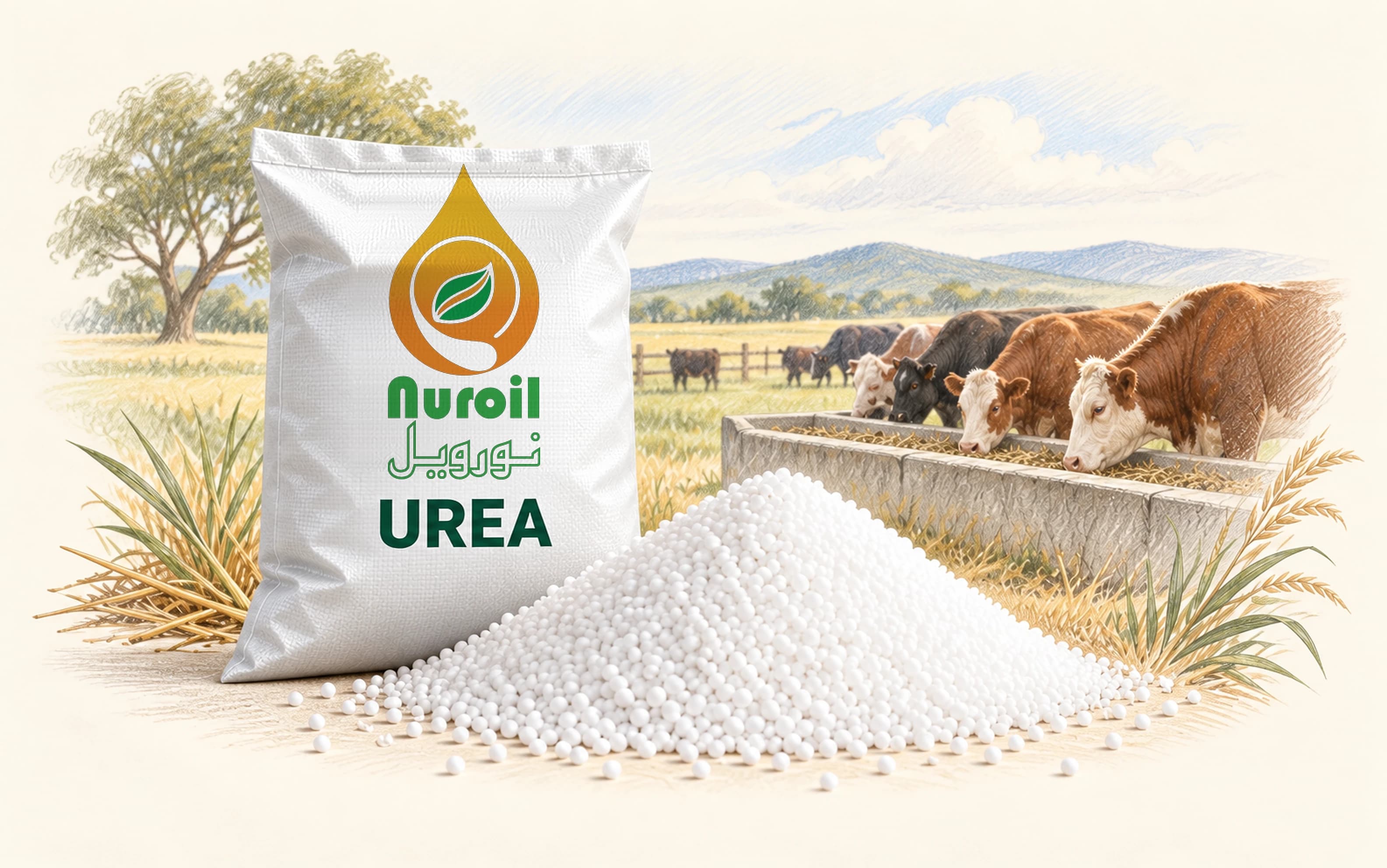
Feed-grade urea is chemically the same compound as fertilizer urea, but it is bought, stored and documented differently because it ends up in animal feed. Mistakes such as using fertilizer stock in a ration, letting bags cake, or missing a registration document can all cause losses. This guide sets out the points a feed mill, premix plant or distributor should cover when buying and receiving feed-grade urea.
Packing formats
| Format | Typical use | Points to check |
|---|---|---|
| 25 kg or 50 kg bags | Small mills, premix plants, block and liquid feed makers | Moisture-resistant liner or laminated woven bag; clear feed labelling; stacking pattern on pallets |
| Bulk bags (around 1 tonne) | Medium and large mills with hoist or discharge frame | Inner liner, discharge spout, lifting loop rating, UV protection if stored outdoors |
| Bulk | Large feed or liquid supplement plants with dedicated silos | Clean, dedicated handling chain; silo condition; segregation from fertilizer flows |
For export shipments, palletised bags or bulk bags in containers are common. Ask for shrink-wrapping or stretch-hooding of pallets on longer voyages, and container desiccants where humid transit is expected.
Storage conditions
Urea absorbs moisture once air humidity rises above its critical point, and caking follows. Producers of feed grades recommend:
- A stable storage temperature, roughly 10–30 °C, avoiding large day-night swings.
- Relative humidity kept below about 70%.
- Low stack heights, since pressure compacts the lower bags.
- No loading or unloading in rain, and short drop heights in bulk handling to limit dust.
- Bags off the floor on pallets, away from walls, roof leaks and direct sun.
- First-in, first-out stock rotation.
Silos for bulk feed urea should allow safe access for clearing lumps, and outdoor silos benefit from insulation to reduce condensation.
Segregation and feed safety
- Store feed urea in a separate, clearly marked area, never mixed with fertilizer stock or other chemicals.
- Keep it secure from animals. Accidental access to concentrated urea is a known cause of poisoning.
- Use dedicated scoops, bins and conveying equipment where possible, and record cleaning when equipment is shared.
- Reject torn, wet or contaminated bags at receipt and quarantine them until assessed.
- Retain a sample from each lot for the period required by your feed safety system.
Documents to request
| Document | What it shows |
|---|---|
| Certificate of analysis per lot | Nitrogen, biuret, moisture and other agreed parameters |
| Product specification | Guaranteed limits, particle size, conditioner used |
| Safety data sheet | Hazards, handling, storage, first aid |
| Feed registration or authorisation evidence | That the product may be sold for feed in your market |
| Feed safety management certification of the producer | That the plant works under feed GMP or an equivalent scheme |
| Certificate of origin | For customs and preferential duty where relevant |
| Third-party inspection report | Independent check of quantity, quality and packing |
Labelling rules differ by market. In some places products below a set nitrogen level must be named as urea with conditioner, and the conditioner must be listed. Confirm label wording with your regulator or feed association before the goods ship. It is easier to agree bag printing or over-labelling with the supplier at the order stage than to relabel stock after arrival.
Treat feed urea as a feed ingredient from the moment it arrives: separate store, separate tools, documented lots.
Putting it into your enquiry
When requesting a quotation, state the grade (feed grade for ruminants), the regulation it must meet, nitrogen, biuret and moisture limits, particle size, packing format and pallet configuration, labelling language, and the documents you need. Include the delivery basis, such as FOB UAE port or CFR/CIF to your port. Nuroil provides a CoA with every delivery of feed-grade urea and can arrange MSDS, certificate of origin and third-party inspection on request. Use the quote request form or contact us to start.