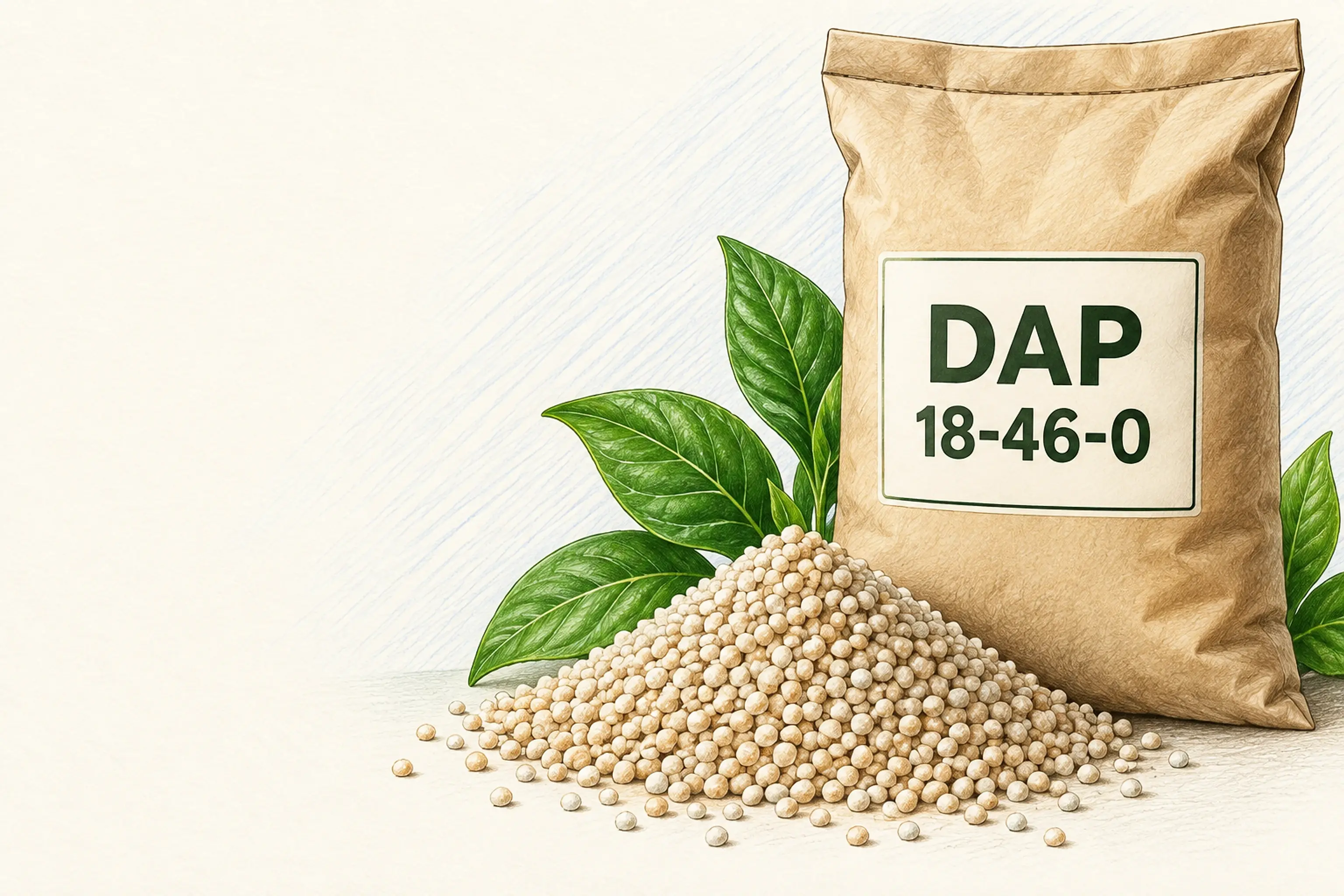
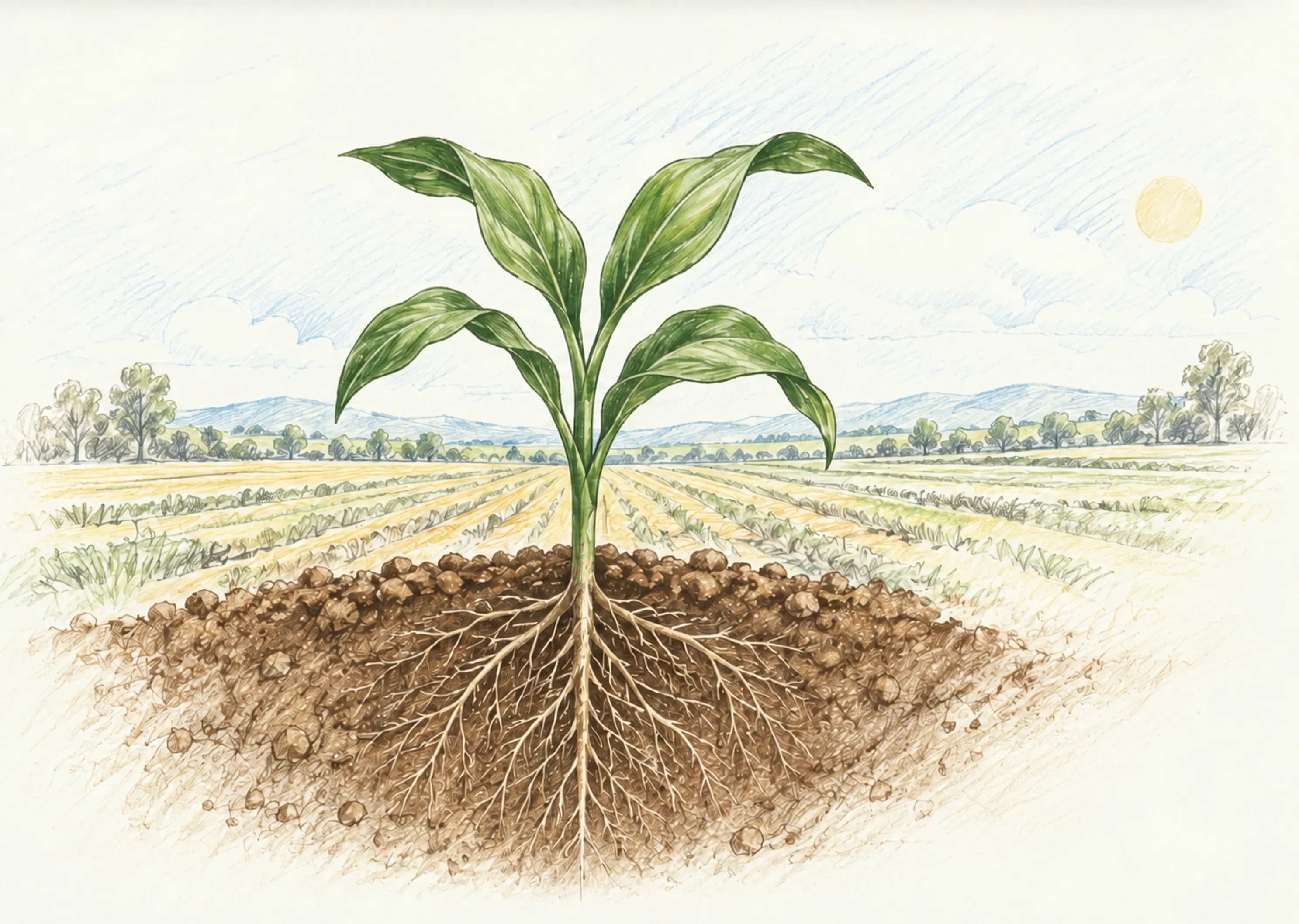
Diammonium phosphate (DAP, 18-46-0) is one of the most convenient ways to get phosphorus into a crop at sowing. Phosphorus moves very little in soil, so putting it close to young roots makes sense. The catch is that DAP is not a neutral salt in the seed row. As each granule dissolves it releases ammonium and creates a small zone of high pH, and in that zone some of the ammonium turns into free ammonia. Germinating seeds and fine seedling roots are sensitive to ammonia, so DAP placed too close to the seed, or at too high a rate, can thin a stand.
What happens around a dissolving granule
A DAP solution has a pH of roughly 7.5 to 8. Immediately around a granule the soil becomes temporarily alkaline, and at higher pH more of the ammonium is present as ammonia gas dissolved in the soil water. That ammonia damages root tips and the emerging radicle, reducing water and nutrient uptake. The effect fades over days to weeks as soil bacteria convert the ammonium to nitrate, which also brings the local pH back down.
Agronomy guidance from Western Canada, where seed-row phosphorus is common practice, describes DAP as much more toxic to seedlings than monoammonium phosphate (MAP) and advises caution whenever it is placed with seed. Published safe-rate tables in that region are built around MAP, and they should not be applied to DAP without a reduction.
Conditions that raise the risk
The amount of free ammonia in the seed zone, and the seedling's ability to cope, depends on soil and seeding conditions. Risk is higher when:
- the soil is already alkaline, contains free lime or carbonates, or has a low cation exchange capacity (sandy soils);
- the seedbed is dry, or hot and windy weather dries it soon after sowing;
- the opener places fertilizer in a narrow band, so the seedbed utilisation (spread width divided by row spacing) is low;
- rows are wide, which concentrates more fertilizer per metre of row;
- seed is sown too deep, the soil is cold, or seed quality is poor, all of which slow emergence and lengthen exposure.
Crops differ too. Canola, flax and many pulses and beans are far less tolerant of seed-placed fertilizer than cereals, and extension guidance often recommends little or no seed-placed phosphorus for them, whatever the source.
Practical ways to place DAP safely
Growers who rely on DAP as their phosphorus source usually manage the risk by separating it from the seed rather than abandoning it:
- Side-band or mid-row band. Placing DAP a few centimetres to the side of and below the seed keeps it within reach of roots after emergence without exposing the seed itself.
- Pre-plant banding or incorporation. Banding before seeding, or broadcasting and incorporating into the topsoil, removes the seed-row issue altogether, although broadcasting is less efficient on soils that fix phosphorus strongly.
- Lower seed-row rates. If DAP must go in the seed row, rates well below the MAP-based ceilings for the same crop and opener are the conservative choice, and should be cut further in dry seedbeds.
- Count all nitrogen in the row. The 18 percent nitrogen in DAP adds to any urea or other nitrogen also placed with the seed. Seed-row nitrogen limits apply to the total.
DAP is an effective starter phosphate, but the seed and the granule should not share the same few millimetres of soil.
Is MAP always the answer?
Where seed-row placement is the only practical option and the soil is alkaline, many agronomists prefer MAP. Where DAP is the locally available or more economical product, separating it from the seed generally gives comparable crop results, because the differences between the two phosphates in early soil reactions become minor within weeks. Local extension services and agronomists are the best guide to safe rates for a given crop, opener and soil.
What to tell your supplier
For seeding equipment, granule size and uniformity matter as much as nutrient content: a consistent 2 to 4 mm granule meters evenly and dissolves predictably. When enquiring for DAP 18-46-0, state the intended placement method, required size range and maximum dust and moisture levels, and ask for a certificate of analysis with each lot. Nuroil supplies DAP from established producers with a CoA per delivery, and can arrange third-party inspection on request through the quote form.