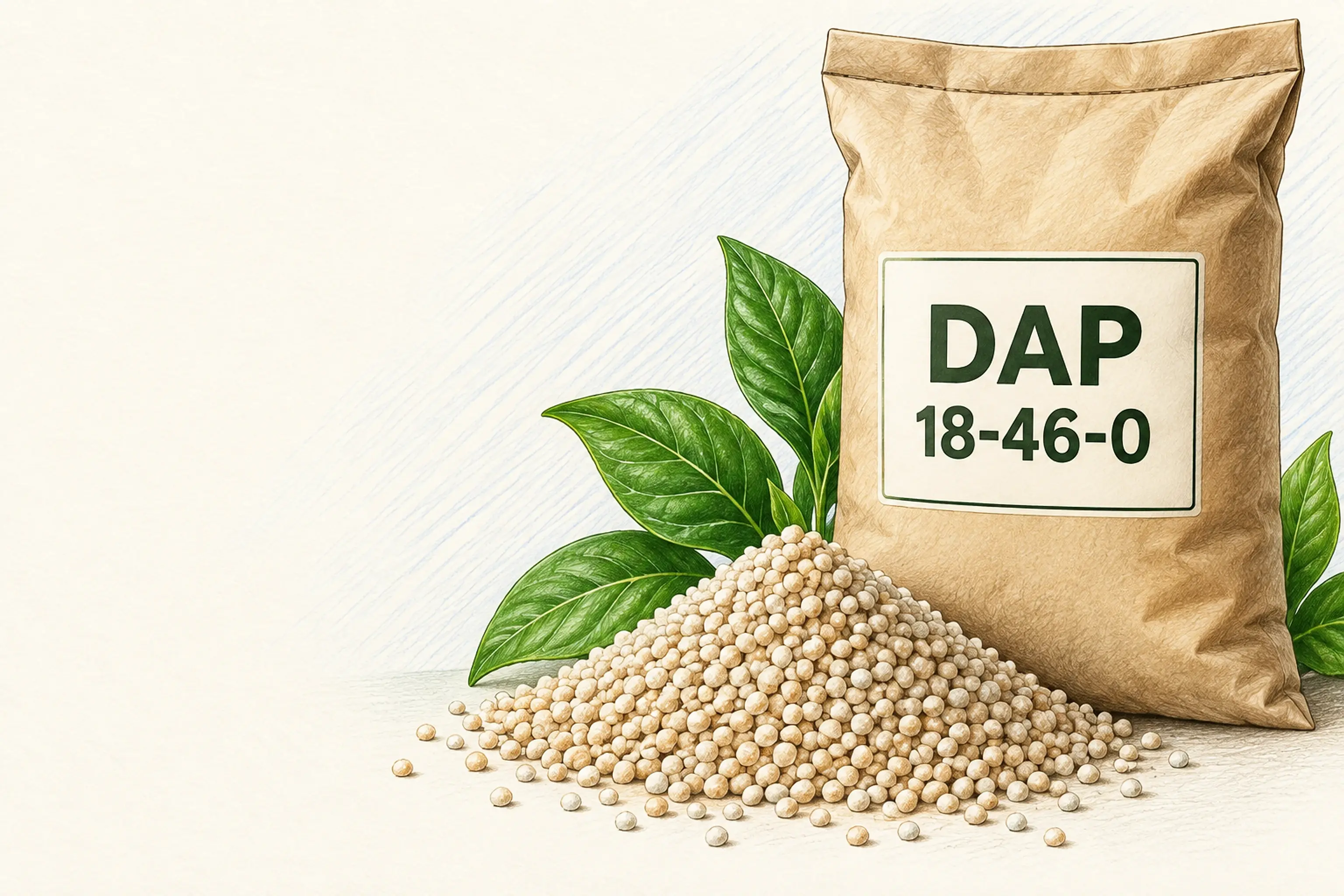
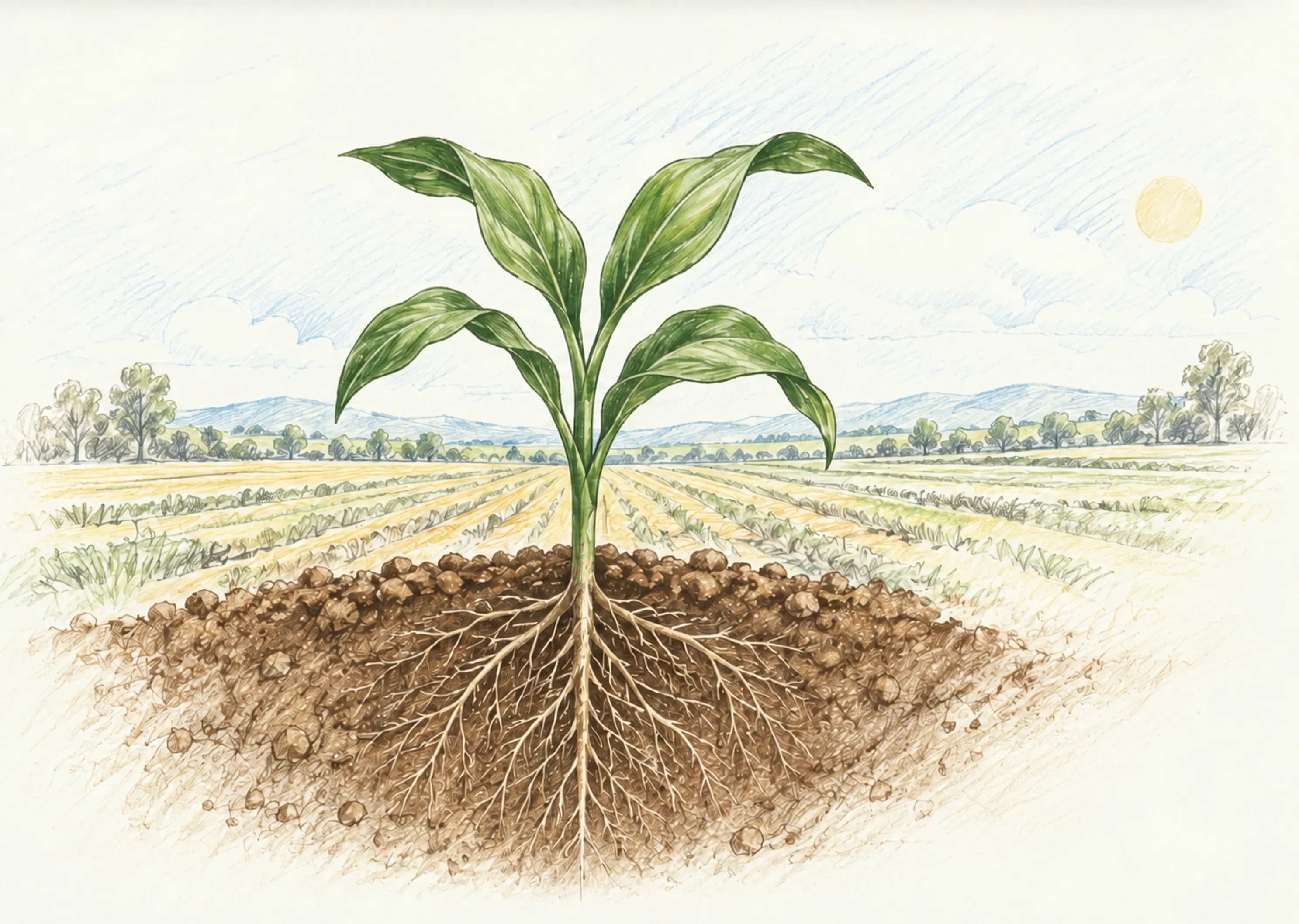
Large areas of farmland in dry and semi-arid regions have alkaline soils, often with free calcium carbonate (lime) in the topsoil. These are also regions where diammonium phosphate (DAP, 18-46-0) is widely used. The combination works, but it behaves differently from DAP on neutral or acid soils, and understanding why helps growers and distributors get more from every tonne.
The chemistry in brief
DAP is ammonium phosphate, (NH₄)₂HPO₄. It is highly water soluble and dissolves quickly once soil moisture reaches the granule. The solution it forms has a pH of about 7.5 to 8, so the soil immediately around a dissolving granule becomes more alkaline for a period. Over the following days and weeks, soil bacteria convert the ammonium to nitrate, a process that releases acidity and pulls the local pH back down.
Monoammonium phosphate (MAP) behaves the opposite way at first: its solution is acidic. On neutral and acid soils the difference matters little once the initial reactions are over. On calcareous soils it can matter more.
Why calcareous soils are a challenge for phosphorus
In soils rich in calcium carbonate, soluble phosphate reacts with calcium to form calcium phosphates that are progressively less soluble. Part of the applied phosphorus is also adsorbed onto carbonate and clay surfaces. Laboratory work on calcareous soils has shown that phosphorus adsorption increases with lime content, and that more DAP is needed to reach a given level of phosphorus in the soil solution than with an acidic source such as phosphoric acid.
Because DAP adds alkalinity at the granule site, it does nothing to slow these reactions locally. Canadian 4R nutrient stewardship material notes that phosphorus from DAP moves less far from the granule than phosphorus from MAP, which can make DAP somewhat less effective on calcareous soils. Other field experience in high-pH regions finds DAP performs well compared with superphosphates. The honest summary is that results depend on the soil, and that placement and timing often matter more than the choice between ammonium phosphates.
Ammonia risk on high-pH soils
The higher the soil pH, the more of DAP's ammonium exists as free ammonia near the granule. On alkaline soils this increases both the risk of seedling injury when DAP is placed with seed and the potential for some ammonia loss if DAP is left on the surface. Banding DAP below the surface and away from the seed addresses both.
Management practices that help
- Band rather than broadcast. Concentrating DAP in a band reduces the soil volume it contacts, so less phosphorus is tied up by lime, and roots meet a zone of higher phosphorus concentration.
- Apply close to sowing. Phosphorus applied long before the crop needs it has more time to convert to less available forms.
- Keep it below the surface. Incorporation or subsurface placement limits ammonia loss and puts phosphorus where moist roots can reach it.
- Use soil testing suited to alkaline soils. Bicarbonate-extraction tests are generally used for calcareous soils; results from an unsuitable method can mislead rate decisions.
- Add organic matter where practical. Manures and residues can improve phosphorus availability in lime-rich soils over time.
- Consider the whole programme. On strongly calcareous soils, some agronomists combine DAP with acidifying nitrogen sources or use MAP for seed-row placement.
| Property | DAP | MAP |
|---|---|---|
| Typical grade | 18-46-0 | 11-52-0 |
| Solution pH | About 7.5 to 8 | About 4 to 4.5 |
| Free ammonia near granule | Higher, especially on alkaline soil | Low |
| Nitrogen supplied with each unit of P | Higher | Lower |
Buying for alkaline-soil markets
Distributors serving calcareous regions benefit from consistent water-soluble phosphate and good granule strength, since banding equipment is less forgiving of fines. When requesting DAP 18-46-0, specify total and water-soluble P₂O₅, granule size range and moisture, and ask for a certificate of analysis per lot. Nuroil can provide CoA with each delivery and arrange independent inspection on request; send your requirements through the quote form.