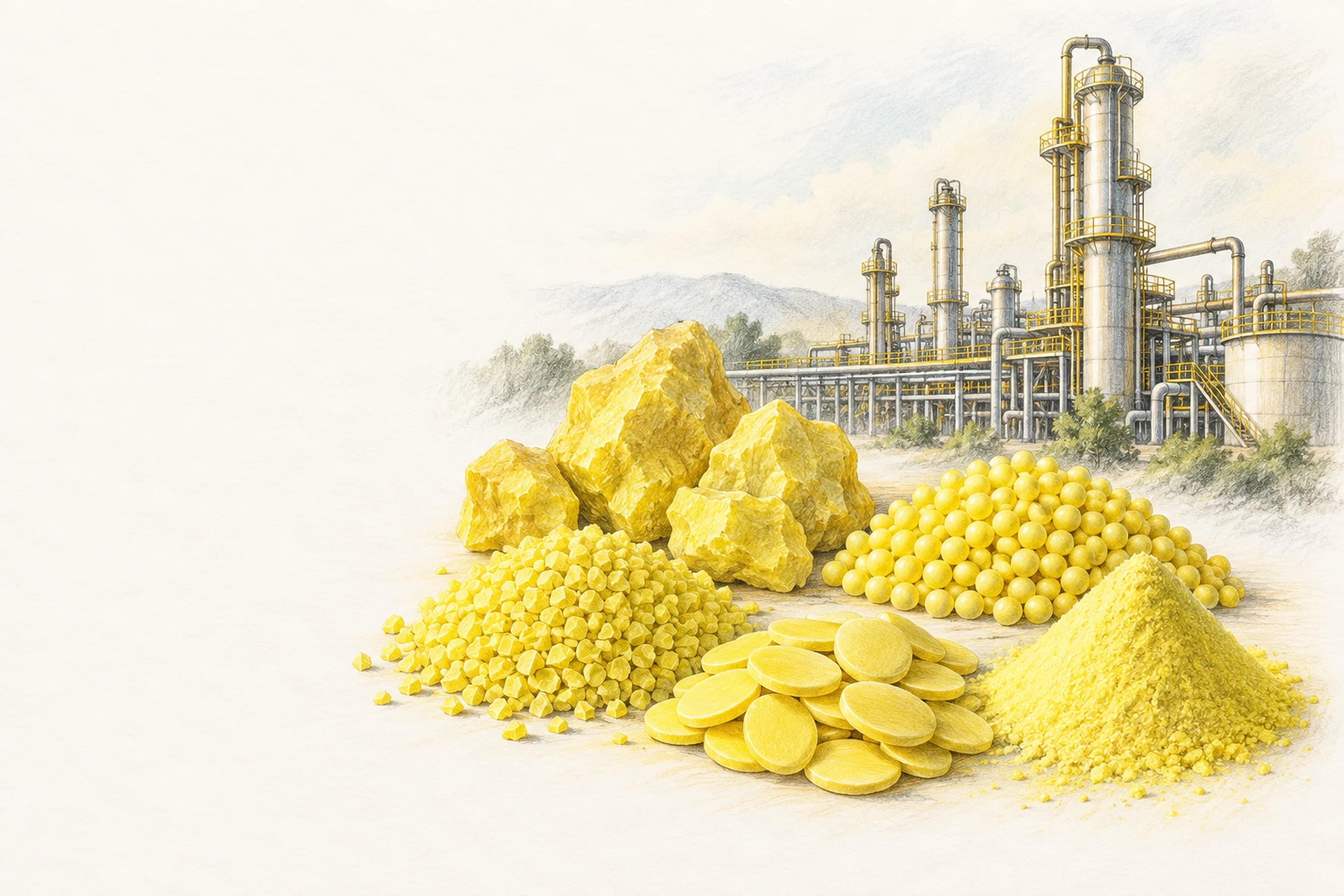
Sulphur remains the main curing agent for natural rubber and most general-purpose synthetic rubbers. For a compounder, the choice is less about whether to use sulphur and more about which form to buy. This guide compares the four forms most often found in rubber plants.
What sulphur does in the compound
During vulcanisation, sulphur forms crosslinks between polymer chains, turning a soft, plastic material into an elastic one. On its own, sulphur cures slowly and needs high temperatures, so it is used with accelerators and with activators, mainly zinc oxide and stearic acid. The ratio of sulphur to accelerator influences the type of crosslinks formed: longer sulphur chains tend to give better strength and fatigue properties, shorter ones better heat and ageing resistance. Systems that rely more on sulphur-donating accelerators and less on elemental sulphur are known as efficient vulcanisation systems.
Whatever system is chosen, the sulphur has to be spread evenly through the batch. Because it is added in small proportions relative to the polymer and fillers, any lump, damp clump or poorly wetted powder shows up as uneven cure. That is why the physical form of the sulphur matters as much as its purity.
The four forms compared
| Form | Strengths | Watch-outs |
|---|---|---|
| Plain rubber-maker's sulphur | Widely available, high purity, low ash | Dusty; can cake if damp; soluble, so bloom-prone if overdosed or added hot |
| Oil-treated sulphur | Less dust, better wetting and dispersion | Still soluble sulphur; the oil adds slightly to the compound |
| Conditioned (flow agent) sulphur | Free-flowing, resists caking in humid stores | Lower sulphur content and higher ash; adjust dosage |
| Insoluble sulphur (usually oil-treated) | Does not bloom before cure; protects tack; reduces bin scorch | Reverts to soluble form if overheated; more expensive; needs careful storage |
When each form makes sense
- General moulded and extruded goods: plain or oil-treated sulphur is standard. Oil-treated grades are often preferred in automatic weighing systems for their lower dust.
- Humid climates or long storage: conditioned grades avoid lumps that would otherwise need screening.
- Tyres, belts, hoses and other built-up products: insoluble sulphur protects tack on uncured components and helps adhesion to fabric and steel cord. Many plants use it fully or partly in place of soluble sulphur in these compounds.
Dosing and mixing practice
- Add sulphur late. In multi-stage mixing, sulphur and accelerators are usually added in the final, cooler stage to avoid scorch.
- Watch the temperature. Keep the final-stage drop temperature within the compound's limits. For insoluble sulphur, exposure above roughly 118 degrees Celsius can cause substantial reversion to soluble sulphur and bring back bloom.
- Adjust for active content. If you switch from a 99.5% grade to a conditioned grade with a lower sulphur content, or to an oil-treated insoluble grade, correct the dosage so the compound receives the same sulphur.
- Check dispersion. Specks, uneven cure or local bloom suggest agglomerates; review powder condition and mixing sequence.
Storage and handling
- Keep bags dry, closed and off the floor. Moisture causes caking and slowly forms weak acid. Reseal part-used bags at the weighing station.
- Store insoluble sulphur in a cool area as the supplier advises, since heat promotes reversion.
- Control dust at weighing stations and earth equipment, because sulphur dust is combustible and can be ignited by static.
- Keep sulphur separate from oxidising chemicals and follow the SDS for protective equipment.
Switching sulphur form changes dosage, mixing temperature limits and storage needs. Run a laboratory trial before changing production compounds.
Specifying your purchase
For each grade, specify minimum sulphur content, fineness, ash, acidity, moisture and, where relevant, oil content or flow agent. Ask for a CoA with actual results per lot. Nuroil supplies rubber-grade sulphur powder on FOB, CFR or CIF terms; send your requirements through request a quote.