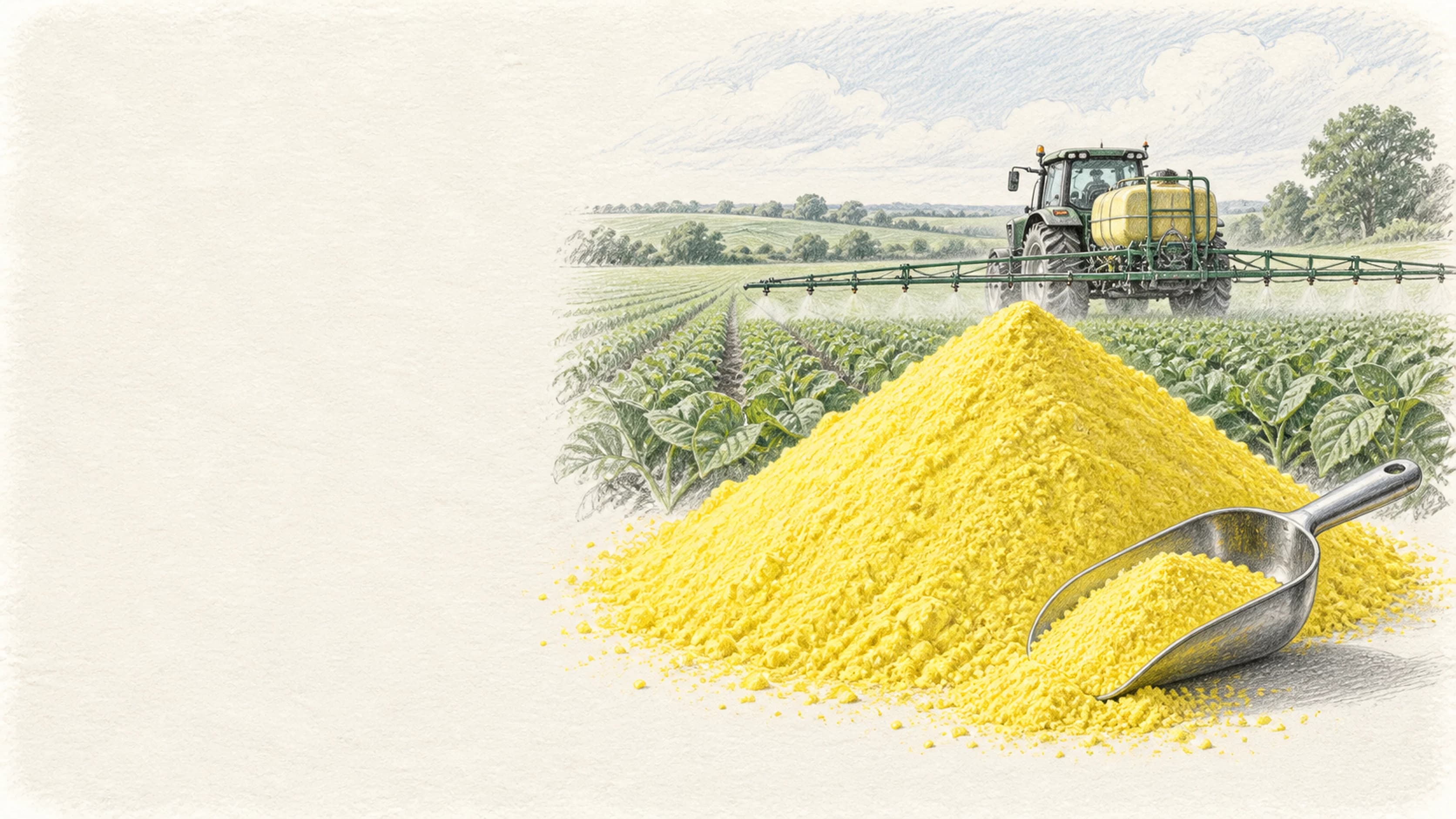
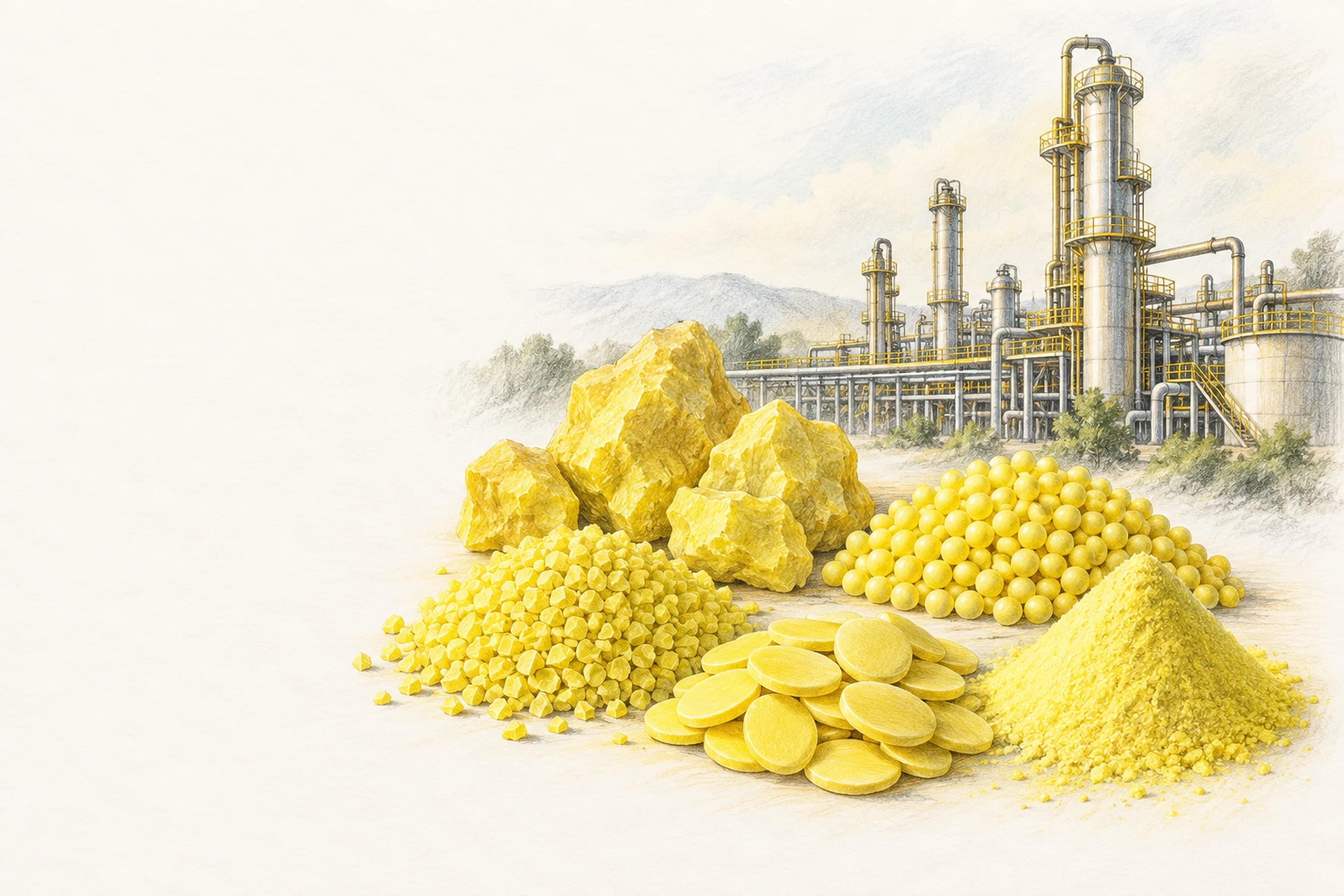
Sulphur powder is sold in several grades that differ mainly in fineness and in what, if anything, has been added. Each user industry has its own expectations, so a single "sulphur powder" specification rarely fits every buyer. This guide explains the common grades and the numbers found on a certificate of analysis.
How sulphur powder is made
Solid sulphur, usually from refinery or gas-plant recovery, is crushed and ground in mills, then classified to the required size. Finer grades go through additional milling, sometimes air-jet milling, to reach micron-level sizes. Some grades are then treated with a small amount of oil to reduce dust, or blended with a flow agent to prevent caking.
Common grades
| Grade | Typical additive | Typical uses |
|---|---|---|
| Ground (commercial) sulphur | None | Chemicals, soil amendment, matches, general industrial |
| Rubber-maker's sulphur | None | Vulcanisation of rubber compounds |
| Oil-treated rubber-maker's sulphur | Small amount of process oil | Rubber compounding with lower dust |
| Conditioned (free-flowing) sulphur | Flow agent such as magnesium carbonate | Rubber and formulation where caking is a problem |
| Superfine or micronised sulphur | Sometimes a flow agent | Fungicide formulation, specialty chemicals |
Reading mesh numbers
Fineness is usually stated as the percentage of powder passing a sieve of a given mesh. Higher mesh numbers mean smaller openings. Approximate openings for US standard sieves are:
A typical oil-treated rubber grade, for example, may be specified as 100% passing 80 mesh, about 99.5% passing 100 mesh and 90% passing 200 mesh. Superfine grades are often specified at 90% or more passing 325 mesh. For micronised material, laser-diffraction results (such as a median particle size in microns) are more informative than sieve data.
Two practical points help when comparing offers. First, check whether the figure is "percentage passing" or "percentage retained", since they are easily confused. Second, fine powders tend to clump during dry sieving, so laboratories may use wet sieving or an air-jet sieve for the finer meshes. Agree the test method in the contract if fineness is critical to your process.
Parameters on the CoA
- Purity. Sulphur content. Untreated rubber grades are commonly 99.5% minimum. Conditioned grades show lower purity because the flow agent counts as non-sulphur.
- Ash. Residue after burning. Low (around 0.1% maximum) for untreated grades; higher for grades containing magnesium carbonate, since the carbonate leaves ash.
- Acidity. Expressed as sulphuric acid, commonly 0.01% maximum. High acidity can affect cure behaviour and corrode equipment.
- Moisture or heat loss. Commonly 0.15% maximum or similar. Moist powder cakes and disperses poorly.
- Oil content. For oil-treated grades, a typical figure is a fraction of a percent.
- Fineness. Percentage passing the relevant sieves.
Compare like with like. A conditioned grade with lower "purity" and higher ash may be exactly what the specification intends.
Matching grade to use
- Rubber: rubber-maker's grade, oil-treated if dust is a concern, conditioned if caking has been a problem. Consider insoluble sulphur for tack-critical compounds.
- Fungicide formulation: superfine or micronised grades with a defined particle size distribution, with additives agreed with the formulator. The finished product must still be registered under local pesticide rules.
- Chemical synthesis: purity and low ash usually matter more than extreme fineness.
- Soil amendment: ground sulphur that is fine enough to oxidise quickly; the coarser bentonite pastilles are an alternative with less dust.
What to include in an enquiry
State the grade, minimum purity, required fineness with sieve sizes, limits for ash, acidity and moisture, any additive that is required or not allowed, the bag size and the destination. Nuroil supplies sulphur powder with a CoA on each delivery; send your specification via request a quote.