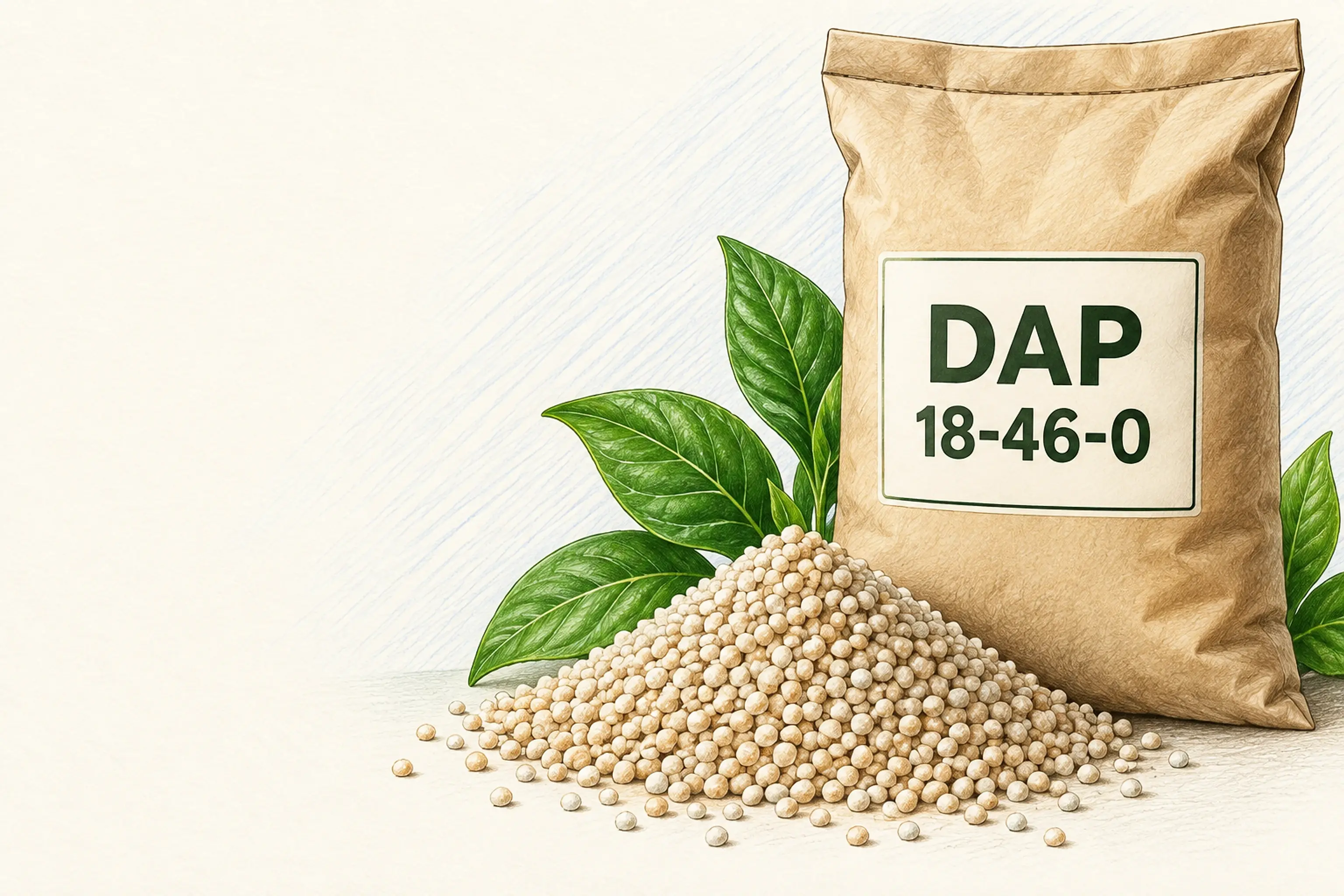
Soil test reports and crop recommendations express phosphorus in different ways, and fertilizer labels use yet another convention. Getting from a recommendation to a quantity of diammonium phosphate (DAP, 18-46-0) to order is simple arithmetic, but mistakes in units are common and costly. This guide sets out the conversions and a worked example.
P or P₂O₅?
By long-standing convention, fertilizer labels state phosphorus as phosphate, P₂O₅, rather than as elemental phosphorus (P). Many soil scientists and some advisory services work in elemental P. The two are linked by fixed factors:
- kg P₂O₅ × 0.436 = kg P
- kg P × 2.29 = kg P₂O₅
So DAP's 46 percent P₂O₅ equals about 20 percent elemental P. Always check which unit a recommendation uses before calculating.
The core formulas
- DAP needed (kg/ha) = P₂O₅ recommendation (kg/ha) ÷ 0.46
- Nitrogen supplied by DAP (kg/ha) = DAP rate × 0.18
- Remaining nitrogen = total N recommendation − N supplied by DAP
- Urea needed for the remainder (kg/ha) = remaining N ÷ 0.46
If the recommendation is in elemental P, convert first: P × 2.29 gives P₂O₅, then divide by 0.46. A shortcut is that 1 kg of P requires about 5 kg of DAP.
Quick reference table
| P₂O₅ required (kg/ha) | DAP (kg/ha) | N supplied (kg/ha) | Elemental P (kg/ha) |
|---|---|---|---|
| 20 | 43 | 8 | 9 |
| 30 | 65 | 12 | 13 |
| 40 | 87 | 16 | 17 |
| 50 | 109 | 20 | 22 |
| 60 | 130 | 23 | 26 |
| 80 | 174 | 31 | 35 |
Figures are rounded. For a bagged product, divide the DAP rate by the bag weight (for example 50 kg) to get bags per hectare.
Worked example
A wheat recommendation calls for 60 kg/ha P₂O₅ and 140 kg/ha N.
- DAP: 60 ÷ 0.46 = 130 kg/ha (about 2.6 bags of 50 kg)
- Nitrogen from DAP: 130 × 0.18 = 23 kg/ha
- Remaining nitrogen: 140 − 23 = 117 kg/ha
- Urea: 117 ÷ 0.46 = 254 kg/ha, usually split across two or more top-dressings
For a 500-hectare programme, the order becomes about 65 tonnes of DAP and 127 tonnes of urea, before any allowance for handling losses or buffer stock.
Points that trip people up
- Mixing up units. Treating a P figure as P₂O₅ under-applies phosphorus by more than half.
- Ignoring DAP's nitrogen. It is a real contribution and should be deducted from the nitrogen plan, especially where nitrogen limits apply.
- Using DAP to meet nitrogen needs. Because the N to P₂O₅ ratio is fixed, chasing nitrogen with DAP over-applies phosphate.
- Area units. Recommendations in kg per acre or per feddan must be converted to the area used for ordering. One hectare is about 2.47 acres.
- Seed-row limits. A calculated rate may exceed what can safely be placed with seed; the excess should be banded away from the seed or applied pre-plant.
When DAP goes into a blend
Distributors who blend DAP with urea and potash work the same arithmetic in reverse. In a blend, the share of DAP by weight multiplied by 0.46 gives the blend's P₂O₅ percentage, and the same share multiplied by 0.18 gives its contribution to total nitrogen, to which the urea share multiplied by 0.46 is added. Checking these sums before blending avoids a product that falls short of its declared grade. Matching granule sizes between DAP and the other components keeps the blend from separating in transport.
From calculation to order
Once the per-hectare rates are fixed, multiply by the planted area, add a sensible allowance for spillage and stock, and round to the packing unit. When you request a quote for DAP 18-46-0 and agriculture-grade urea, include the tonnage of each, packing, delivery port and the arrival window your season requires. Nuroil confirms specifications against a certificate of analysis with each delivery.