80/100 and 60/70 are neighbours on the penetration scale, and buyers sometimes treat them as interchangeable. They are not. A difference of 20 penetration units changes how a binder handles in the plant, how it behaves on a hot road and how well it copes with a cold night. This article looks at what separates the two and where 85/100 fits in.
Softer means a higher number
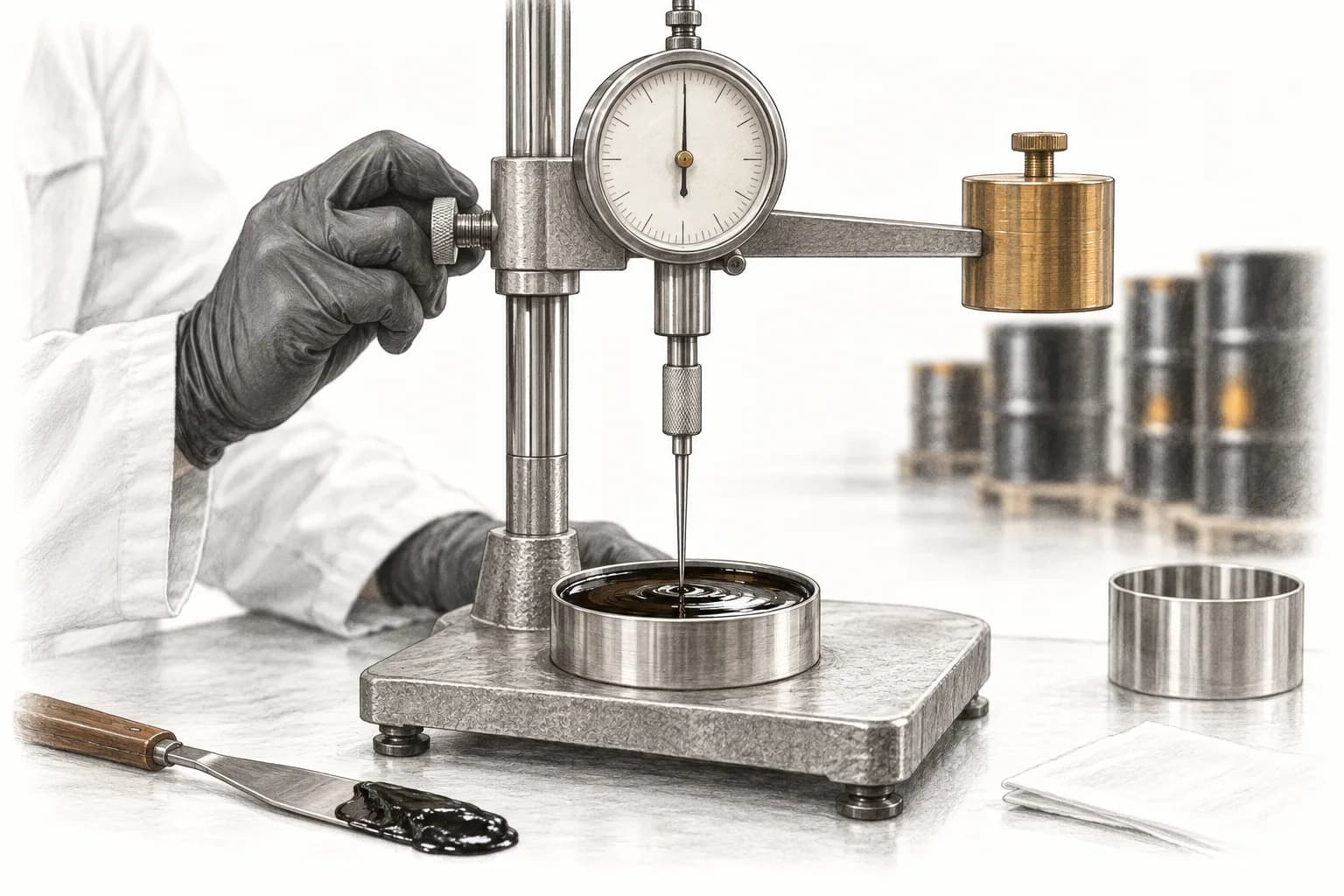
In the penetration test a standard needle is loaded with 100 g for five seconds at 25°C, and the depth is reported in tenths of a millimetre. 80/100 lets the needle sink further than 60/70, so it is the softer binder. Softer binders are generally preferred in cooler regions, where low-temperature cracking is the main risk; harder binders are preferred in warm regions, where rutting dominates.
Softening point usually follows the same pattern: a softer grade begins to flow at a lower temperature. In the European standard, for instance, the 70/100 grade has a lower softening point band than the harder 40/60 grade. That is a warning sign for hot-climate paving with soft grades.
Where 80/100 and 85/100 are used
- Surface dressing and spraying. Softer binders spray and wet chippings more easily. Indian refiners note that VG-10, used for spraying, replaced the old 80/100 grade.
- Cooler climates and high altitudes, where a stiffer binder would crack.
- Base stock for emulsions and modified products, where the manufacturer wants a soft starting binder.
- Lightly trafficked roads where rutting risk is low.
85/100 is the equivalent grade within ASTM D946 and AASHTO M 20. 80/100 comes from older British-style and Indian specifications. The bands overlap heavily but are not identical, so a lot tested at 82 meets 80/100 but not 85/100.
By contrast, for dense asphalt carrying regular truck traffic in warm or hot climates, 60/70 or harder is the normal choice. A soft binder in that setting may rut and bleed in summer, especially at intersections and on slopes where vehicles move slowly.
Side-by-side comparison
| Point | 80/100 and 85/100 | 60/70 |
|---|---|---|
| Penetration at 25°C (0.1 mm) | 80–100 or 85–100 | 60–70 |
| Relative stiffness | Softer | Medium |
| Typical climate | Cool to temperate | Warm to hot |
| Typical uses | Surface dressing, emulsions, light-traffic paving | Dense asphalt for medium to heavy traffic |
| Main risk if misapplied | Rutting and bleeding in heat | Cracking in severe cold |
| Nearest viscosity grade (IS 73) | VG-10 | VG-30 |
Ageing changes the picture
Both grades harden during hot mixing. Specifications check this with a thin film oven ageing test and set a minimum retained penetration: the aged binder must keep a stated percentage of its original penetration. In ASTM D946 the minimum is lower for softer grades, because softer binders tend to lose more of their penetration in the test. A soft grade that hardens excessively in the plant may end up behaving more like a medium grade on the road, so ageing results deserve as much attention as the headline penetration.
Pick the grade for the climate and traffic first, then check that the ageing results show the binder will stay close to that grade after mixing.
Storage differences
Softer grades are pumpable at lower temperatures, so they can also be stored cooler. Eurobitume guidance for bulk tanks suggests about 115°C for 70/100 for storage of up to a month, compared with about 120°C for 50/70, and lower temperatures again for longer storage. Keeping a soft grade hotter than necessary for long periods hardens it, which narrows the very difference you paid for. Plan tank allocation so the two grades are never mixed, since even a modest heel of a harder grade can shift a soft lot towards the bottom of its band.
Making the enquiry
Name the exact band (80/100 or 85/100 are different requirements), the standard and its edition, the use, quantity and packing. Ask for penetration, softening point, ductility, flash point and thin film oven results on the certificate of analysis. If you are not sure which grade your project needs, the road authority's specification or the mix designer should decide. Nuroil can offer both soft and medium penetration grades, and our team can confirm which standard a product is certified to.