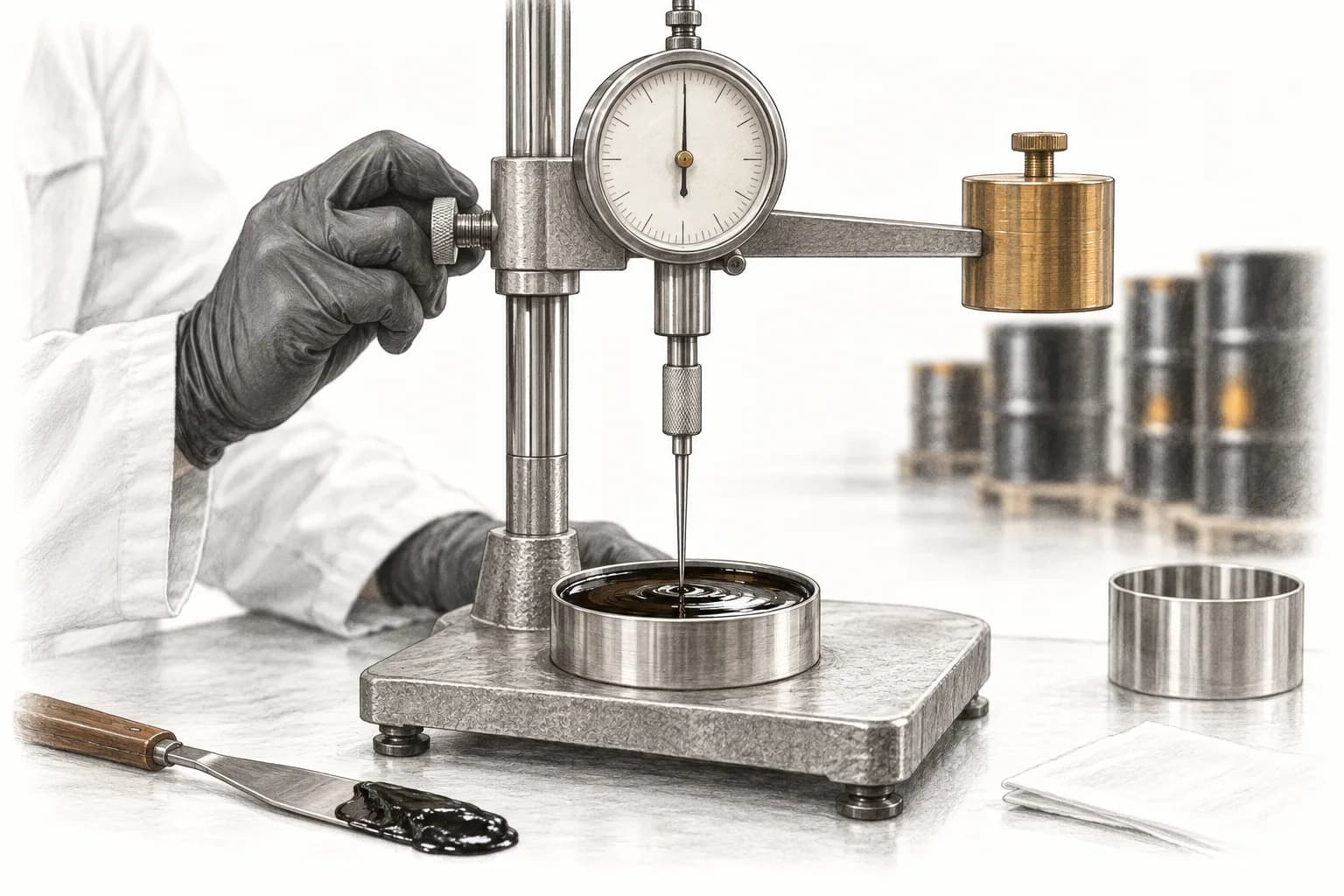
A lot of 60/70 leaves the refinery with a certificate showing, say, 64 penetration. Weeks later a site laboratory tests it at 57 and the contractor rejects it. Was the certificate wrong? Sometimes, but more often the binder has genuinely changed, or the second sample does not represent the lot. Understanding the usual causes helps buyers and suppliers resolve disputes quickly and prevent them in the first place.
Hardening from heat and air
Bitumen hardens when it is held hot in contact with air. Light components evaporate and the binder oxidises, both of which reduce penetration and raise softening point. The thin film oven tests in the specifications exist precisely because this happens in the asphalt plant. The same process, more slowly, takes place in storage tanks and in reheated drums.
Eurobitume guidance recommends not letting bitumen go cold in a bulk tank and gives grade-specific storage temperatures. For storage of up to a month it suggests around 120°C for 50/70 and 40/60, and 115°C for 70/100. For storage longer than a month the recommended temperatures drop to around 80°C and 75°C respectively. Holding a soft grade far hotter than needed for long periods is a common reason for falling penetration.
Localised overheating during reheating
When cold bitumen is reheated, material next to the heating coils or flame tubes can overheat before the bulk is liquid. Eurobitume advises raising thermostat settings in small steps of 5–10°C and circulating once the minimum pumping temperature is reached. It also recommends testing the bitumen against its specification before use after a shutdown. Drums heated aggressively over open fires suffer the same problem in a more extreme form.
Contamination and grade mixing
- Tank heels. A tank or road tanker that previously held a harder grade, cutback or modified binder can shift the result of the next delivery.
- Water. Moisture causes foaming on heating and can affect test specimens. Bitumen meeting IS 73, for example, must not foam at 175°C.
- Solvents and fuel used to clean equipment soften the binder and lower the flash point.
Sampling and testing differences
Penetration is an empirical test with real repeatability limits. Two competent laboratories can report results a few units apart on the same sample. Add to that a sample taken from the surface of a drum, a pipe dead-leg or the first litres from a valve, and differences grow. Standards for sampling, such as EN 58 and the national equivalents, exist to make samples representative; Irish road specifications, for example, require samples to be taken at the point of delivery under EN 58.
| Symptom on site test | Likely causes to check |
|---|---|
| Penetration lower, softening point higher | Long hot storage, overheating, oxidation in reheated drums, harder heel in tank |
| Penetration higher, flash point lower | Contamination with solvent, fuel or cutback |
| Results scattered between samples | Poor sampling point, unmixed tank, specimens prepared differently |
| Foaming during sample preparation | Water in the binder or in the container |
Preventing disputes
- Agree the sampling point and method in the contract, and retain sealed reference samples from loading.
- Use third-party inspection at loading for large lots.
- Keep storage temperatures as low as practical for the grade, and log them.
- Dedicate tanks and tankers to one grade, or clean them between grades.
- Compare like with like: same standard, same test method, and an allowance for test precision.
Most out-of-grade findings trace back to heat history or to the sample, not to the refinery certificate.
What to ask your supplier for
Ask for a certificate of analysis for each lot, the batch number and production date, and retained samples. For bulk and large drum shipments, consider independent inspection at loading. Nuroil provides a CoA with every penetration grade delivery and can arrange third-party inspection on request; contact us through the contact page if a site result needs investigating.