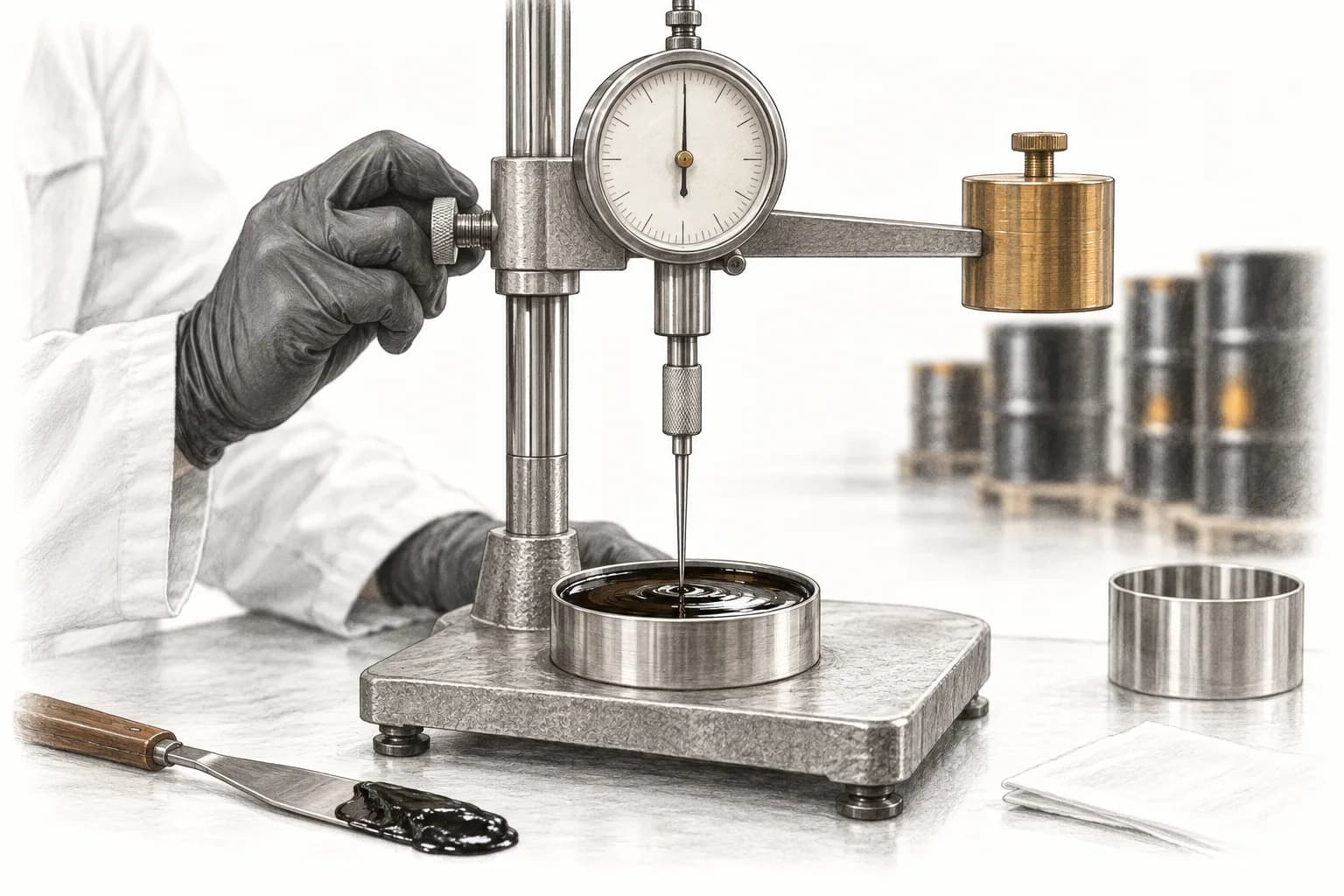
Penetration grade bitumen is specified under several standards, and the same-sounding grade can carry different requirements under each. The two most often cited in international trade are ASTM D946 (also published as AASHTO M 20) and the European EN 12591. This guide sets out the grades and main limits so buyers can see what each specification actually asks for.
ASTM D946 grades
ASTM D946 covers five grades named by their penetration range at 25°C: 40–50, 60–70, 85–100, 120–150 and 200–300. Recent editions note that these ranges are legacy paving grades that date back decades and that, in North America, they are now mainly used for roofing, since road agencies there have moved to performance grading. Elsewhere they remain common in paving tenders.
The standard controls penetration, flash point (Cleveland open cup), ductility at 25°C, solubility in trichloroethylene, and the behaviour of the binder after a thin film oven test, expressed as retained penetration.
| Property | 40–50 | 60–70 | 85–100 | 120–150 | 200–300 |
|---|---|---|---|---|---|
| Penetration at 25°C (0.1 mm) | 40–50 | 60–70 | 85–100 | 120–150 | 200–300 |
| Flash point, °C min | 232 | 232 | 232 | 218 | 177 |
| Ductility at 25°C, cm min | 100 | 100 | 100 | Check edition | |
| Retained penetration after thin film oven, % min | 55 | 52 | 47 | 42 | 37 |
Flash points in the standard are set in °F (450°F, 425°F and 350°F); the Celsius values above are conversions. Always check the current edition named in the contract, as limits and test methods are revised over time.
EN 12591 grades
The European standard names grades by a penetration band written with a slash, such as 40/60, 50/70, 70/100 and 160/220. Unlike ASTM D946, every grade also carries a softening point band, and ageing is assessed with the rolling thin film oven test at 163°C through three results: retained penetration, increase in softening point and change of mass.
| Property | 40/60 | 70/100 | 160/220 |
|---|---|---|---|
| Penetration at 25°C (0.1 mm) | 40–60 | 70–100 | 160–220 |
| Softening point, °C | 48–56 | 43–51 | 35–43 |
| Retained penetration after RTFOT, % min | 50 | 46 | 37 |
| Increase in softening point after RTFOT, °C max | 9 | 9 | 11 |
| Change of mass after RTFOT, % max | 0.5 | 0.8 | 1.0 |
| Flash point, °C min | 230 | 230 | 220 |
| Solubility, % min | 99 | 99 | 99 |
The table follows the values reproduced in an Irish road authority binder specification for EN 12591. National annexes can add or tighten requirements, such as a Fraass breaking point or a minimum viscosity.
Key differences for buyers
- Band width. EN bands are wider (for example 50/70 against 60–70), so a binder can meet one and fail the other.
- Softening point. EN 12591 limits it for every grade; ASTM D946 does not.
- Ductility. ASTM D946 sets a minimum; EN 12591 does not require it in its core table.
- Ageing method. ASTM D946 uses the thin film oven; EN uses the rolling thin film oven with three criteria.
- Grade names. 85–100 and 80/100 are different bands; 70/100 is the closest EN grade.
A grade name is only meaningful alongside the standard and edition it is certified to.
Other standards you may meet
Many national road specifications are built on one of these two documents, sometimes with local changes. Some use older band names such as 80/100 and 30/40, and several countries have replaced penetration grades entirely with viscosity grades or performance grades. India, for instance, moved its paving bitumen standard IS 73 from penetration to viscosity grading. When a tender cites a national standard, ask for a copy of the property table rather than assuming it matches ASTM or EN limits, and confirm that the testing laboratory works to the methods the standard references.
Specifying in an enquiry
Quote the grade exactly as written in the standard, name the standard and edition, and ask for a certificate of analysis reporting every property in the relevant table. If the project uses a national specification derived from one of these, attach it. Nuroil can supply penetration grade bitumen certified to the standard your tender names; send details through request a quote.