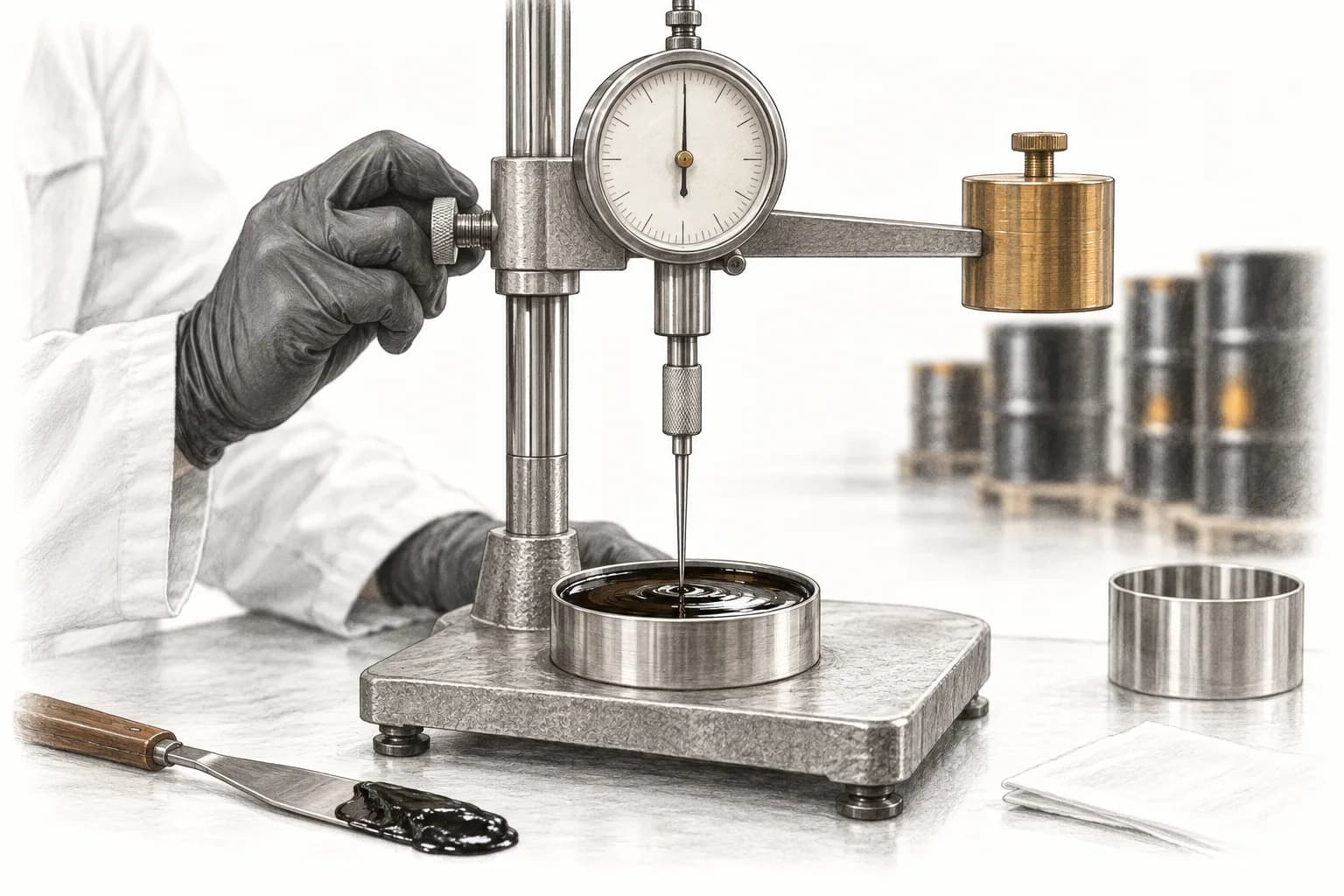
Every lot of penetration grade bitumen should arrive with a certificate of analysis (CoA). It is the main evidence that the binder meets the contract, yet many buyers only glance at the penetration figure. This guide walks through the results usually reported for grades such as 40/50, 60/70 and 80/100, what each one tells you, and the checks worth making before accepting a lot.
Identification details
Before the numbers, check the header. A useful CoA names the product and grade, the standard and edition tested against, the batch or tank number, the date of sampling and testing, and the laboratory. If the certificate does not name a standard, you cannot tell which limits apply. Match the batch number to the drums, bags or tank documents.
Results on the original binder
| Result | What it shows | What to look for |
|---|---|---|
| Penetration at 25°C | Consistency at a moderate service temperature | Inside the band, ideally not on the edge |
| Softening point (ring and ball) | Temperature at which the binder softens enough to flow | Consistent with the grade; a high value for the penetration may indicate an oxidised or unusual binder |
| Ductility at 25°C | How far a specimen stretches before breaking | Meets the minimum where the standard requires it |
| Flash point (open cup) | Safety margin when heating | Above the minimum; a low value can signal solvent or fuel contamination |
| Solubility | Purity, i.e. the share that dissolves in solvent | Usually 99% or more |
| Kinematic viscosity at 135°C (if reported) | Flow at mixing temperatures | Useful for setting plant temperatures |
Results after ageing
The thin film oven test (ASTM D1754) or rolling thin film oven test (ASTM D2872, EN 12607-1) heats thin films of binder at 163°C to simulate hardening in the asphalt plant. In the rolling version the binder is aged for 85 minutes in rotating glass bottles with a stream of air. The CoA should then report:
- Change of mass, the volatiles lost. Specifications cap it, commonly at 0.5–1.0% depending on grade.
- Retained penetration, the aged penetration as a percentage of the original. A higher value means less hardening.
- Increase in softening point (EN grades) or ductility of the residue (some ASTM-based specifications).
Ageing results are the best early warning that a binder will harden quickly in the plant and on the road.
Calculating the penetration index
From penetration and softening point you can estimate how sensitive the binder is to temperature. The method, due to Pfeiffer and Van Doormaal, assumes most bitumens have a penetration of about 800 at their softening point. A working form is:
PI = (1952 − 500 × log P − 20 × SP) / (50 × log P − SP − 120)
where P is the penetration at 25°C and SP is the softening point in °C. Conventional paving bitumens typically fall roughly between −1 and +1. A strongly negative PI indicates a binder that softens quickly as temperature rises; a high positive PI is typical of blown or oxidised bitumens. The assumption behind the formula does not hold well for polymer modified binders, so treat PI as a guide only for conventional grades.
Checks before accepting a lot
- Standard, grade and batch on the CoA match the contract and the packages.
- All properties in the standard's table are reported, not just penetration.
- Results are within limits with some margin, especially penetration and softening point.
- Ageing results are present and pass.
- Dates are recent and consistent with the shipment.
A certificate that reports only penetration is not a full certificate.
Documents to request
Along with the CoA, ask for the safety data sheet, the certificate of origin where your customs require it, and, for large lots, an independent inspection report from loading. Nuroil supplies a CoA with every penetration grade bitumen delivery and can provide CoO, MSDS and third-party inspection on request. To discuss documentation for an order, contact us.