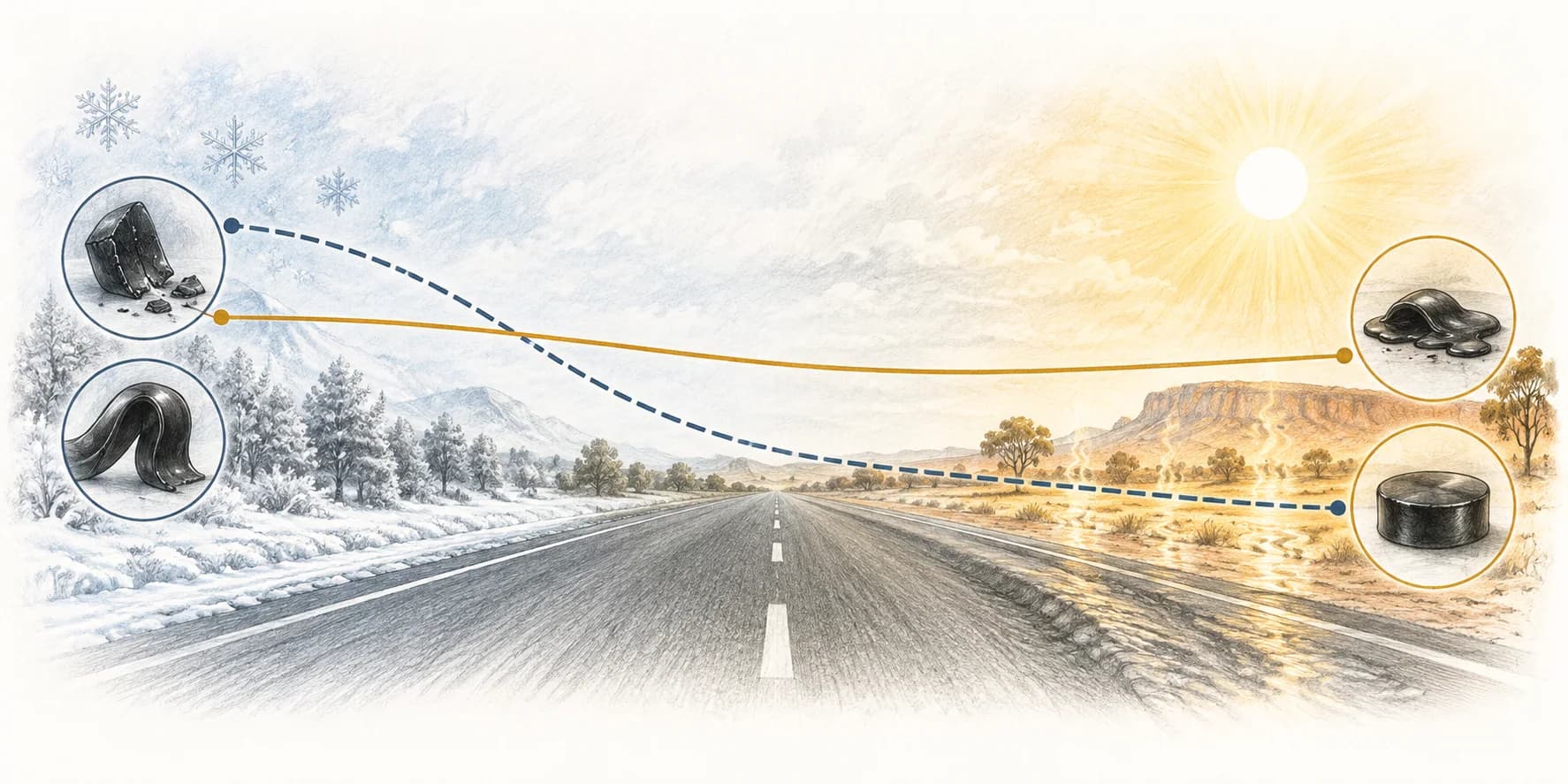
Most AS 2008 classes are defined by the viscosity of the bitumen as supplied. A few are not. Class 450 and the multigrade asphalt binder M1000 are graded on the viscosity of the bitumen after it has been aged in the laboratory. This detail surprises buyers who expect every grade to be tested in the same way, and it matters when comparing certificates.
What happens to bitumen in the asphalt plant
When bitumen is mixed with hot aggregate it is spread into very thin films and exposed to air at temperatures well above 140°C. Lighter fractions evaporate and some components oxidise. The result is that the binder in freshly laid asphalt is noticeably stiffer than the bitumen that arrived in the tanker.
Laboratories reproduce this short-term ageing with the rolling thin film oven (RTFO) test. Bitumen is poured into glass bottles that rotate in a hot oven while air is blown across them, so the film is constantly renewed. The residue is then tested and treated as a stand-in for the binder in newly placed asphalt.
Two ways of using the aged result
AS 2008 uses the RTFO residue in two different ways:
- As a limit on hardening. For classes graded on the original bitumen, such as Class 170 and Class 320, the residue viscosity must not exceed a set multiple of the original. One producer's data sheet for Class 320 states a maximum of 300 per cent of the original viscosity. This stops a supplier delivering a bitumen that looks right on day one but hardens excessively in the plant.
- As the grading basis itself. For Class 450 and M1000, the class band is set on the aged residue. Supplier data shows Class 450 at roughly 750 to 1150 Pa·s at 60°C after RTFO, and M1000 at roughly 3500 to 6500 Pa·s after RTFO.
Why grade on the aged binder at all
Grading on the aged residue ties the specification more closely to what the pavement actually receives. Two bitumens with the same original viscosity can age differently depending on crude source and refining route. If the asphalt designer cares about stiffness in the finished layer, specifying the aged value removes some of that uncertainty. The approach is sometimes signalled in the name, as in AR450, where AR stands for aged residue.
Class 450 is the bitumen of choice for asphalt wearing and base courses in New South Wales, while M1000 is a multigrade asphalt binder made by a process that flattens the viscosity-temperature curve to give extra stiffness at high temperatures.
What this means when reading a certificate
| Class | Grading basis | Key number to check |
|---|---|---|
| Class 170, 240, 320, 600 | Original bitumen | 60°C viscosity of the sample as supplied, plus residue-to-original ratio |
| Class 450 | RTFO residue | 60°C viscosity after ageing |
| M500 | Original bitumen | 60°C viscosity as supplied |
| M1000 | RTFO residue | 60°C viscosity after ageing |
A common mistake is to compare the original viscosity of a Class 450 sample against the 750 to 1150 Pa·s band and conclude that it fails. The original value will be lower; it is the aged value that must sit inside the band. The reverse mistake also happens, where an aged result for Class 320 is compared with the original band.
Practical checks for buyers
- Confirm which edition of AS 2008 the project calls up, as limits and test lists have been revised over time.
- Make sure the certificate states clearly whether each viscosity is on original or RTFO residue.
- Check that the laboratory used the AS 2341 series methods named in the specification, or agreed equivalents.
- For export cargoes, agree in advance whether RTFO testing is done at the load port, at destination, or both, because it adds time.
For Class 450 and M1000, the number that decides compliance is the viscosity after ageing, not the viscosity as delivered.
Specifying aged-residue grades in an enquiry
If you need Class 450 or M1000, name the class and the AS 2008 edition, and ask for a certificate of analysis that reports both original and RTFO residue results. Independent inspection at loading can be arranged on request. You can send these details through the Australian Standard bitumen page or contact Nuroil to discuss testing before shipment.