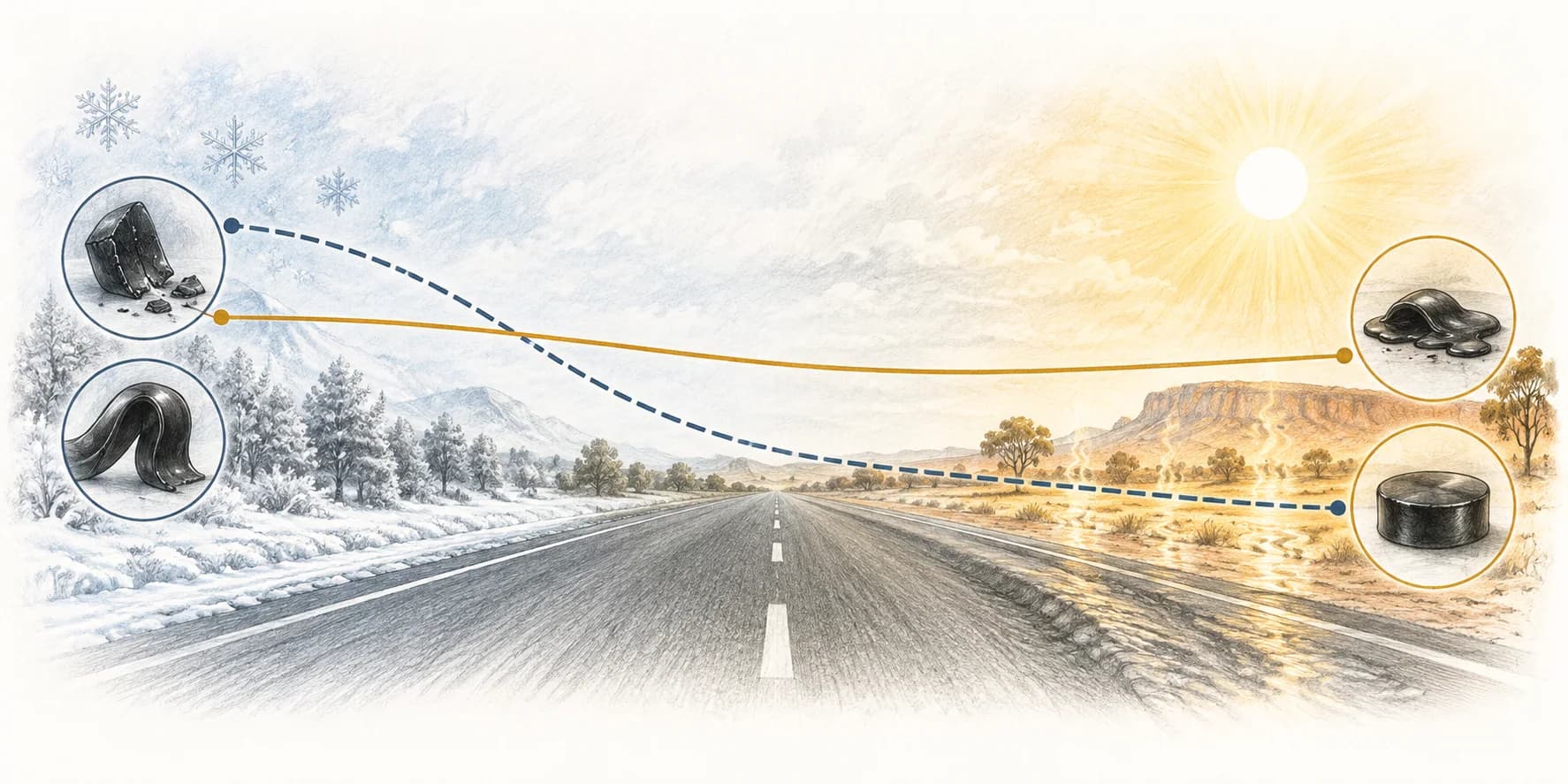
Alongside its numbered classes, AS 2008 includes two multigrade bitumens, M500 and M1000. They are not polymer modified binders, yet they behave differently from conventional classes of similar handling viscosity. Understanding why helps buyers decide whether a multigrade is worth specifying.
The idea behind multigrade bitumen
All bitumen gets softer as it warms. How quickly it softens is shown by its viscosity-temperature curve. A conventional bitumen that is soft enough to spray or mix comfortably will also be relatively soft on a very hot road. A stiffer conventional class fixes the hot-weather problem but is harder to handle and can be more brittle in winter.
Multigrade bitumen is made with a processing technique that changes the shape of that curve. The aim is to keep the binder workable at application temperature while making it noticeably stiffer at high pavement temperatures. In other words, it tries to take the good end of two different classes.
M500 and M1000 compared
| Point | M500 | M1000 |
|---|---|---|
| Main use | Sprayed sealing | Asphalt |
| Grading basis | 60°C viscosity of original bitumen | 60°C viscosity after RTFO ageing |
| Typical 60°C viscosity band (supplier data) | About 400 to 600 Pa·s | About 3500 to 6500 Pa·s (aged) |
| Typical spraying temperature (supplier data) | 175 to 185°C | Not normally sprayed |
Because M1000 is graded on aged residue, its band cannot be compared directly with the original-bitumen bands of the conventional classes. Always check the actual specification limits.
Where M500 is used
M500 is a sprayed seal binder. It is chosen where a Class 170 seal could soften, flush or let stone roll over in hot weather, but where the agency does not want the cost or handling of a polymer modified seal. Its spraying temperature in supplier guidance is the same 175 to 185°C window as conventional sealing grades, so standard sprayers can apply it.
Where M1000 is used
M1000 is an asphalt binder for layers that need high resistance to rutting, such as heavily trafficked routes and areas with slow-moving or stationary trucks. Because it is graded on aged residue, the asphalt designer can predict the stiffness of the binder in the finished layer more directly. Supplier storage guidance for M1000 is slightly lower than for conventional asphalt classes when holding for up to 14 days, at about 120 to 140°C.
When a multigrade makes sense
- The road is in a hot region and conventional binders have shown bleeding or rutting.
- The project wants better high-temperature performance without moving to a polymer modified binder.
- The agency specification lists multigrade as an accepted option for the layer.
A multigrade is not a substitute for a polymer modified binder where elastic recovery, crack resistance or very high stress performance is the design target. Austroads guidance treats conventional, multigrade and modified binders as separate choices with different strengths.
Handling and storage notes
Treat multigrades like other hot bitumens. Store at the lowest temperature that allows practical use, avoid repeated heating cycles, and follow the supplier's maximum holding times. Industry advisory notes on bitumen storage give guidance on safe temperatures and durations, and the product safety data sheet must be followed for handling and personal protection.
Multigrade bitumen gives extra stiffness on hot days while staying close to conventional classes in how it is handled.
Enquiring for M500 or M1000
Specify the multigrade by its AS 2008 designation, the edition of the standard, the quantity and the delivery form. Ask for a certificate of analysis that shows the grading viscosity on the correct basis: original for M500, aged residue for M1000. Availability of multigrades depends on producer capability, so it is worth confirming early through the Australian Standard bitumen page or the quote request form.