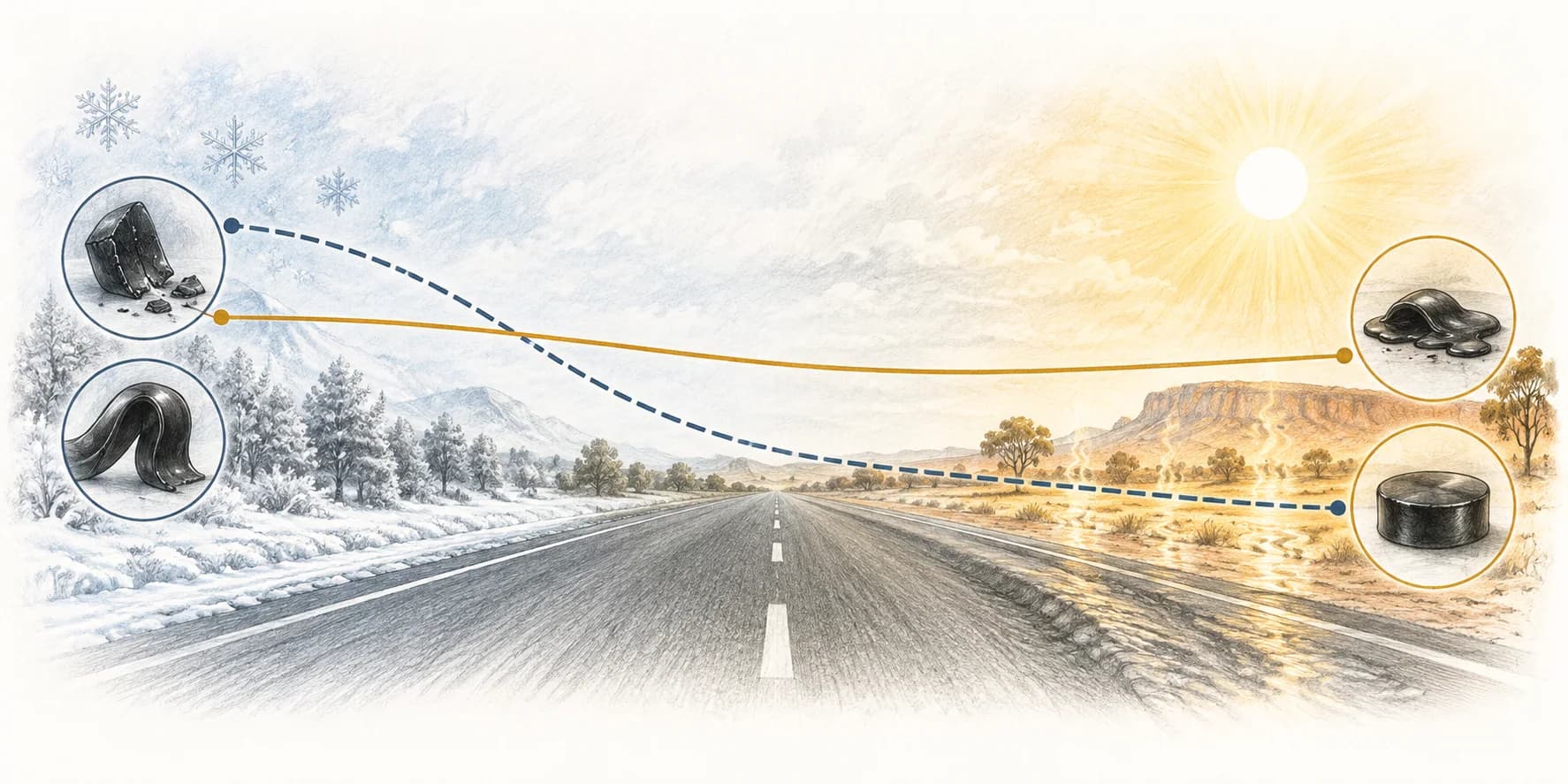
Australian Standard AS 2008 grades paving bitumen by its viscosity at 60°C, measured in pascal-seconds. The two classes that buyers meet most often are Class 170 and Class 320. They come from the same family of refinery bitumen, but they are stiff enough apart that each has settled into its own main job: Class 170 for sprayed sealing, Class 320 for asphalt.
What the class number tells you
The number in the class name is the approximate midpoint of the 60°C viscosity band. Supplier data published against AS 2008 gives Class 170 a band of roughly 140 to 200 Pa·s and Class 320 a band of roughly 260 to 380 Pa·s. In plain terms, Class 320 is close to twice as resistant to flow at a hot pavement temperature as Class 170.
Sixty degrees Celsius was chosen because it represents a hot road surface in summer, which is when rutting and bleeding happen. A stiffer binder at that temperature holds aggregate and resists deformation better, but it can be less forgiving in cold weather and harder to spray.
Why Class 170 is the usual sprayed seal binder
A sprayed seal is a thin film of hot bitumen sprayed onto a prepared pavement, immediately covered with a single layer of stone. The binder must wet and grip the stone quickly and then stay flexible for years under sun and traffic. Class 170 suits this because:
- It is fluid enough at normal spraying temperatures, which suppliers put at about 175 to 185°C, to form an even film across the spray bar.
- Its lower stiffness helps it accommodate pavement movement and resist cracking on lightly trafficked rural roads.
- It is also the common base bitumen for making cutbacks, emulsions and many modified binders, so it is widely stocked.
In cooler regions Class 170 is also used in some asphalt, particularly lower-volume roads and fatigue-resistant layers where flexibility matters more than rut resistance.
Why Class 320 is the usual asphalt binder
Asphalt carries heavier, slower and more concentrated loads at intersections, bus stops and freight routes. Here the main risk is permanent deformation in hot weather. Class 320 gives the mix more stiffness at high temperature, so it is the most common choice for dense-graded asphalt on medium and heavily trafficked roads.
Class 320 can also be sprayed. Data sheets describe its use as a sealing binder for heavy-duty sites and very hot inland regions, where a Class 170 seal might soften and bleed. Spraying it needs good temperature control, and one producer recommends a minimum pavement temperature of around 15°C for sealing with it.
Side-by-side summary
| Point | Class 170 | Class 320 |
|---|---|---|
| Viscosity at 60°C (approx. band) | 140 to 200 Pa·s | 260 to 380 Pa·s |
| Main use | Sprayed sealing, light-traffic asphalt | Dense-graded asphalt |
| Secondary use | Base for cutbacks, emulsions, modified binders | Heavy-duty or hot-climate seals |
| Main strength | Flexibility, good stone wetting | Resistance to rutting at high temperature |
Class 240 sits between the two and is preferred for sealing by some road agencies that want a little more stiffness than Class 170 without moving to Class 320.
Factors that should drive the choice
- The project specification. Road agencies set the class in their contract documents, often by layer and traffic category. This always overrides general guidance.
- Climate. Hotter pavements push towards stiffer classes; cold, wet areas favour the more flexible ones.
- Traffic. Heavy, slow or channelled traffic calls for stiffer binder or a modified product.
- Plant and equipment. Spray rigs, heating capacity and asphalt plant temperatures need to suit the class chosen.
Class 170 is chosen for flexibility and easy spraying; Class 320 is chosen for stiffness in hot, heavily loaded asphalt.
Specifying either class in an enquiry
When asking for AS 2008 bitumen, state the class exactly as written in the project specification, the quantity, and whether you need it in bulk, drums or another pack. Ask for a certificate of analysis showing the 60°C viscosity and the other AS 2008 tests, and say whether third-party inspection is required at loading. Nuroil can quote either class on FOB, CFR or CIF terms through the Australian Standard bitumen page or the quote request form.