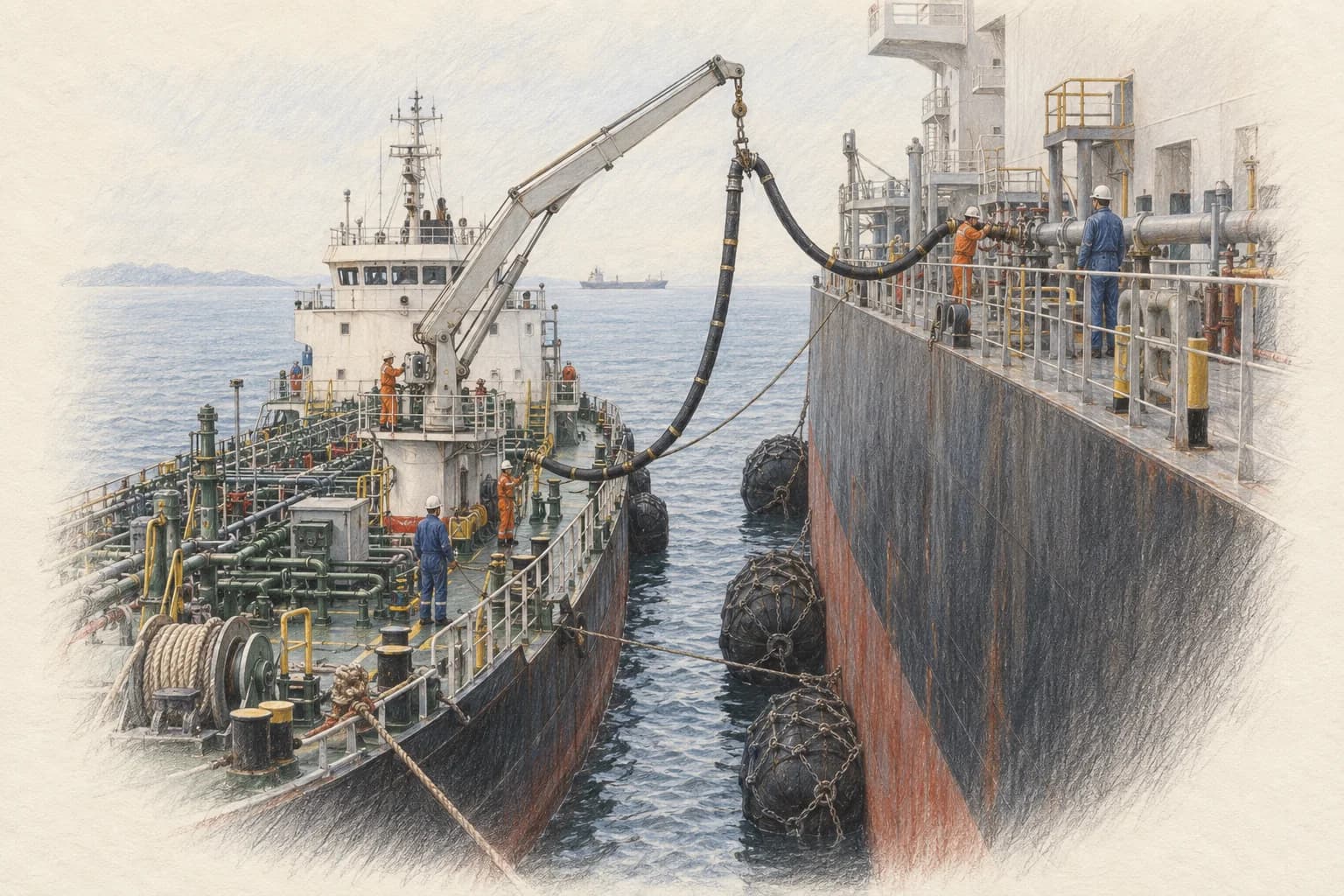
Most of the world's merchant fleet runs on one or more of four fuel types: very low sulphur fuel oil (VLSFO), high sulphur fuel oil (HSFO), marine gasoil (MGO) and marine diesel oil (MDO). They differ in sulphur content, how they are made, how they must be handled on board, and where they may legally be burned. This guide sets them side by side.
Residual and distillate fuels
ISO 8217 divides marine fuels into two families. Distillate fuels (categories beginning DM, plus FAME-containing DF grades in recent editions) are made largely from distilled refinery streams; they are thin, light in colour and need little or no heating. Residual fuels (categories beginning RM) contain heavier residue from refining; they are viscous, dark and must be heated, settled and centrifuged before use.
VLSFO and HSFO are residual fuels. MGO and MDO are distillates.
The four fuels at a glance
| HSFO | VLSFO | MDO | MGO | |
|---|---|---|---|---|
| Family | Residual | Residual (often blended) | Distillate, may contain some residue | Distillate |
| Typical ISO 8217 category | RMG 380, RMK 500 | Usually RMG 380 or lower viscosity RM grades | DMB | DMA, DMZ |
| Sulphur | Above 0.50%, commonly up to 3.5% | 0.50% max | Depends on supply; low sulphur versions available | 0.10% max for ECA use; higher versions exist |
| Where it may be burned | Only with an approved scrubber | Outside ECAs | Depends on sulphur level | Everywhere if 0.10% max |
| Heating on board | Yes, for storage, transfer and injection | Yes, usually less than HSFO | Little or none | None; may need cooling |
| Separator treatment | Essential | Essential | Usually | Filtration and often separation |
| Main issues | Higher acid formation; needs high-BN cylinder oil | Batch variability, stability and compatibility, cold flow on some blends | Can be darker and contain some residue | Low viscosity at hot inlet; cold flow in winter |
HSFO
The traditional heavy fuel of deep-sea shipping. Its high sulphur content means it can be burned only on ships fitted with an approved exhaust gas cleaning system, or carried as cargo. Its handling properties are well understood, but its combustion produces more sulphuric acid in the cylinder, which needs to be neutralised by cylinder oil with a higher base number.
VLSFO
The main compliant residual fuel outside emission control areas since 2020. It is produced from low sulphur residues or by blending residues with lighter low-sulphur components. Viscosity, density, pour point and aromatic content vary widely between suppliers, so each batch should be tested, stored separately and checked for compatibility before mixing.
MGO
A clear distillate used in auxiliary engines, emergency equipment, small vessels and in main engines inside emission control areas. Under ISO 8217, DMA has a minimum flash point of 60°C and viscosity between 2.0 and 6.0 cSt at 40°C. DMZ has a higher minimum viscosity, which helps with the low-viscosity issues some engines face. DMX is a special light grade with a lower flash point for emergency equipment outside machinery spaces.
MDO
A heavier distillate, corresponding to DMB, which may contain a small proportion of residual material and so can look dark. It suits medium- and high-speed engines on coastal ships, workboats and fishing fleets. Its maximum viscosity is higher than DMA, giving more margin against low viscosity at the pumps.
The right fuel depends first on where the ship will burn it and what equipment it has, then on engine requirements, and only then on price.
FAME blends
Recent editions of ISO 8217 include distillate grades that allow fatty acid methyl ester (FAME) content, designated DFA, DFZ and DFB. These blends need attention to storage time, water and microbial growth. Ships should confirm with engine makers before using them.
Specifying a marine fuel enquiry
State the fuel type and ISO 8217 category, the edition of the standard, maximum sulphur, quantity in metric tonnes, port and delivery window. For distillates, add any cold flow limits; for residual fuels, add any limits on stability and on catalytic fines that your engines require. Nuroil supplies bunker and marine fuels on request; see the bunker and marine fuel page or request a quote.