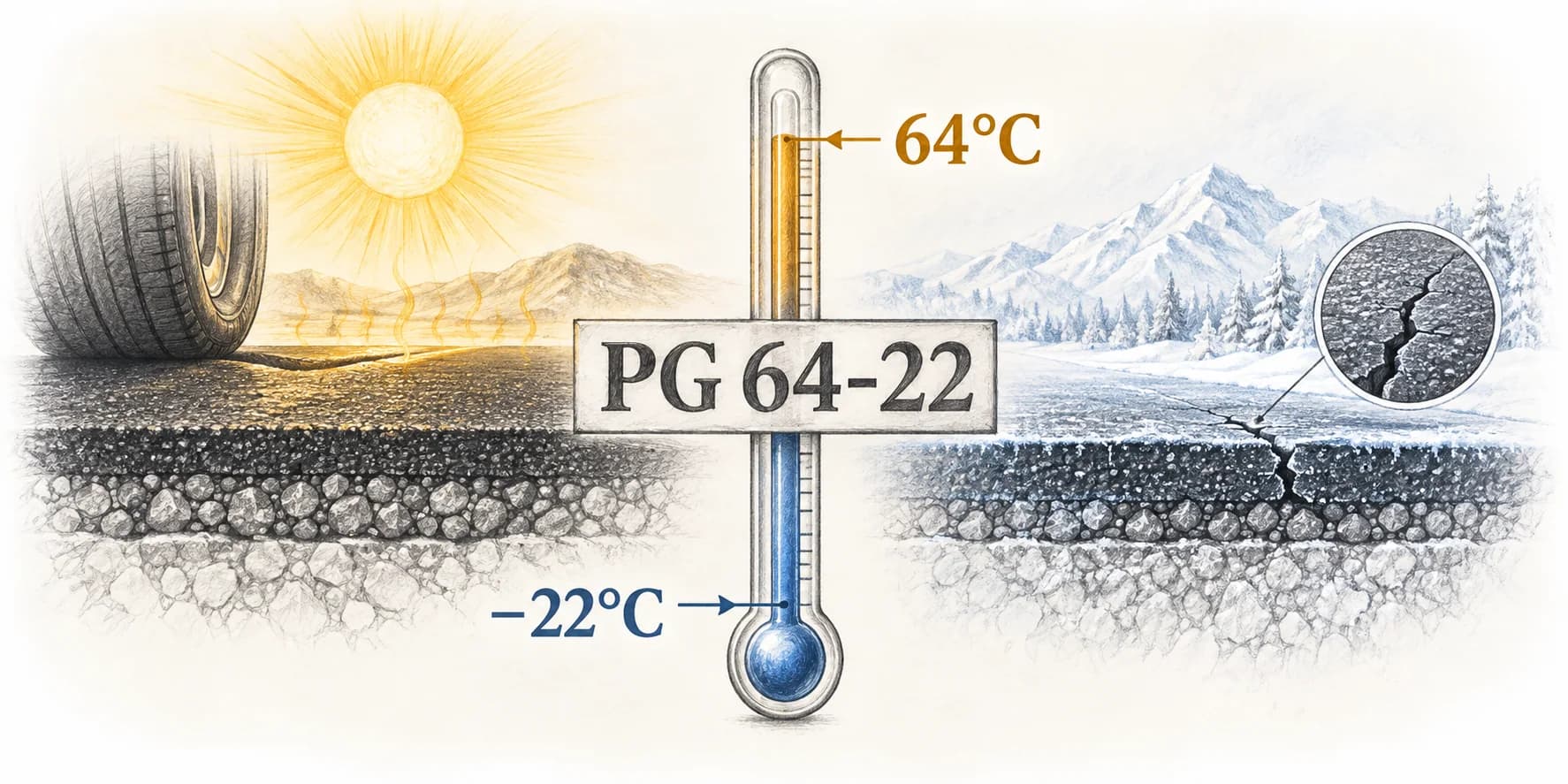
A performance grade such as PG 70-10 is earned by passing a defined sequence of laboratory tests. Knowing what each test does makes it much easier to read a certificate of analysis, compare offers and spot a result that does not fit the claimed grade. This guide follows the sequence used in the AASHTO M 320 specification.
Three states of the binder
The PG system tests bitumen in three conditions, because a binder's properties change during its life:
- Original (unaged) binder, as delivered.
- Short-term aged binder, conditioned in the rolling thin film oven (RTFO). A thin film of binder rotates in glass bottles at 163 °C for 85 minutes under a stream of air, simulating hardening during hot mixing and laying.
- Long-term aged binder, made by taking RTFO residue and ageing it further in the pressure ageing vessel (PAV) at 2.1 MPa air pressure for 20 hours, typically at 100 °C (90 or 110 °C depending on climate). This simulates several years of service.
Tests on the original binder
Flash point confirms the binder can be heated safely; M 320 requires at least 230 °C. Rotational viscosity at 135 °C must not exceed 3 Pa·s, so the binder can be pumped and mixed at normal plant temperatures. The dynamic shear rheometer (DSR) then measures stiffness and elasticity at the high-temperature grade: the rutting parameter G*/sin δ must be at least 1.00 kPa at 10 rad/s.
Tests on RTFO residue
The RTFO mass change must not exceed 1.00 per cent, which limits volatile loss during mixing. The DSR is repeated on the aged residue at the high-temperature grade, and G*/sin δ must now reach at least 2.20 kPa. Under the MSCR specification (AASHTO M 332), this residue is also used for the MSCR test, which reports non-recoverable creep compliance (Jnr) and percent recovery.
Tests on PAV residue
The DSR measures the fatigue parameter G*·sin δ at an intermediate temperature linked to the grade; it must not exceed 5000 kPa. The bending beam rheometer (BBR) then loads a small beam of binder at a cold temperature, 10 °C warmer than the low-temperature grade, and records how stiff it is and how quickly it relaxes after 60 seconds. Creep stiffness must not exceed 300 MPa and the m-value, the rate of relaxation, must be at least 0.300. Where stiffness falls between 300 and 600 MPa, a direct tension test may be used instead.
Summary of requirements
| Binder state | Test | Temperature | Requirement | Protects against |
|---|---|---|---|---|
| Original | Flash point | - | ≥ 230 °C | Unsafe heating |
| Original | Rotational viscosity | 135 °C | ≤ 3 Pa·s | Pumping and mixing problems |
| Original | DSR, G*/sin δ | High grade | ≥ 1.00 kPa | Early rutting |
| RTFO | Mass change | 163 °C | ≤ 1.00 % | Excess volatiles |
| RTFO | DSR, G*/sin δ | High grade | ≥ 2.20 kPa | Rutting |
| PAV | DSR, G*·sin δ | Intermediate | ≤ 5000 kPa | Fatigue cracking |
| PAV | BBR stiffness and m-value | Low grade + 10 °C | S ≤ 300 MPa, m ≥ 0.300 | Low-temperature cracking |
Reading a certificate
- Check that DSR results are reported at the temperature matching the claimed high grade, not a lower one.
- Look at the margin: a G*/sin δ only just above the limit leaves little room for variation between batches.
- For hot-climate grades with a −10 °C low grade, BBR tests are run at 0 °C.
- If the specification is M 332, expect Jnr and percent recovery at 3.2 kPa as well as the M 320 results.
- A continuous grade (for example 77.4-13.1) shows exactly where the binder passes and helps compare suppliers.
The same limits apply to every grade; only the test temperatures move with the climate.
Documents to request
Ask for a CoA listing each of these results with the test temperatures, the standard used (M 320 or M 332), and whether the binder is modified. Full PG verification takes several days of laboratory time, so agree in advance whether you need complete grading on each lot or a reduced set of control tests plus periodic full grading. Nuroil provides a CoA with every delivery and third-party inspection on request; contact us to discuss testing requirements.