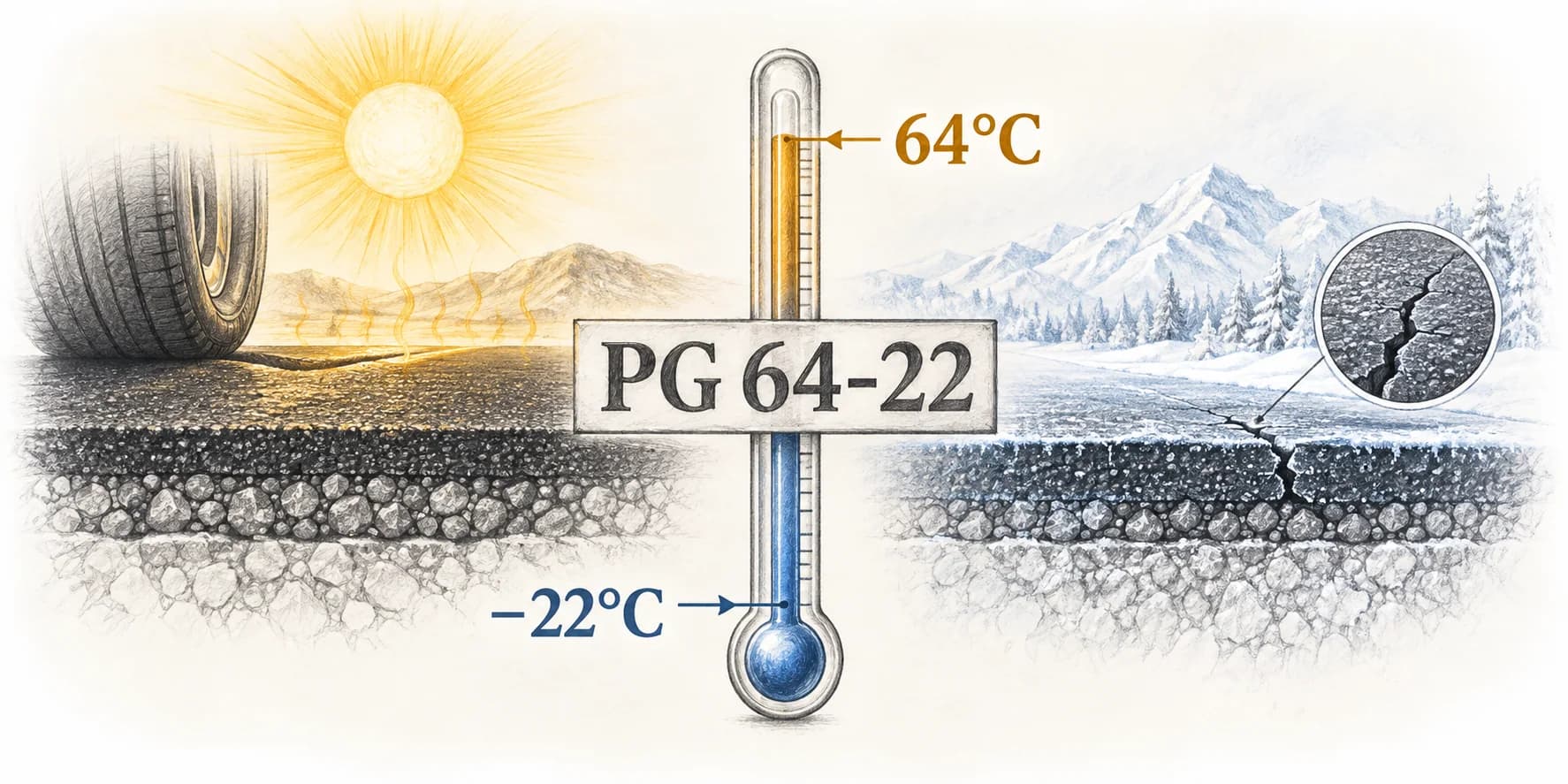
A performance grade is chosen first from climate. But two roads with the same climate can need different binders: a free-flowing motorway lane and a container terminal gate do not load the asphalt in the same way. Performance-grade systems deal with this in one of two ways, grade bumping or MSCR traffic designations. Buyers meet both in tender documents, so it helps to understand how they relate.
Why traffic speed and volume matter
Bitumen is viscoelastic: its stiffness depends on both temperature and loading time. A fast-moving wheel loads a point on the road for a fraction of a second; a slow or stationary truck loads it for much longer. Longer loading has a similar effect to higher temperature, so slow traffic causes more rutting. Very high traffic volumes add the cumulative effect of millions of load repetitions.
Grade bumping
The original Superpave approach compensated by raising the high-temperature grade. For slow or heavy traffic, the designer moves the high-temperature grade up by one or two 6 °C steps, so a site whose climate calls for PG 64-22 might receive PG 70-22 or PG 76-22. The rules for when to bump are given in the mix design standard for roads, and airfield specifications have their own provisions.
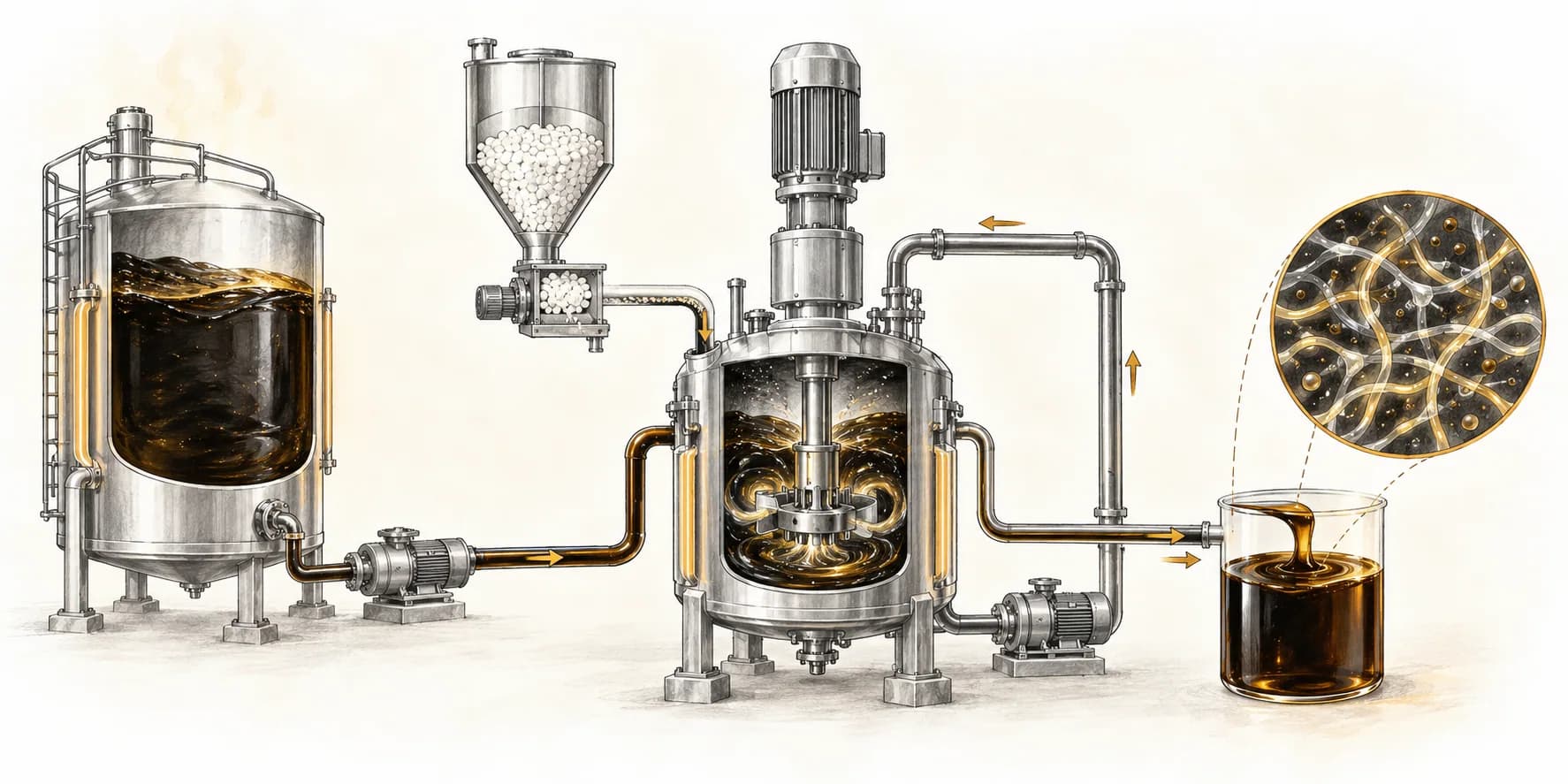
Grade bumping is simple, but it has drawbacks. It specifies a binder for a temperature the pavement never reaches, and the conventional rutting parameter from the dynamic shear rheometer did not always capture the benefit of elastomeric polymers. Some modified binders that performed well in the field looked no better than unmodified ones on that test.
The MSCR test
The multiple stress creep recovery (MSCR) test was introduced to address those weaknesses. A sample of short-term aged binder is tested in the dynamic shear rheometer at the climate's high pavement temperature. It is loaded for one second and allowed to recover for nine seconds, first ten times at a low stress of 0.1 kPa and then ten times at 3.2 kPa. Two results come out:
- Non-recoverable creep compliance (Jnr), the deformation left after each cycle relative to the stress applied. A lower Jnr means better rutting resistance.
- Percent recovery, how much of the deformation springs back, which reflects elastic polymer modification.
Traffic letters instead of bumping
Under the MSCR specification the high-temperature grade stays at the climate value, and a letter shows the traffic level. Each letter has a maximum Jnr at 3.2 kPa:
| Letter | Traffic level | Maximum Jnr at 3.2 kPa (kPa⁻¹) | Example grade |
|---|---|---|---|
| S | Standard | 4.5 | PG 64S-22 |
| H | Heavy | 2.0 | PG 64H-22 |
| V | Very heavy | 1.0 | PG 64V-22 |
| E | Extremely heavy | 0.5 | PG 64E-22 |
The traffic thresholds that decide which letter applies, usually expressed in equivalent single axle loads and sometimes adjusted for slow traffic, differ between road authorities, so always use the project's own criteria.
Where percent recovery comes in
Many agencies add a minimum MSCR percent recovery to V and E grades, or to any grade where they want to be sure the binder is genuinely polymer modified. Others keep an elastic recovery requirement. A binder can reach a low Jnr simply by being very hard, but a recovery requirement checks that the stiffness comes with elasticity.
Grade bumping raises the test temperature; MSCR keeps the real temperature and tightens the rutting limit.
What this means for buyers
Check whether your specification uses bumped grades (for example PG 76-22 under AASHTO M 320) or MSCR grades (for example PG 64V-22 under AASHTO M 332), because the same binder may be described differently under each. In an enquiry, give the full designation and standard, plus any percent recovery limit, and ask for MSCR Jnr and recovery results on the CoA. Nuroil can quote performance grades to either system; details are on the performance grade bitumen page.