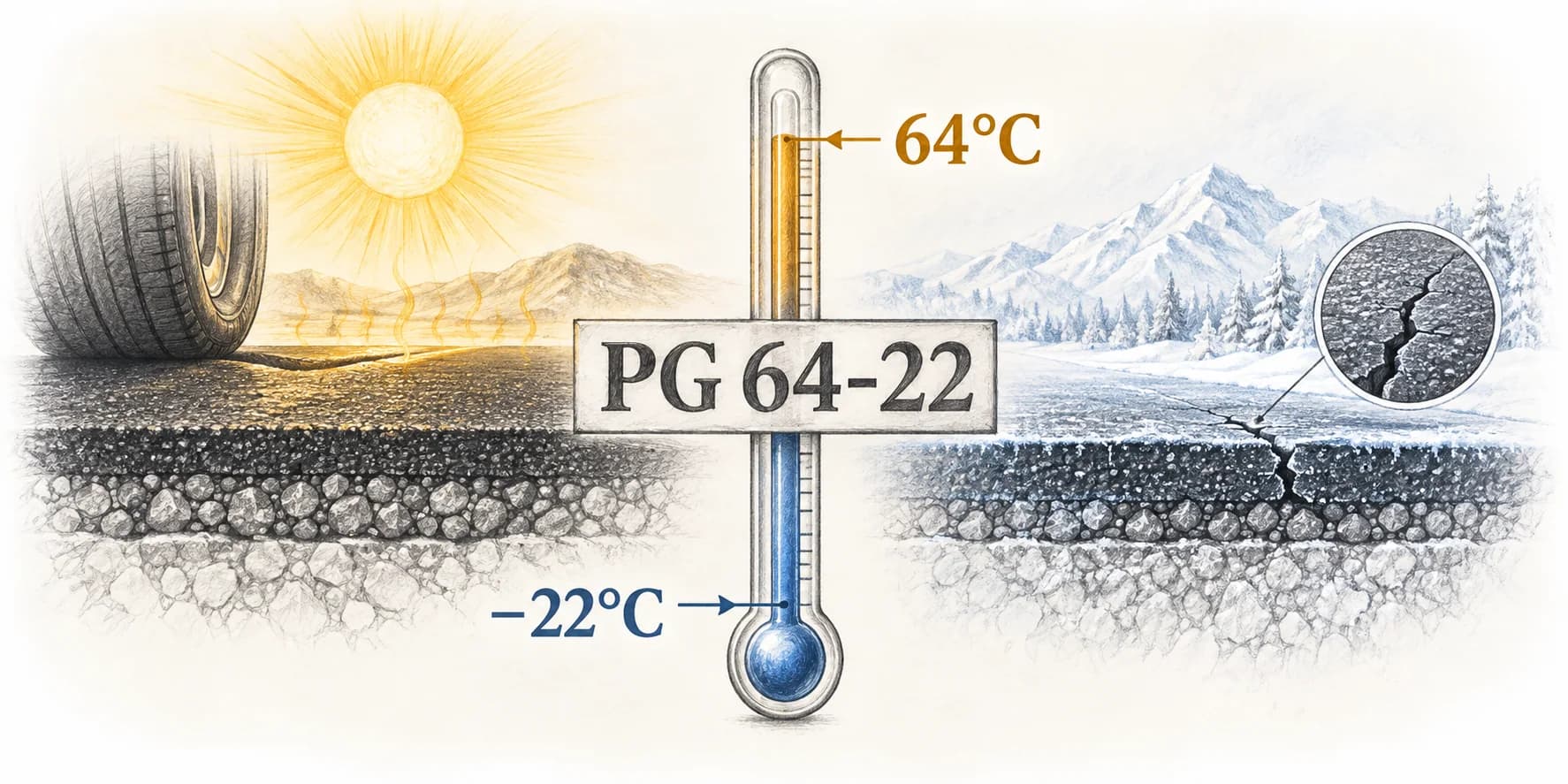
Paving bitumen is traded under three main grading systems: penetration grades such as 60/70, viscosity grades such as VG-30 or AC-20, and performance grades such as PG 64-22. Buyers who work across markets often receive tenders in one system and offers in another. This guide explains what each system measures and why direct conversion is not reliable.
What each system measures
Penetration grading
Viscosity grading
Performance grading
Side-by-side
| Feature | Penetration grade | Viscosity grade | Performance grade |
|---|---|---|---|
| Example | 60/70, 40/50 | VG-30, AC-20 | PG 64-22, PG 76-10 |
| Main measurement | Needle penetration at 25 °C | Viscosity at 60 °C | DSR and BBR at design temperatures |
| Ageing considered | Short-term only, as a secondary check | Short-term, often | Short- and long-term |
| Low-temperature cracking | Not directly | Not directly | Yes, via BBR |
| Suits modified binders | Limited | Limited | Yes, especially with MSCR |
| Grade linked to climate | Indirectly, by experience | Indirectly | Directly |
Why there is no exact conversion
A PG grade depends on how stiffness changes with temperature and with ageing, which varies with the crude oil and refining route. Two 60/70 binders from different refineries can grade differently, one perhaps PG 64-22 and another PG 64-16 or PG 70-16, because their low-temperature behaviour or ageing resistance differs. Published comparison tables are useful starting points, but any approximate match must be confirmed by testing the actual binder to AASHTO R 29, the practice for grading or verifying a PG binder.
Broadly, harder penetration grades and higher viscosity grades tend to give higher high-temperature PG grades, while the low-temperature grade is the least predictable. Hot-climate grades such as PG 70-10 and PG 76-10 correspond roughly to hard paving bitumens, or to polymer-modified binders where elastic recovery is also required.
The ageing step adds a further source of difference. Penetration and viscosity specifications usually check the binder only after short-term oven ageing, whereas a PG grade also depends on long-term ageing in the pressure ageing vessel. A binder that hardens quickly with age may meet its penetration grade comfortably yet fail the fatigue or low-temperature requirement of the PG grade it was expected to match.
Handling mixed specifications
- Tender in PG, supply source in penetration grade: ask the producer for full PG test results on the actual product before committing.
- Tender in penetration grade, supplier offers PG: request penetration, softening point and other required tests in addition, as the PG certificate will not show them.
- Modified binders: PMB specified under EN 14023 and binders specified by PG with MSCR use different tests; agree in writing which governs.
- Acceptance testing: check that the receiving laboratory can run DSR and BBR tests if the specification is PG.
Penetration and viscosity grades describe a binder at one or two temperatures; a performance grade describes it across the climate it will face.
Buying across grading systems
State the governing specification clearly in your enquiry, and avoid asking suppliers to "convert" grades. If you are moving from penetration or viscosity grades to performance grades, ask for both sets of results for the first deliveries so your team can build experience. Nuroil supplies penetration, viscosity and performance grade bitumen; see the bitumen range or request a quote.