"Polymer modified bitumen" covers several quite different products. The modifier that goes into the base bitumen decides how the binder behaves under load, how it ages and how it must be stored. Buyers who only ask for "PMB" can end up comparing offers that are not like for like. This article looks at the three modifier families most often met in paving: SBS, EVA and crumb rubber.
Two ways a modifier can stiffen bitumen
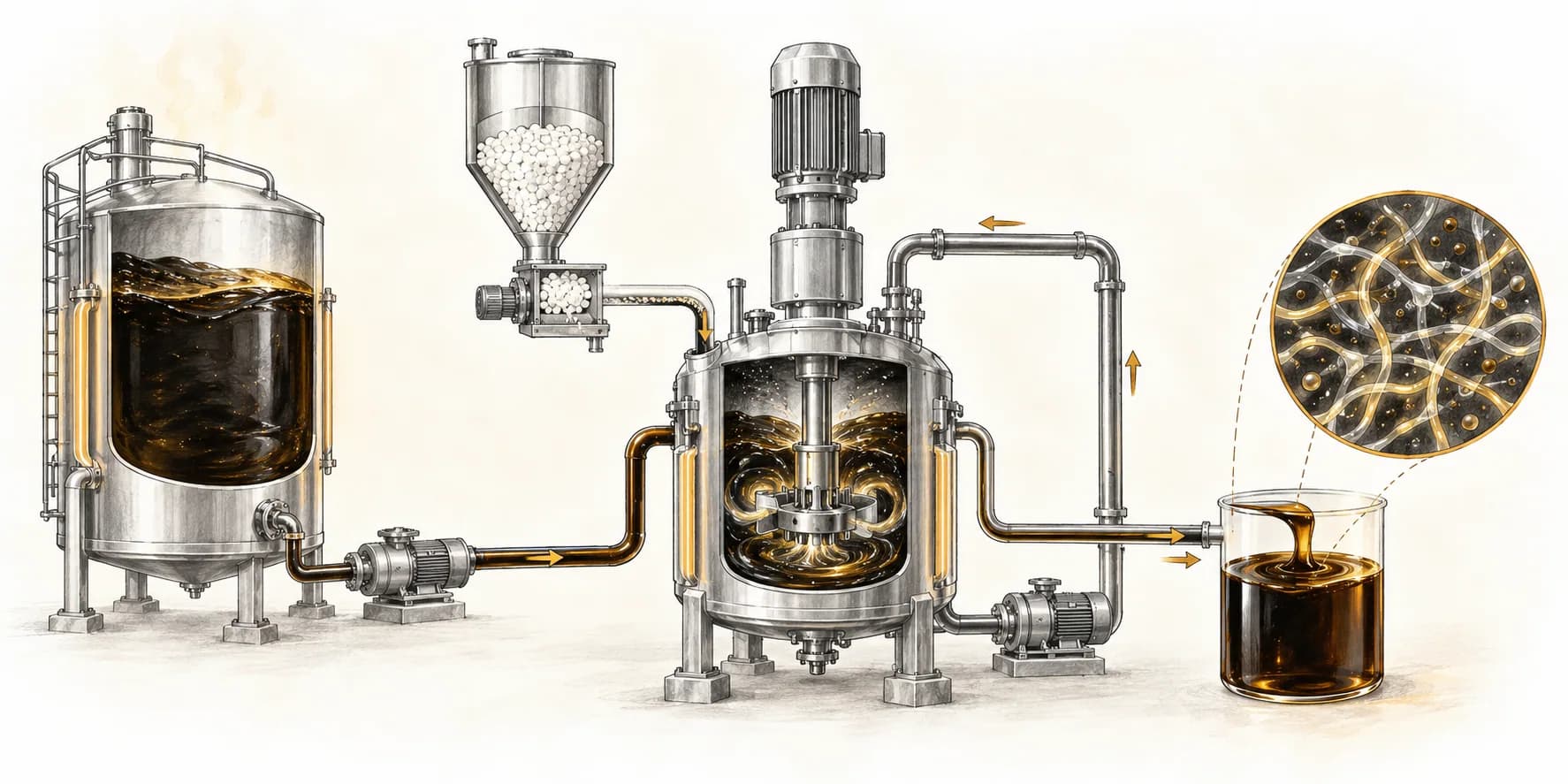
Modifiers fall into two broad groups. Elastomers, of which styrene-butadiene-styrene (SBS) is by far the most common, form a rubbery network inside the bitumen. Under load the network stretches and then pulls back, so the binder recovers much of its deformation. Plastomers, mainly ethylene vinyl acetate (EVA) and polyethylene, work differently. They form a stiffer, partly crystalline structure that resists deformation by being rigid rather than by springing back.
That difference sounds academic, but it shows up directly in the tests used to specify the binder. An SBS binder typically scores well on elastic recovery and on the percent recovery measured in the multiple stress creep recovery (MSCR) test. An EVA binder can be just as stiff at high temperature, yet show recovery values not much different from unmodified bitumen.
SBS: the general-purpose elastomer
SBS is the default choice where a road must resist both rutting in summer and cracking under repeated loads or in cold nights. Laboratory comparisons generally find that SBS mixtures handle fatigue and low-temperature cracking better than plastomer mixtures, and that the advantage persists after ageing.
The trade-offs are practical. SBS is lighter than bitumen and can migrate upwards in a hot tank if the blend is not compatible or not stabilised. The polymer backbone also degrades if the binder is held too hot for too long, so storage temperature and holding time matter more than with straight-run grades. Research on aged SBS binders shows that how finely the polymer is dispersed affects how well the binder keeps its properties.
EVA and other plastomers: stiffness for rutting
EVA raises the stiffness of the binder and, at the mixture level, often gives strong resistance to permanent deformation. That makes it attractive for slow, heavy, channelled traffic in hot climates, such as container yards, bus stops and junction approaches, where rutting is the dominant failure.
The weakness is flexibility. In some binders the stiffening extends into intermediate and low temperatures, which can reduce cracking resistance. On the positive side, studies have found that the internal structure of EVA-modified bitumen changes little with ageing, irrespective of polymer content.
Crumb rubber: recycled tyre rubber as a modifier
Crumb rubber from ground scrap tyres can be added to bitumen in the "wet" process, where it is blended into hot bitumen and allowed to swell before mixing, or in the "dry" process, where it replaces a small part of the fine aggregate. Only the wet process truly modifies the binder. Done well, it can improve fatigue and thermal cracking resistance. Wet-process asphalt rubber uses high rubber contents and is very viscous, so it needs suitable plant and handling. Crumb rubber binders are covered in more detail in a separate guide on this site.
Side-by-side comparison
| Property | SBS (elastomer) | EVA (plastomer) | Crumb rubber (wet process) |
|---|---|---|---|
| Main mechanism | Elastic network that recovers | Rigid, partly crystalline network | Swollen rubber particles in bitumen |
| Rutting resistance | Good | Good to very good | Good |
| Fatigue and low-temperature cracking | Good | Can be reduced | Good when properly designed |
| Elastic recovery | High | Low to moderate | Moderate (resilience) |
| Storage sensitivity | Phase separation and degradation if overheated | Phase separation possible | Particles settle; often blended near use |
Choose the modifier from the failure you are trying to prevent: recovery and cracking resistance point to SBS, pure stiffness against rutting can point to a plastomer.
What to put in an enquiry
Name the specification and class the binder must meet rather than only the polymer, for example an EN 14023 designation or a performance grade with MSCR and elastic recovery limits. If the modifier type matters to your design, state it. Ask for a certificate of analysis showing elastic recovery, softening point and storage stability results, plus recommended storage, pumping and mixing temperatures from the producer. Nuroil can source SBS-modified grades against a stated specification; share your requirements through the quote request form.