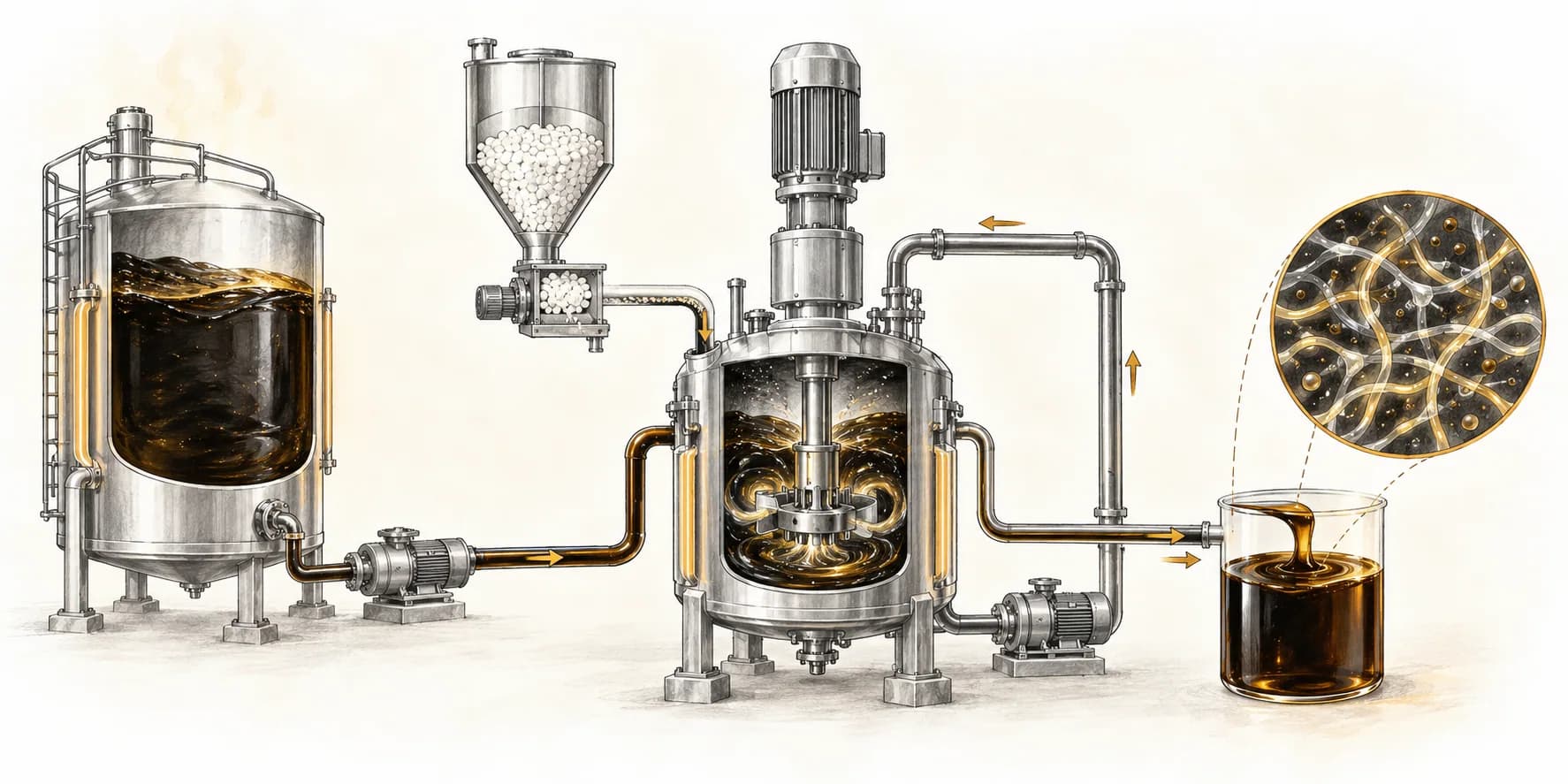
Two binders can share the same penetration and softening point and still behave very differently on the road. One may be a well-dispersed SBS modified bitumen; the other may be a harder base bitumen with little or no polymer. The elastic recovery test is the simplest laboratory check that separates them, which is why it appears in almost every polymer modified bitumen (PMB) specification.
How the test works
The test uses the same ductility bath and dumbbell-shaped moulds as the classic ductility test. A sample of binder is conditioned at a fixed temperature, usually 25 °C, and stretched at a controlled rate to a set elongation. The thread is then cut in the middle. After a specified rest period the two halves have pulled back towards their ends, and the gap between them is measured. Elastic recovery is the recovered length expressed as a percentage of the elongation.
In Europe the method is EN 13398, which is referenced by EN 14023 for PMB. In North America ASTM D6084 and AASHTO T 301 describe similar procedures, and agencies often add an elastic recovery limit alongside a performance grade. The details of elongation, rest time and temperature differ between methods, so a result is only meaningful when the method is quoted with it.
Reading the result
Unmodified paving bitumen recovers very little, because it flows rather than springs back. A binder with a continuous elastomer network recovers much more. Many PMB grades are specified with a minimum of 50 per cent at 25 °C, and higher-performance grades call for 70 or 80 per cent or more. Under EN 14023 these limits are expressed as classes, and on product declarations a recovery of more than 80 per cent sits in a lower-numbered, more demanding class than one of 50 per cent.
- High recovery with the expected softening point usually indicates a well-dispersed elastomer at an adequate dose.
- High softening point but low recovery suggests stiffening from a plastomer, a harder base bitumen or oxidation rather than an elastic network.
- Recovery falling after storage points to polymer degradation from overheating or long holding times.
Elastic recovery and MSCR percent recovery
The multiple stress creep recovery (MSCR) test, run in a dynamic shear rheometer on short-term aged binder, also reports a percent recovery. Many road agencies now use MSCR recovery as their main check for elastomer modification and keep elastic recovery as a supplementary or alternative requirement. The two do not convert directly into one another, but they usually rank binders in the same order. EVA-modified binders illustrate the difference well: research has found that their MSCR recovery behaves much like unmodified bitumen, even when they are stiff.
Limits of the test
Elastic recovery is a screening test. It confirms that an elastic network is present but does not tell you how the binder will resist rutting at 60 °C, how it will crack in cold weather or how it will age. Results also vary between laboratories if conditioning and cutting are not done carefully. For this reason it is always read alongside softening point, penetration, storage stability and short-term ageing results, or alongside a full performance grade.
Elastic recovery proves the polymer is working; it does not on its own prove the binder suits your road.
Using elastic recovery in purchasing
When buying PMB, state the elastic recovery method, temperature and minimum value in your enquiry, and ask whether the result on the certificate of analysis was measured on the delivered batch. For bulk or long-haul deliveries, ask for elastic recovery to be reported both on the original binder and, where your specification requires it, on the residue after RTFOT ageing. Nuroil supplies a CoA with every delivery and can arrange third-party inspection on request; use the contact page to discuss the grade you need.