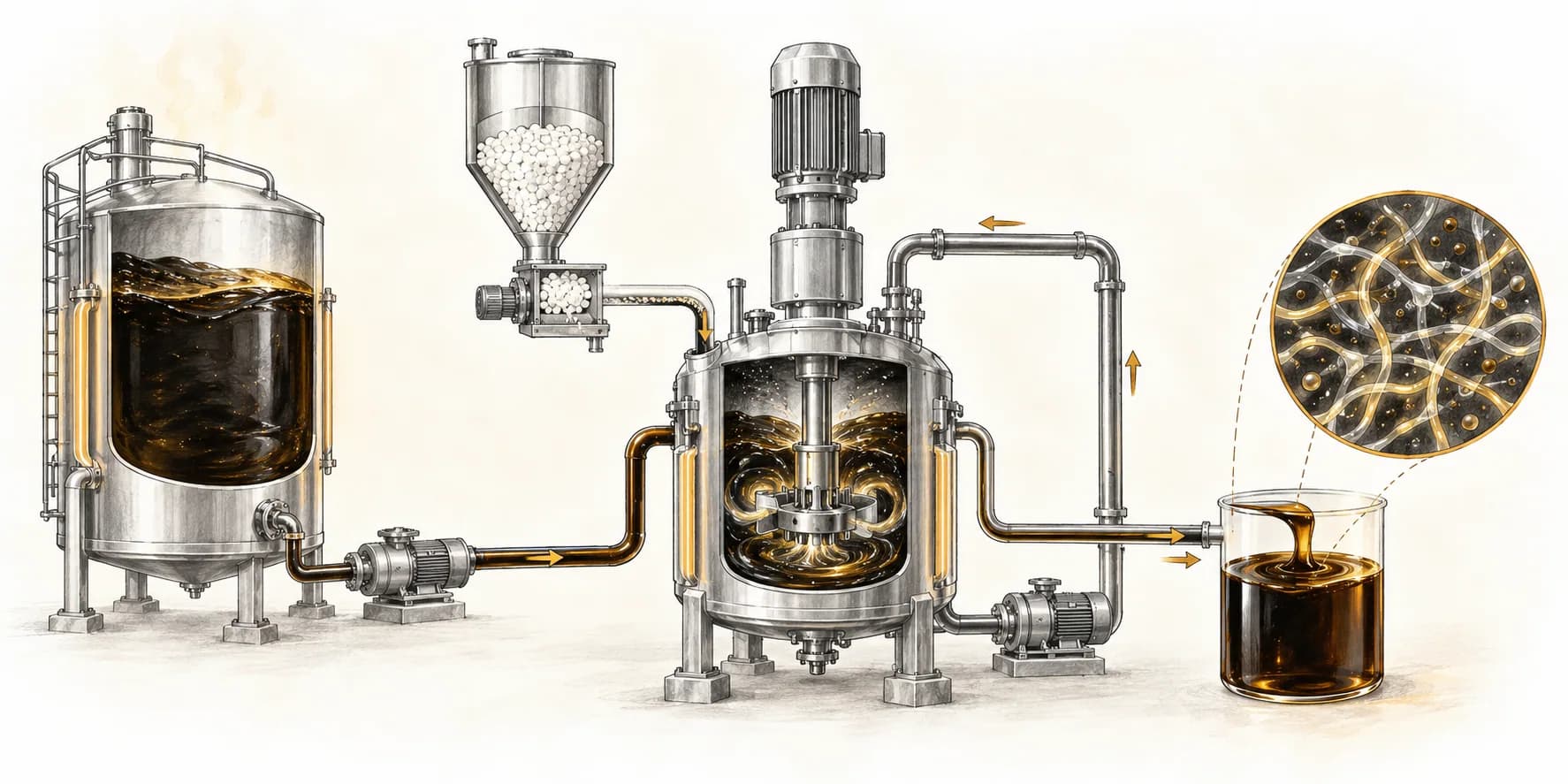
Polymer modified bitumen (PMB) is less forgiving in storage than conventional paving grades. The polymer can separate from the bitumen if the blend is left still for long periods, and it can degrade if held too hot for too long. Both problems reduce the very properties the buyer paid for. This guide covers the storage stability test, temperature limits and practical terminal and plant practice.
Why PMB separates
SBS and similar polymers are less dense than bitumen. If the polymer is not fully compatible with the base bitumen, or the blend has not been stabilised, a polymer-rich phase can rise in a hot, unstirred tank while a polymer-poor phase collects lower down. Binder drawn from the top then has a higher softening point than binder drawn from the bottom, and mixes made from different parts of the tank perform differently. Research has found that PMB with polymer contents up to around 6 per cent can show this tendency in hot storage.
The storage stability test
EN 13399 measures this tendency. A sample is sealed in a vertical tube and held at high temperature for a set period without stirring. The tube is then cooled, cut into top and bottom sections, and the softening point and penetration of each section are measured. The difference between top and bottom is reported; a small difference means a stable blend. EN 14023 sets classes for the maximum allowable difference, and specifications in many countries use a softening point difference of a few degrees as the limit. Similar tests, sometimes called separation or cigar tube tests, appear in other national specifications.
Temperature limits and polymer degradation
Industry guidance for paving bitumen, including PMB, puts the upper handling limit at around 200 °C, and recommends keeping product at least 30 °C below its flash point, or below national limits if those are lower. Within that ceiling, lower is better for PMB. A study of SBS-modified bitumen held in sealed containers found that properties stayed intact for 21 days at 150 °C, but eroded significantly within the first three days at 180 °C or above. Producers' data sheets give the safe storage, pumping and mixing ranges for each grade and should always take priority.
| Situation | Good practice |
|---|---|
| Short-term holding (days) | Keep at the lower end of the producer's pumping range, with circulation or agitation |
| Longer storage | Reduce temperature where possible; reheat slowly and stir before use |
| Pumping and transfer | Use the producer's pumping range; PMB is more viscous than neat bitumen at the same temperature |
| Mixing at plant | Follow the producer's mixing range; avoid local overheating at heating coils |
| Changing grades in a tank | Drain and avoid mixing different PMB types or PMB with neat bitumen unless approved |
Terminal and plant practice
- Agitation. Tanks for PMB should have mechanical agitators or circulation lines so the binder is kept uniform, especially if the grade's storage stability is marginal.
- Even heating. Hot spots near heating elements degrade polymer. Thermal oil coils with controlled temperature are preferred to direct flame heating.
- Dedicated tanks and lines. Contamination with other grades changes softening point and recovery results.
- Sampling. Take samples from a circulating line or from more than one tank level, so the result represents the whole tank.
- Returning tanks to service. Follow industry guidance for empty or restarted tanks, as residual water can flash to steam and cause boil-over when hot product is first loaded.
Delivery forms
PMB is shipped in heated bulk tankers or ISO tank containers, and some grades in steel drums. Drummed PMB needs careful, even reheating, and long reheating times increase the risk of degradation. For long sea voyages, ask the supplier whether the grade is stable for the expected transit and storage period.
Store PMB as cool as the producer allows, keep it moving and test it where it leaves the tank.
What to ask the supplier
Request the storage stability result on the CoA, the producer's storage, pumping and mixing temperatures, maximum recommended holding time, and the SDS. For bulk orders, agree on where samples will be taken and whether third-party inspection is required. Nuroil provides a CoA with every delivery and MSDS and inspection on request; request a quote with your grade and delivery form.