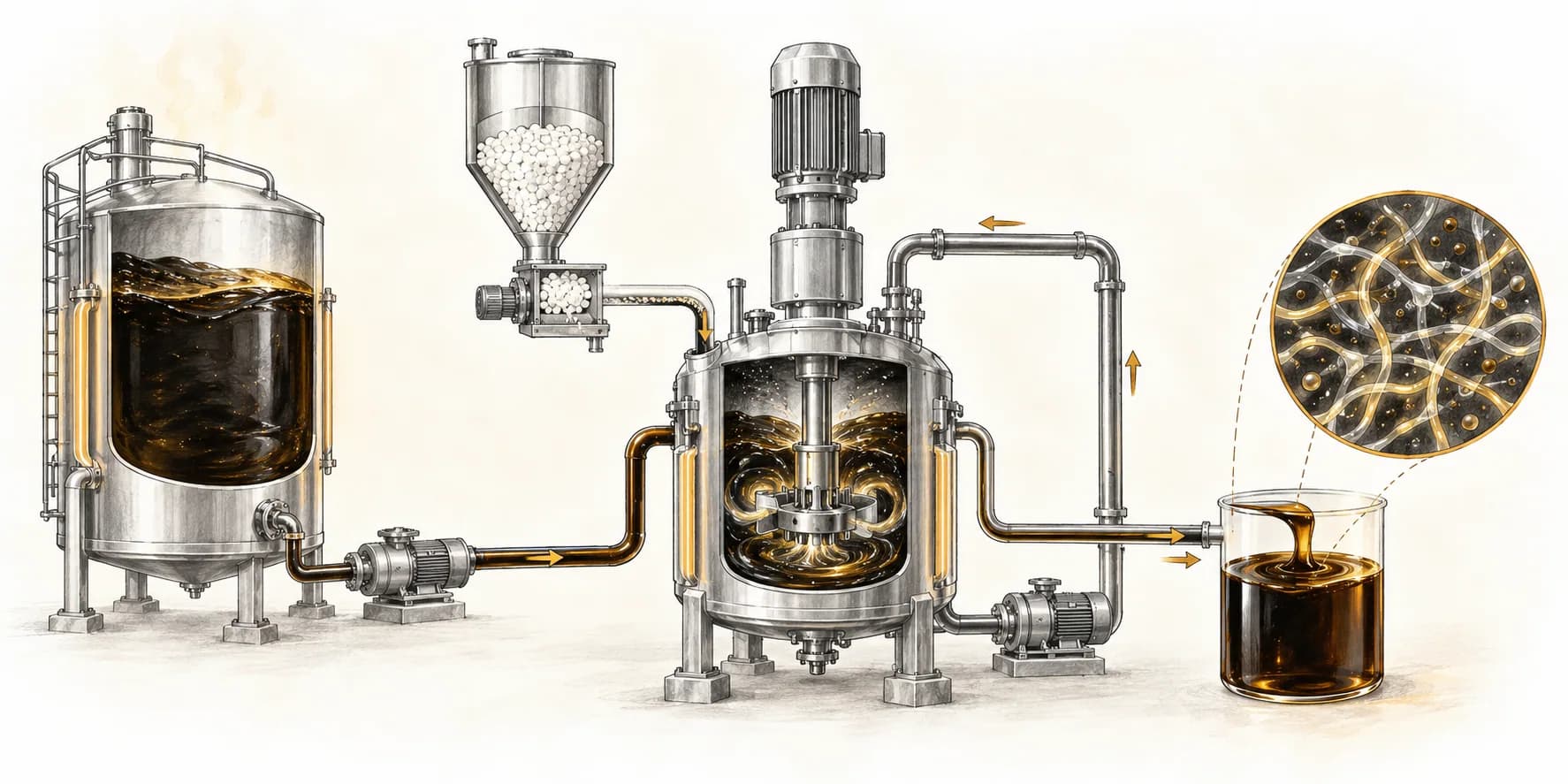
Crumb rubber modified bitumen uses rubber ground from scrap tyres to modify the binder or the asphalt mix. It sits alongside SBS and EVA as one of the main modification routes, with the added benefit of reusing a waste stream. The term covers several quite different products, so this guide sets out the main types and what a buyer should specify.
Wet process: asphalt rubber binder
In the wet process, crumb rubber is blended into hot bitumen before the binder meets the aggregate. Over a reaction period the rubber particles absorb light oily fractions from the bitumen, swell and soften, producing a thick, elastic binder. US federal highway guidance describes typical rubber contents of about 18 to 25 per cent of the binder, with blending temperatures roughly in the range 166 to 204 °C. The ASTM specification for asphalt-rubber binder notes that at least 15 per cent rubber by mass of the blend is usually needed for acceptable properties.
The result depends on blending temperature, reaction time, mixing energy, rubber particle size and the aromatic content of the base bitumen. Wet-process binders raise the softening point substantially and, when properly designed, improve fatigue and thermal cracking resistance. They are used in gap-graded and open-graded hot mixes, in chip seals and in stress-absorbing interlayers.
Terminal blends and field blends
High-rubber wet-process binders are very viscous and the rubber particles tend to settle, so they are usually produced close to the asphalt plant in mobile blending units and used within a limited time. Terminal-blended products use finer rubber and lower rubber contents, sometimes combined with polymer, and are processed so that they can be stored and transported more like a conventional PMB. Terminal blends are easier to handle but generally less heavily modified than field-blended asphalt rubber.
Dry process: rubber as part of the aggregate
In the dry process, granulated rubber replaces a small share of the fine aggregate, typically about 1 to 3 per cent of the total aggregate mass, and is mixed with the aggregate before the bitumen is added. Mixing times are short and the rubber reacts little with the binder, so the bitumen itself is not truly modified. Field results with dry-process mixes have varied widely, and research has linked them with better rutting resistance but possible weaknesses in cracking. The dry process also cannot be used in chip seals or cold mixes.
Comparison of the main types
| Feature | Wet process (field blend) | Terminal blend | Dry process |
|---|---|---|---|
| Where rubber goes | Into the binder | Into the binder | Into the aggregate |
| Rubber content | High (around 15 to 25 per cent of binder) | Lower, finer rubber | About 1 to 3 per cent of aggregate |
| Storage and transport | Limited; agitation needed, used soon after blending | Storable like PMB | Normal bitumen supply |
| Binder modification | Strong | Moderate | Little |
| Typical uses | Gap-graded and open-graded mixes, chip seals, interlayers | Dense and open mixes, seals | Some hot mixes only |
Specifications and tests
Field-blended asphalt rubber is typically controlled by rotational viscosity at high temperature, penetration, softening point, resilience and flash point. Terminal blends are more often specified like other modified binders, using softening point, elastic recovery, storage stability or performance grade tests. Because rubber particles can interfere with some rheometer geometries, agencies may adapt test methods for rubber binders. Always confirm which specification and test methods apply.
Handling notes
- Keep wet-process binders agitated in heated tanks so rubber stays in suspension.
- Follow the producer's temperature range; excessive heat or time can degrade the rubber and change viscosity.
- Expect higher mixing and compaction temperatures than for conventional grades, and plan plant pumps and lines accordingly.
- Refer to the product SDS for fume control and personal protective equipment, as for any hot bitumen.
Crumb rubber only modifies the binder in the wet process; the dry process is a mix modification.
Buying crumb rubber modified binders
State whether you need a storable terminal blend or will blend on site, the target specification, rubber content or particle size limits if specified, and the required tests on the CoA. Ask about shelf life, storage temperature and agitation needs before arranging shipment. To discuss modified binders for your project, contact Nuroil.