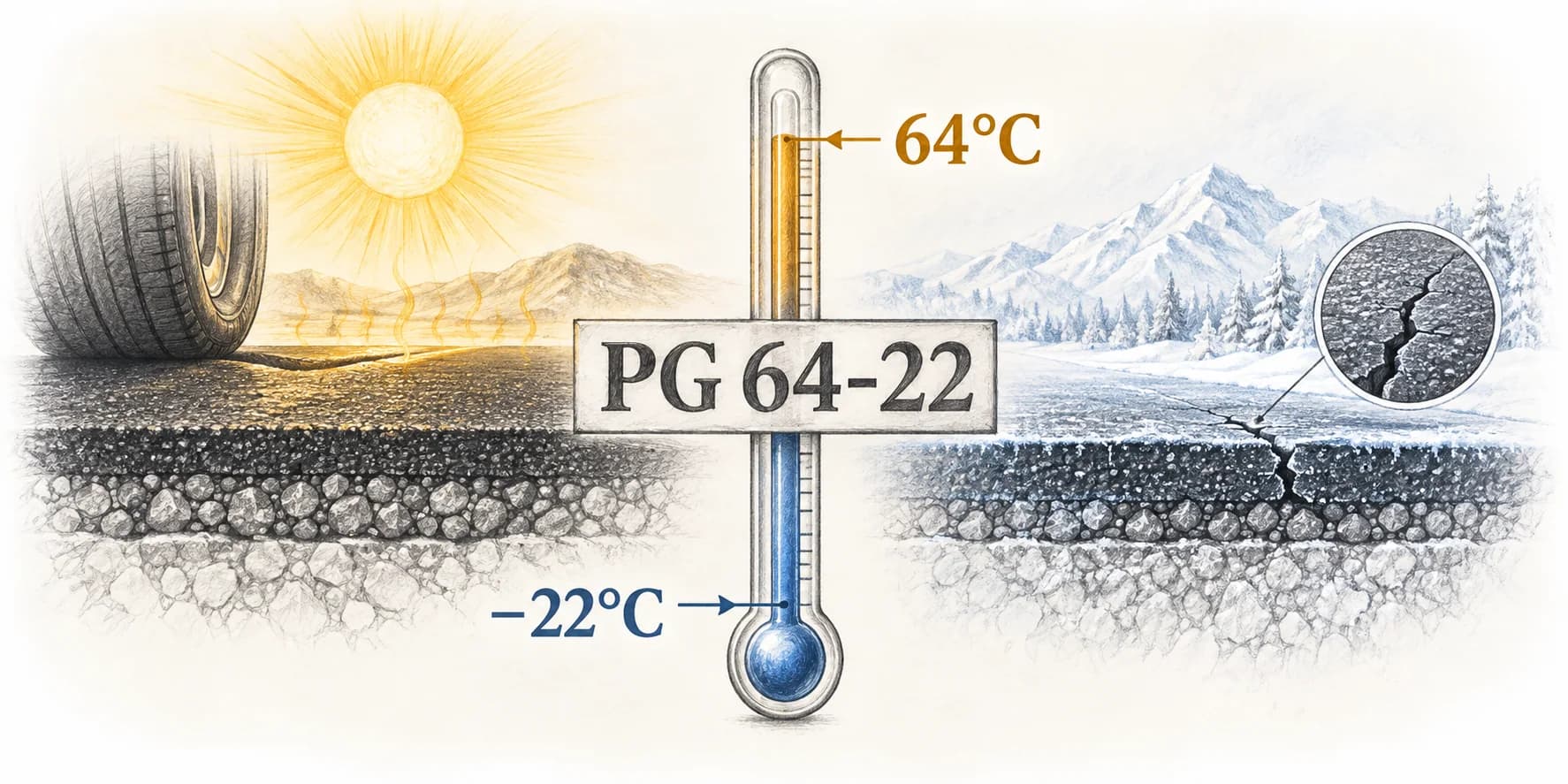
Performance grade (PG) bitumen is named after the climate it is designed for. A grade such as PG 64-22 or PG 76-10 is not a measured property like penetration; it is a statement that the binder passed a set of tests at specific pavement temperatures. Once you know how to read the two numbers, PG designations become one of the most informative ways to describe a paving binder.
The two numbers
The first number is the high-temperature grade. It is the average seven-day maximum pavement design temperature, in °C, at which the binder still meets the requirements for rutting resistance. The second number is the low-temperature grade: the minimum pavement design temperature at which the binder still meets the requirements for cracking resistance.
So a PG 64-22 binder is suitable where the hottest seven-day period averages up to 64 °C at the pavement and the coldest pavement temperature does not fall below −22 °C. A PG 76-10 binder can handle pavement temperatures up to 76 °C but is only graded down to −10 °C, which suits hot climates with mild winters. Note that these are pavement temperatures, which in summer sun are considerably higher than air temperatures.
Six-degree steps
Both numbers move in 6 °C steps. High-temperature grades run PG 46, 52, 58, 64, 70, 76 and 82; low-temperature grades run −10, −16, −22, −28 and so on. A PG 64 binder covers design temperatures from 64 °C up to, but not including, 70 °C. Because of these steps, a binder that actually passes at 68 °C is still graded PG 64. Some laboratories report the "continuous grade", the exact temperature at which the binder passes, which helps when comparing similar products.
The criteria stay the same, the temperature changes
An important feature of the PG system is that the pass/fail limits are the same for every grade. What changes is the temperature at which the tests are run. A PG 76 binder must reach the same rutting stiffness at 76 °C that a PG 64 binder must reach at 64 °C. This makes grades comparable across climates and across crude sources, which older penetration and viscosity systems did not always manage.
Letters and extra requirements
Under the newer multiple stress creep recovery (MSCR) specification, a traffic letter is added after the high-temperature number:
A grade written PG 64H-22 is graded for the 64 °C climate but must meet a stricter limit on non-recoverable creep, reflecting heavier or slower traffic. Some agencies also add "plus" requirements such as minimum elastic recovery, which effectively demand polymer modification.
What the spread tells you
The gap between the high and low numbers indicates how demanding the grade is. A rule of thumb often quoted in the industry is that when the two numbers add up to more than about 90 (ignoring the minus sign), the grade is difficult to achieve with unmodified bitumen. By that measure PG 64-22 (86) is commonly met with refinery bitumen, PG 76-22 (98) normally requires polymer modification, and PG 70-10 (80) and PG 76-10 (86) depend on the crude source and refining. Treat this as a guide only; the tests decide.
| Grade | High design temperature | Low design temperature | Typical setting |
|---|---|---|---|
| PG 64-22 | 64 °C | −22 °C | Temperate climates, standard traffic |
| PG 70-10 | 70 °C | −10 °C | Warm and desert climates with mild winters |
| PG 76-10 | 76 °C | −10 °C | Very hot climates |
| PG 76-22 | 76 °C | −22 °C | Hot summers with cold winters, heavy traffic; usually modified |
Using the grade in an enquiry
Quote the exact grade, including any traffic letter, and the standard it must meet (for example AASHTO M 320 or M 332). If your specification adds elastic recovery or other requirements, list them too. Ask for a CoA that shows the test results at the grade temperatures. See Nuroil's performance grade bitumen page for the grades we supply.