Oxidised bitumen is sold under names such as 85/25, 90/15, 95/25 and 115/15. Buyers used to paving bitumen often read these the wrong way round, because a paving grade such as 60/70 refers only to penetration. For oxidised grades, the two numbers measure two different properties, and understanding them is the quickest way to judge whether a grade suits a roofing, coating or sealing job.
The first number is softening point
The first figure is the ring and ball softening point in degrees Celsius. In this test a small disc of bitumen held in a brass ring is heated in a liquid bath with a steel ball on top, and the softening point is the temperature at which the bitumen sags far enough under the ball to touch a plate below. It is measured to EN 1427, ASTM D36 or an equivalent national method.
Softening point tells you how much heat the material can take before it starts to flow. A higher number means a product that stays put on a hot roof, a sloping surface or a warm pipeline.
The second number is penetration
The second figure is penetration at 25°C in tenths of a millimetre (dmm). A standard needle loaded with 100 g is allowed to sink into the sample for five seconds, and the depth is recorded. It is measured to EN 1426, ASTM D5 or an equivalent.
Penetration is a measure of hardness at ordinary temperatures. A lower number means a harder, stiffer material; a higher number means a softer, more flexible one.
The names are midpoints of a range
A grade name is not an exact result. Under the European framework standard for oxidised bitumen, BS EN 13304, grades are defined by combinations of softening point and penetration expressed in multiples of five, and a manufacturer's data sheet for a 95/25 product explains that the name gives the midpoint of the softening point range followed by the midpoint of the penetration range. That product, for example, specifies a softening point of 90 to 100°C and a penetration of 20 to 30 dmm.
| Grade | Softening point, °C (typical range) | Penetration at 25°C, dmm (typical range) | Character |
|---|---|---|---|
| 85/25 | 80 to 90 | 20 to 30 | Moderate heat resistance, relatively flexible |
| 90/15 | 85 to 95 | 10 to 20 | Similar heat resistance, noticeably harder |
| 95/25 | 90 to 100 | 20 to 30 | Higher heat resistance with similar flexibility to 85/25 |
| 115/15 | 110 to 120 | 10 to 20 | Highest heat resistance, hard |
Ranges follow the midpoint convention and match those published for 85/25 and 90/15 in the Indian industrial bitumen standard and for 95/25 in the data sheet cited. Individual producers' limits can differ, so always check the specification sheet for the product being offered.
Why the pair matters more than either number
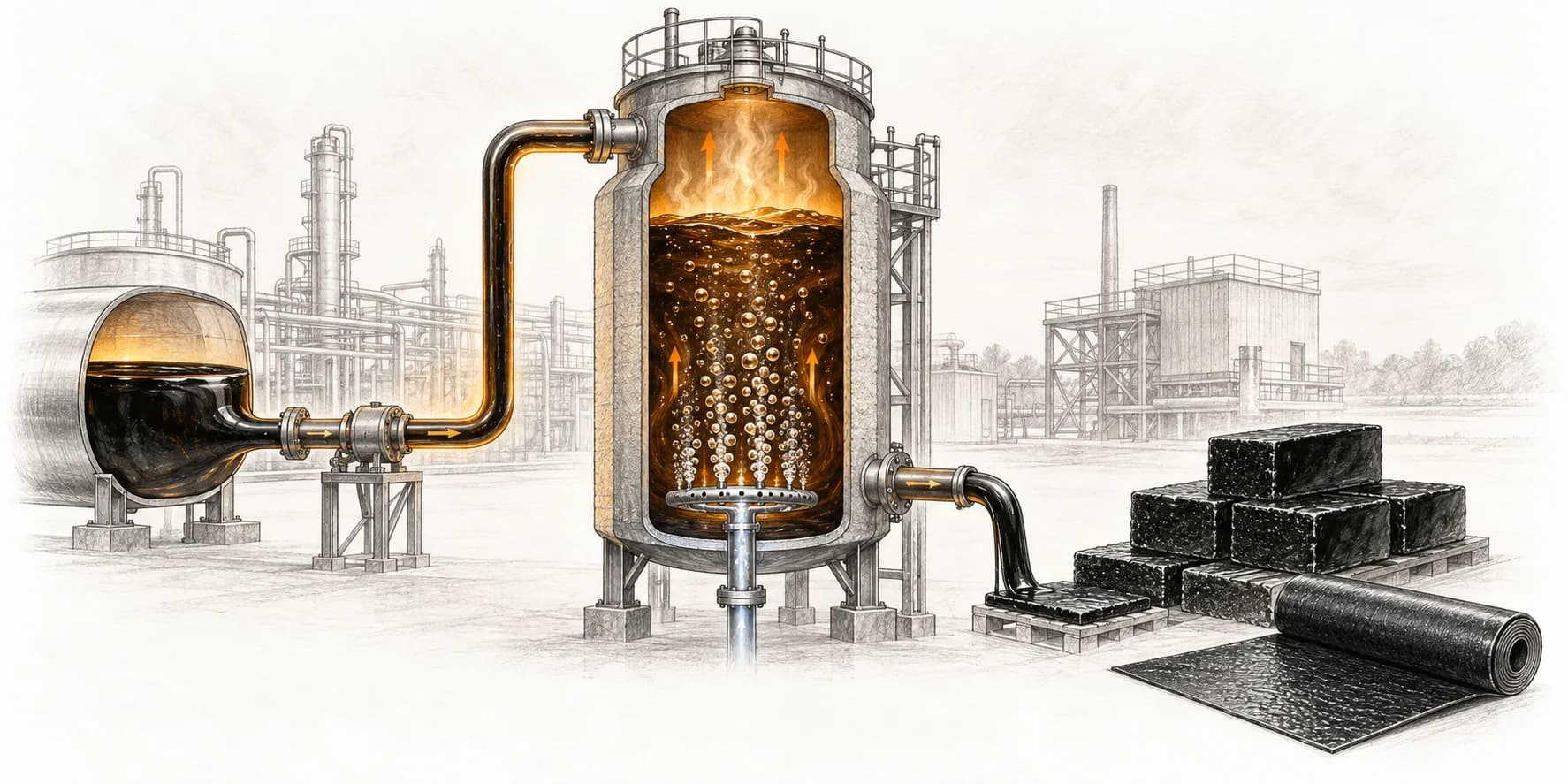
Paving bitumen softens quickly as it warms; its softening point is typically in the 40s or low 50s °C. Air blowing changes this: it raises the softening point much more than it lowers the penetration, giving a material that is far less sensitive to temperature. The combination of numbers expresses that balance.
- Compare 85/25 and 95/25: the same hardness at room temperature, but the 95/25 resists flow at a higher temperature.
- Compare 85/25 and 90/15: similar heat resistance, but 90/15 is harder and less forgiving of movement or cold.
- 115/15 combines a very high softening point with low penetration, for duties where heat resistance is the priority.
Read the first number for heat resistance and the second for flexibility; pick the grade by balancing the two for the job.
What to check on the certificate
When buying, ask for both results on the certificate of analysis with their test methods, and confirm they fall inside the agreed range, not just near the grade name. Other common lines on an oxidised bitumen specification include solubility, loss on heating and flash point. State the grade, the standard or specification sheet it should meet, the packing and the destination climate in your enquiry. Nuroil supplies oxidised bitumen with a CoA for every delivery; send your requirements through the quote form.