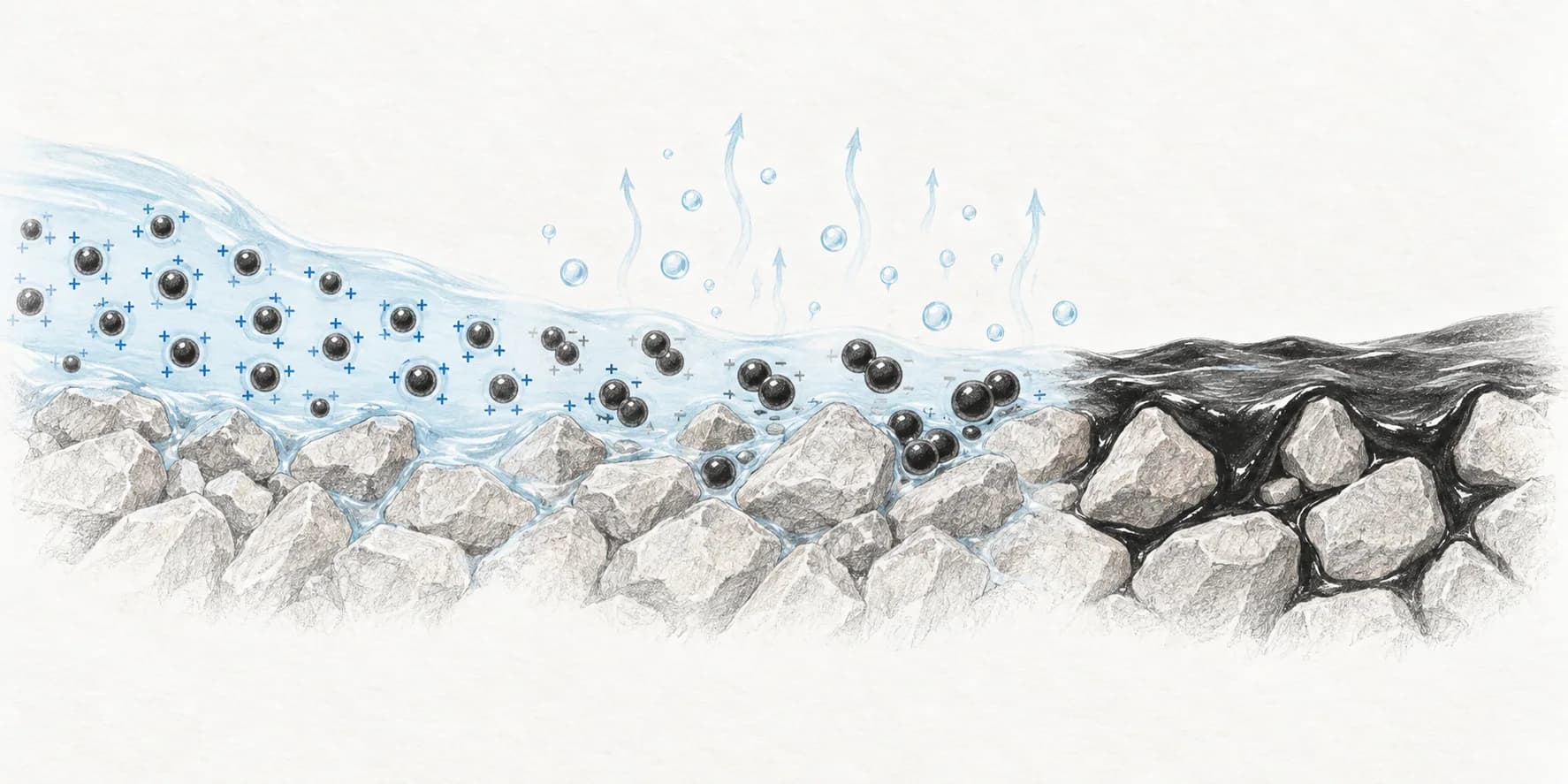
Slurry seal is a thin maintenance surfacing made by mixing bitumen emulsion, graded fine aggregate, mineral filler, water and small amounts of additive, then spreading it on an existing pavement. As the emulsion breaks and cures, it forms a new wearing surface that seals out water, slows oxidation of the old asphalt, and restores texture and skid resistance. Maintenance guidance from the California Department of Transportation puts the typical service life at three to five years.
The emulsion
Slurry needs an emulsion that will mix with a large amount of fine aggregate and filler without breaking in the mixer, yet set quickly enough to reopen traffic. That rules out rapid setting grades. The usual choices are:
- CQS-1h, a cationic quick setting grade, the most widely used.
- QS-1h, its anionic equivalent.
- CSS-1h and SS-1h, slow setting hard-base grades, where a longer working time is acceptable.
The h indicates a hard base bitumen; residue penetration is typically 40 to 90 dmm. Polymer modified versions are also used. Micro surfacing is a related system that always uses a polymer modified quick setting emulsion, has stricter aggregate requirements, and breaks chemically so it is less dependent on weather.
Aggregate types and uses
Slurry aggregate is graded into three types. Finer gradings give a thinner, smoother seal; coarser gradings give more texture and durability under traffic.
| Type | Grading | Typical use | Typical rate (kg dry aggregate per m²) |
|---|---|---|---|
| Type I | Finest, all passing 4.75 mm | Crack and void filling, parking areas, very light traffic | About 4.3 to 6.5 |
| Type II | Medium, all passing 9.5 mm | General wearing course on residential and moderate-traffic roads | About 5.4 to 8.1 |
| Type III | Coarsest, all passing 9.5 mm with more coarse stone | Higher-traffic roads and minor shape correction | About 10.8 to 13.6 |
Rates are converted from the Caltrans guide's pounds per square yard and are indicative; the project specification governs. Aggregate must be clean and durable, and specifications set minimum sand equivalent and durability values for each type.
Filler, water and additives
Mineral filler such as Portland cement or hydrated lime is counted as part of the aggregate. It helps mixing, improves cohesion and absorbs water from the emulsion so it breaks faster after placement. Water must be clean enough that it does not destabilise the emulsion. Additives, often emulsifier solutions or salts such as aluminium sulphate, mostly act as retarders to keep the mix workable when temperatures rise during the day.
Mix design tests
Slurry mixes are designed in the laboratory with the actual emulsion, aggregate and filler. Common tests from the International Slurry Surfacing Association include:
- Mixing test: trial proportions are mixed and the time the slurry stays uniform is recorded; designs typically target over 180 seconds.
- Cohesion test: shows how fast the mix gains strength, and so how soon traffic can return.
- Wet track abrasion test: specimens are cured, soaked and abraded under water to find the minimum binder content.
- Loaded wheel and sand adhesion test: helps find the maximum binder content before the surface becomes flushed.
The design binder content sits between the abrasion and sand adhesion limits.
Site conditions and opening to traffic
- Apply in daylight, with the surface at 10°C and rising and humidity at about 60% or less; a light breeze helps.
- Do not start if rain is imminent or freezing is expected within 24 hours.
- Do not use slurry on pavements with structural defects such as alligator cracking, deep rutting or potholes; repair them first.
- A common rule of thumb is that slurry can carry traffic once it has turned black. Some early stone loss is normal, but should be small.
Slurry seal protects a sound pavement. It does not strengthen a failing one.
Supplying emulsion for slurry work
Because slurry mixes are designed around the specific emulsion, consistency between batches matters. Specify the grade and standard (for example CQS-1h to AASHTO M 208 or ASTM D2397), any polymer modification, the season of use and the total programme quantity. Ask for a certificate of analysis with each batch and a sample for mix design before the main order. Nuroil supplies bitumen emulsions with a CoA for every delivery; use the quote form to share your slurry programme.