A certificate of analysis for a bitumen emulsion can list a dozen results, split between tests on the emulsion itself and tests on the bitumen left after the water is removed. Knowing what each test measures makes it much easier to judge whether a delivery suits the job and to spot problems early. The test methods below are those collected under ASTM D244 and its companion standards; AASHTO and other national standards use closely related methods.
Tests on the emulsion
| Test | Method | What it tells you |
|---|---|---|
| Residue by distillation | ASTM D6997 | Bitumen content, and any oil distillate present |
| Residue by evaporation | ASTM D6934 | Bitumen content by a quicker method |
| Saybolt Furol viscosity | ASTM D7496 | Whether it will spray or mix as intended |
| Sieve test | ASTM D6933 | Oversized particles or lumps that can block nozzles |
| Storage stability and settlement | ASTM D6930 | How much the emulsion separates while standing |
| Demulsibility | ASTM D6936 | How readily a rapid setting grade breaks |
| Cement mixing | ASTM D6935 | How stable a slow setting grade is with fine material |
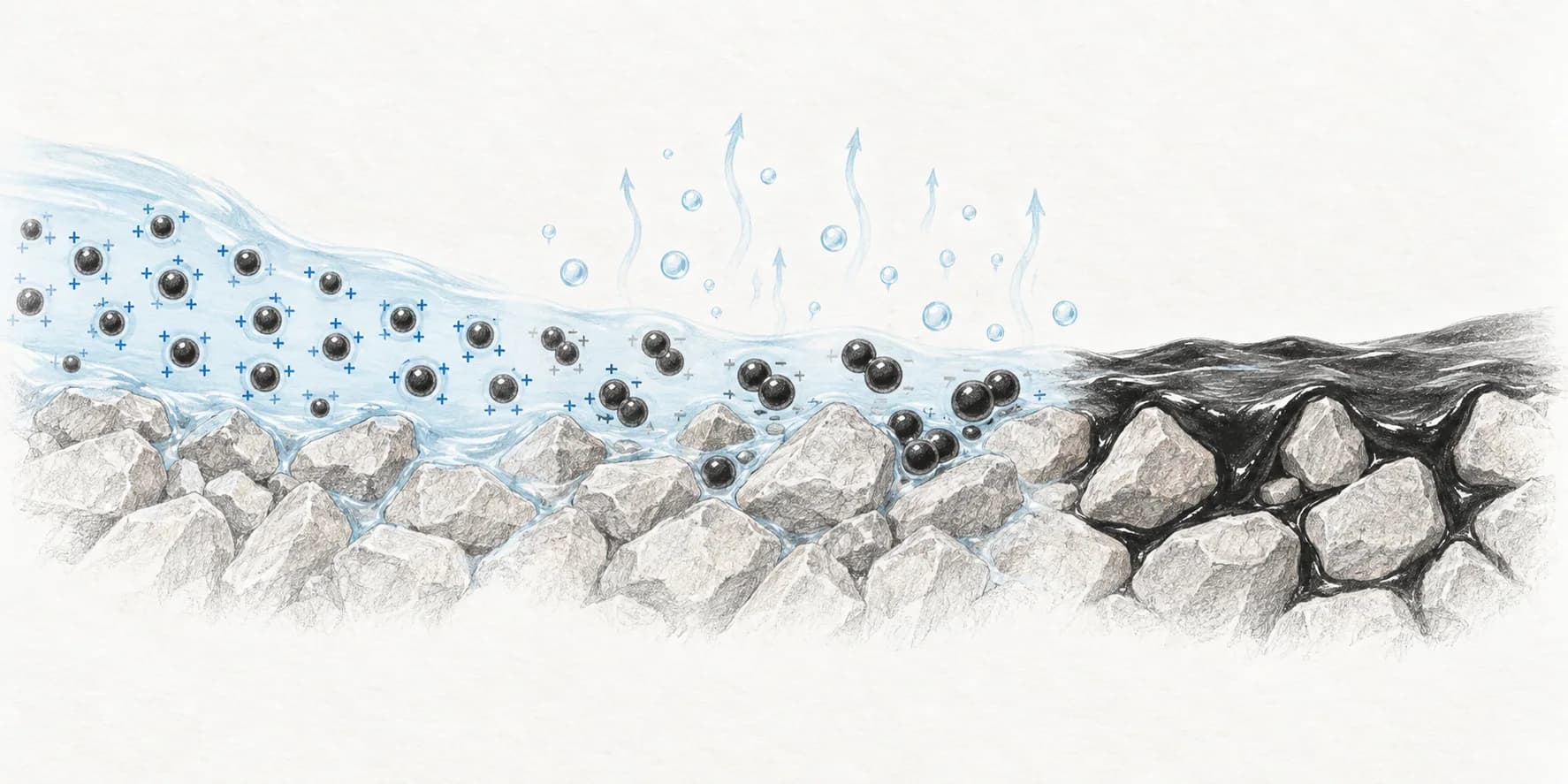
| Particle charge | ASTM D7402 | Confirms a cationic emulsion is positively charged |
| Density | ASTM D6937 | Converts between volume and mass for invoicing and spray rates |
Reading the emulsion results
Residue
Viscosity
Sieve test
Storage stability
Demulsibility and cement mixing
Particle charge
Tests on the residue
- Penetration at 25°C shows how hard the residual bitumen is. Grades with an h suffix typically require 40 to 90 dmm; softer grades 100 to 200 or 100 to 250.
- Ductility shows how far the residue stretches before breaking; 40 cm minimum is common.
- Solubility in a solvent such as trichloroethylene confirms the residue is essentially pure bitumen; 97.5% minimum is a common limit.
- Softening point and elastic recovery appear on polymer modified grades and show the effect of the polymer.
Good sampling makes good results
Emulsions change with time, temperature and handling, so test results are only as good as the sample. Industry guidance recommends sampling from the original storage tank rather than from a distributor, taking several samples, and testing within about two days. Samples should not be overheated or left for weeks before testing, and rapid setting grades are the most sensitive to delay. Some specifications also require demulsibility to be tested within a set period after shipment.
Check residue first, then the tests that match the grade's job: demulsibility for rapid setting, cement mixing for slow setting, particle charge for cationic.
What to ask for when buying
Request a batch-specific certificate of analysis listing each test, the method, the specification limit and the result, along with the grade and standard it is certified against. For long sea transits, ask for the production date and recommended use-by period. Nuroil provides a CoA with every delivery of bitumen emulsions, and independent third-party sampling and testing can be arranged on request. Set out your requirements through the quote form.