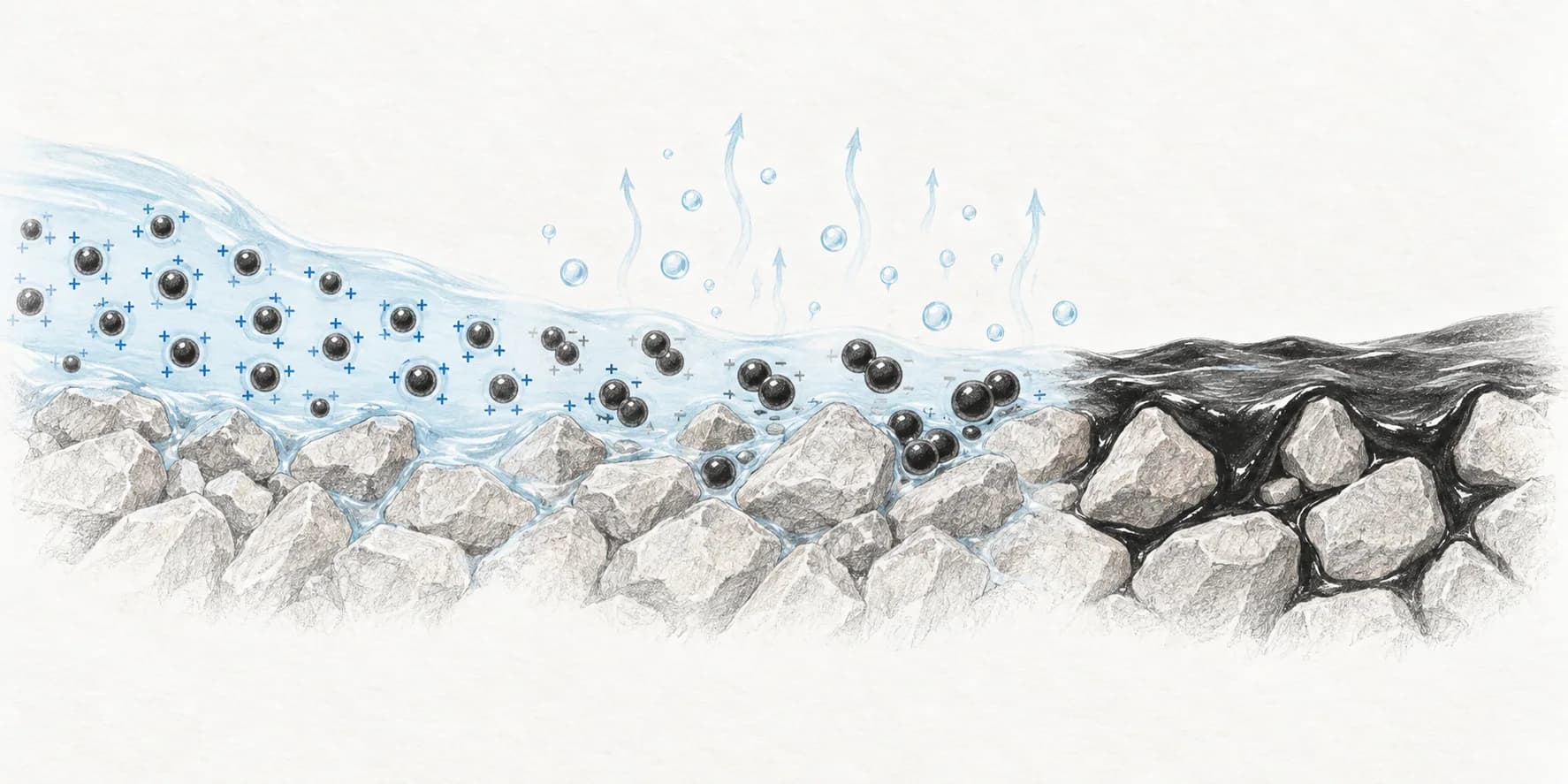
CRS-1, CSS-1, CSS-1h and SS-1h are among the most frequently ordered bitumen emulsion grades. They look similar on paper, but each is built for a different job, and their specifications differ in ways that matter on site. This guide sets out the typical requirements side by side, based on the AASHTO M 140 and M 208 style tables adopted by US highway agencies and mirrored in ASTM D977 (anionic) and ASTM D2397 (cationic).
Decoding the names
- C at the start means cationic (positively charged droplets). No C means anionic.
- RS is rapid setting; SS is slow setting.
- The number relates to viscosity: a 1 is a lower viscosity grade than a 2.
- An h means a harder base bitumen, shown by a lower penetration of the residue.
Typical requirements
The values below are representative of one US state table based on the national standards. Individual agencies and other national standards vary, so the governing specification for your project always takes precedence.
| Property | CRS-1 | CSS-1 | CSS-1h | SS-1h |
|---|---|---|---|---|
| Charge | Positive | Positive | Positive | Anionic (no charge test) |
| Saybolt Furol viscosity, s | 20 to 100 at 50°C | 20 to 100 at 25°C | 20 to 100 at 25°C | 20 to 100 at 25°C |
| Storage stability, 24 h, % max | 1 | 1 | 1 | 1 |
| Sieve test, % max | 0.10 | 0.10 | 0.10 | 0.10 |
| Demulsibility, % min | 40 | not required | not required | not required |
| Cement mixing, % max | not required | 2.0 | 2.0 | 2.0 |
| Residue, % min | 60 | 57 | 57 | 57 |
| Oil distillate, % max | 3 | not required | not required | not required |
| Residue penetration at 25°C, dmm | 100 to 250 | 100 to 250 | 40 to 90 | 40 to 90 |
| Residue ductility at 25°C, cm min | 40 | 40 | 40 | 40 |
| Residue solubility, % min | 97.5 | 97.5 | 97.5 | 97.5 |
What the key limits tell you
Demulsibility versus cement mixing
Viscosity temperature
Residue penetration
Oil distillate
Where each grade is used
| Grade | Typical uses |
|---|---|
| CRS-1 | Surface dressing and chip seals with siliceous stone, some tack coats where fast break is wanted |
| CSS-1 | Prime coats (usually diluted), fog seals, tack coats, soil stabilisation |
| CSS-1h | Tack coats, slurry seals, fog seals in warm climates, cold mixes with fine aggregate |
| SS-1h | Tack coats, slurry and fog seals, particularly with limestone and other calcareous aggregates |
Choose the setting speed for the job, the charge for the aggregate, and the h version when warm weather or tracking is a concern.
Checking a supply against the specification
When enquiring, name the grade and the exact standard and edition, because limits and test temperatures differ between countries and agencies. Ask for a certificate of analysis covering viscosity, residue, sieve test, storage stability and residue penetration, plus particle charge for cationic grades and demulsibility or cement mixing as appropriate. Nuroil supplies bitumen emulsions with a CoA for every delivery, and third-party inspection can be arranged on request through the quote form.