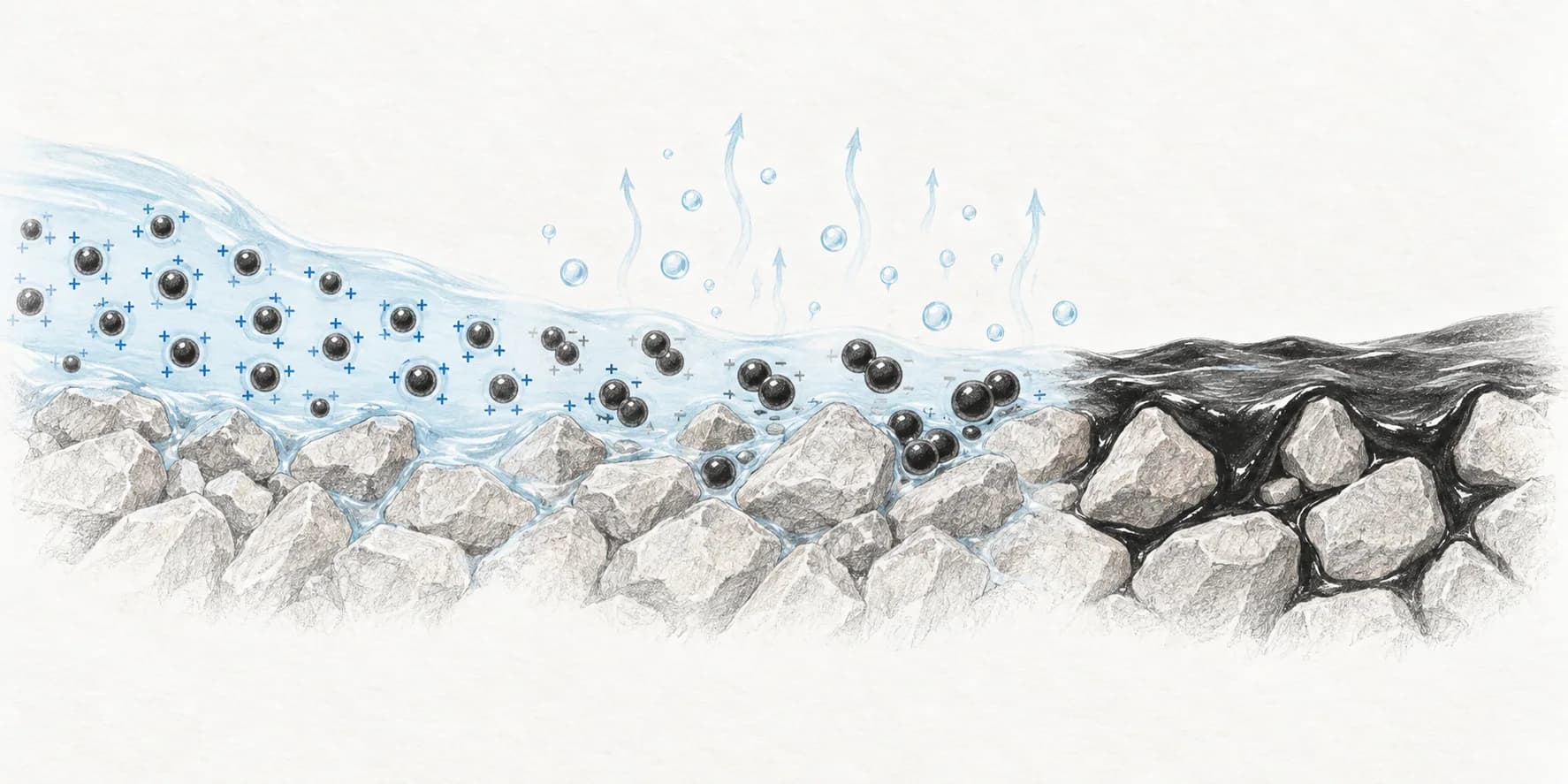
A bitumen emulsion is designed to be stable until it meets the road or the aggregate, and then to break and set at a predictable speed. When that timing goes wrong, the result is either a tank full of separated bitumen or a surface that stays brown and soft while traffic waits. Most problems trace back to a small number of causes in storage, handling or site conditions.
Breaking in storage or in transit
Once an emulsion has broken in a tank, it cannot be put back together. The usual causes are:
- Freezing. Ice formation forces the droplets together, leaving a layer of bitumen and a layer of water. Neither is usable and the tank is hard to empty.
- Overheating. Too much heat drives off water and thickens the product until it will not pump. An industry recommended storage range is about 10°C to 82°C, and the product data sheet should be followed. Heating coils that run much hotter than the bulk can break emulsion on the coil surface.
- Mixing incompatible products. Cationic and anionic emulsions, and in some cases different grades of the same charge, destabilise each other and break. Tanks and tankers should be dedicated, or emptied and cleaned between products.
- Excessive pumping and agitation. Repeated recirculation can reduce viscosity, entrain air and eventually break the emulsion. Gentle, slow circulation is preferred.
- Uncontrolled dilution. Rapid setting grades should not be diluted with water. Slow and medium setting grades can be, by adding water slowly to the emulsion, and a small compatibility check in a flask is sensible before diluting a full tank.
Skin, crust and settlement
A skin forms where the surface of the emulsion is exposed to air and loses water. Horizontal tanks expose a large surface and are more prone to it; vertical tanks, or horizontal tanks kept full, reduce the problem. Crust that has formed generally will not re-emulsify and will block strainers and spray nozzles, so pumping should be from the bottom of the tank.
Over longer periods, droplets slowly settle and the bottom of a tank becomes richer in bitumen than the top. Specifications control this with a 24-hour storage stability test, usually with a limit of 1% difference, and in some cases a five-day settlement test. Stock that has stood for a long time should be gently circulated and sampled before use.
Will not break or set on the road
| Symptom | Likely causes | What to check |
|---|---|---|
| Stays brown, slow to break | Cool or humid weather, heavy application, too much dilution, no sun | Surface temperature, humidity, rate and dilution records |
| Breaks before it can be spread | Very hot or dusty aggregate, too reactive a grade, hot weather | Grade choice, aggregate moisture, need for retarder in mixes |
| Poor coating of stone | Charge mismatch with aggregate, dirty or dusty aggregate | Particle charge on CoA, aggregate cleanliness |
| Washed off by rain | Rain before the emulsion set | Forecast, setting time of the grade |
For slurry seals, guidance from the California Department of Transportation lists faults such as a brown or whitish mix, mix that will not set and mix that breaks in the spreader box, and notes that excess water or too little cement filler can cause the emulsion to break onto the fines only, leaving a segregated, flushed surface.
Most emulsion failures are decided before the spray bar opens: in the tank, the pump and the weather forecast.
Sampling for a fair test
If a complaint needs testing, sample properly. Industry guidance is to take samples from the original storage tank rather than from a distributor, take several, and test within about two days. Long delays, rough handling or overheating of samples can change viscosity and other results, and rapid setting grades are the most sensitive to delay. Testing a poorly kept sample can wrongly blame a good product.
What to agree with your supplier
When ordering, state the expected storage time and conditions at destination, the climate during use, and whether the product will be stored in vertical or horizontal tanks. Ask for the recommended storage temperature range, the shelf life, a certificate of analysis that includes storage stability and sieve test, and the SDS. Nuroil supplies bitumen emulsions with a CoA for every delivery and can advise on packing for long transits; get in touch if you are planning storage at site.