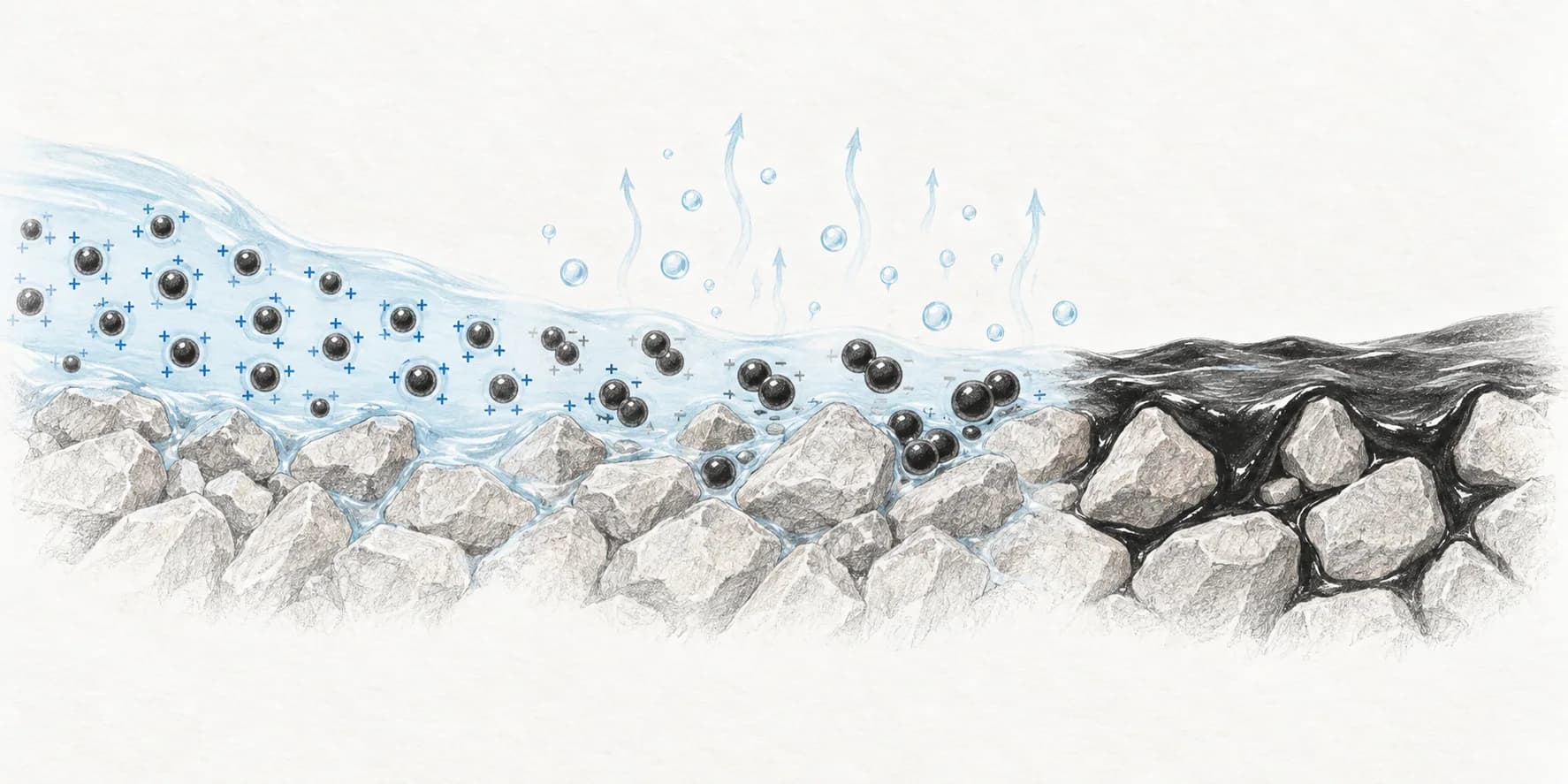
A prime coat is a low-viscosity bitumen spray applied to a compacted granular base before the first asphalt layer goes down. It soaks into the top few millimetres, binds loose fines, seals the surface against rain during construction and gives the asphalt something to bond to. Cutback bitumens were traditionally the standard priming material, but emulsions are widely used as an alternative because they contain little or no petroleum solvent.
Prime coat and tack coat are different jobs
The two are often confused. A tack coat is a thin film designed to glue one bituminous layer to another and is not meant to penetrate. A prime coat is designed to penetrate an unbound granular surface. That changes how the emulsion is chosen and applied: the priority for a prime is that the bitumen soaks in rather than sitting on the surface.
Which emulsions and how much dilution
Slow setting grades, typically SS-1, SS-1h, CSS-1 and CSS-1h, are the usual choice because they stay stable long enough to be absorbed. Maintenance guidance from the Missouri Department of Transportation notes that emulsions used for priming almost always need dilution, with ratios ranging from about 1:1 to 10:1 water to emulsion depending on the base and the method of treatment. Diluting lowers the viscosity and helps the emulsion enter the pores of the base.
Rates depend heavily on how open the base is. The same guidance gives, for a 1:1 dilution, roughly 0.5 gallons per square yard (about 2.3 L/m²) on tight bases with a high fines content, up to about 1.5 gallons per square yard (about 6.8 L/m²) on loose sands and very porous surfaces. These are diluted volumes, not residual bitumen, and the project specification always governs.
| Base condition | Typical approach | Main risk |
|---|---|---|
| Open-graded, porous | Diluted slow setting emulsion at a higher rate, possibly in several light passes | Under-application, leaving the surface dusty and unbound |
| Dense, high fines | Lower rate, greater dilution, slightly damp surface | Bitumen film left on top that causes slippage |
| Very tight, polished | Consider a cutback prime or a different interface treatment | Emulsion does not penetrate at all |
Preparing and spraying the base
- Shape and compact first. The base should be at final level, compacted and swept of loose material.
- Slightly damp, not wet. A damp base absorbs emulsion more readily, and a light water spray helps after a dry spell. Standing water must not be left on the surface.
- Half width at a time. Priming one half of the road and letting it cure keeps a lane open and avoids traffic on fresh prime.
- Check the weather. Emulsions cure by losing water, so cold or humid conditions slow or stop curing. Do not prime when rain is expected before the prime has penetrated.
Reading the result
A correct prime leaves the surface darkened and lightly bound, with no free bitumen. Two faults are common:
- Too light. The surface looks light brown, the emulsion disappears almost immediately and the top of the base is still dusty. The asphalt layer may not bond.
- Too heavy. Bitumen ponds or bleeds on the surface. The excess must be removed or blotted, or it will form a slip plane under the new asphalt.
If penetration is very slow because of cold or damp weather, a small amount of clean blotter sand can be lightly spread to take up the excess. Soil should not be used.
The aim of a prime is penetration. A shiny black film on top of the base is a fault, not a finish.
Curing before paving
An emulsion prime is cured when it has penetrated and hardened enough that it cannot be picked up by tyres or a finger. In good weather this may take about a day; cool or humid conditions can extend it to several days. Paving over uncured prime traps water and can lead to poor bond. Patched or repaired areas need the same cure before mix is placed.
What to specify when ordering
Give the emulsion grade and standard, whether you need it supplied ready-diluted or undiluted, and the total area and target rate so quantities can be checked. Mention the base type and climate, as these affect grade choice. Ask for a certificate of analysis showing residue, viscosity and sieve test, and for an SDS. Nuroil supplies bitumen emulsions in drums, IBCs or bulk with a CoA for every delivery; for advice on matching a grade to your base, contact the team.