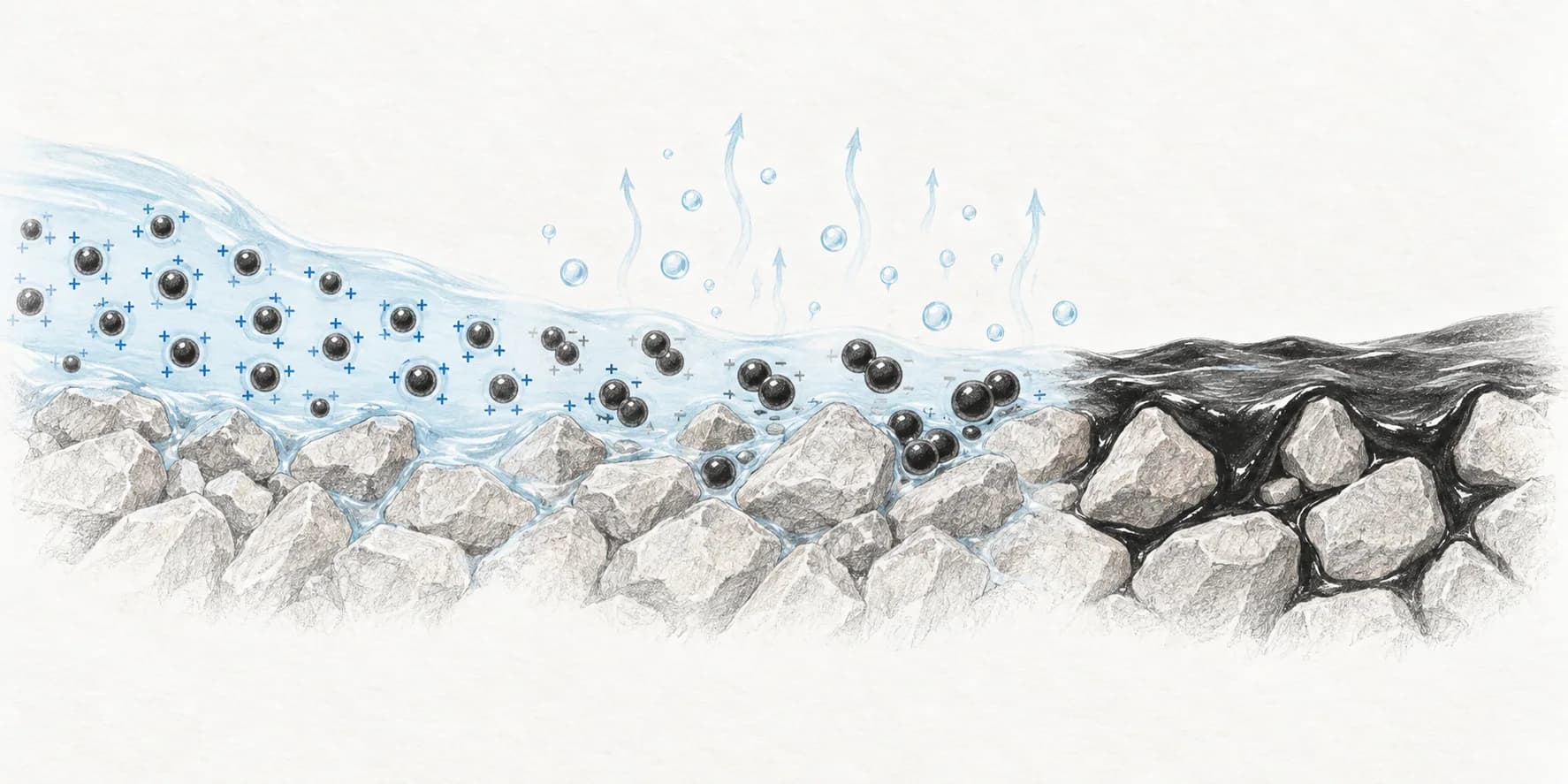
A tack coat is the thin film of bitumen sprayed between two asphalt layers so that they act as one. When the bond is weak, layers slide over each other under braking and turning traffic, and the pavement can crack and shove long before its design life is reached. Bitumen emulsions are the most common tack coat material because they spray easily at modest temperatures and spread evenly. Getting the result right comes down to three things: the right grade, the right amount of residual bitumen, and an even spray.
Which emulsions are used
Slow setting emulsions such as SS-1, SS-1h, CSS-1 and CSS-1h have long been the most common tack coat grades. Rapid setting grades such as CRS-1 are also used where a faster break is wanted. Each carries trade-offs:
- Slow setting grades are stable, easy to dilute and forgiving to spray, but take longer to break and set, which can delay paving.
- Rapid setting grades break quickly, reducing waiting time, but should not be diluted with water and need a distributor in good condition.
- Hard-base and reduced-tracking grades (often marked with an h, or with labels such as NT or TT in some specifications) use a stiffer base bitumen so that truck tyres pick up less tack.
Polymer modified versions, sometimes written with a P suffix, are used for demanding applications such as spray pavers.
State the rate as residual bitumen
The most common mistake in tack coat specifications is an ambiguous rate. "Apply at 0.2 litres per square metre" could mean diluted emulsion, undiluted emulsion or the bitumen left after the water has gone, and each reading gives a very different film. US highway guidance recommends that every rate be written as residual bitumen, because that is what actually bonds the layers.
An undiluted emulsion typically leaves somewhere between about 57% and 70% residue once set, so the bar rate must be higher than the residual target. Published recommendations from the Asphalt Institute, quoted by the US Federal Highway Administration, are summarised below (converted from gallons per square yard and rounded):
| Surface | Residual rate (L/m²) | Approx. undiluted bar rate (L/m²) |
|---|---|---|
| New asphalt | 0.09 to 0.23 | 0.14 to 0.32 |
| Existing asphalt | 0.18 to 0.32 | 0.27 to 0.50 |
| Milled surface | 0.18 to 0.36 | 0.27 to 0.54 |
| Portland cement concrete | 0.14 to 0.23 | 0.23 to 0.36 |
Rougher, older and milled surfaces have more texture to fill, so they need more tack. The guidance also encourages the upper end of each range, as research has suggested that common field rates are often too low.
Dilution and how to account for it
Slow setting emulsions are sometimes diluted, historically to help older distributors spray evenly. Modern distributors can apply undiluted emulsion uniformly, and FHWA guidance advises against dilution in the field. If dilution is allowed, it is better done by the supplier under control, and the added water must be counted when working out residual rate.
A worked example from the same guidance: a bar rate of 0.10 gallons per square yard of an emulsion diluted 70:30 (emulsion to added water), where the emulsion itself contains 33% water, gives 0.10 × 0.70 × 0.67, or roughly 0.047 gallons per square yard of residual bitumen. Without records of the dilution, the residual rate cannot be known at all.
Write the tack coat rate as residual bitumen, and record any water added, or nobody can check what was really applied.
Getting even coverage on site
- Clean, dry surface. Dust and loose material stop the tack from bonding; sweep or wash first.
- Calibrated distributor. Calibrate at least yearly and check rates on site, for example with weighed pads or nozzle catch containers as described in ASTM D2995.
- Nozzles and bar height. Nozzles should be set at about 15 to 30 degrees to the spray bar so the fans do not collide, and the bar height set for a double or, better, triple overlap; triple overlap is typically reached at roughly 30 cm.
- Allow it to break. The emulsion turns from brown to black as it breaks. Heavier rates, dilution, cloud and cool surfaces all lengthen break and set times.
- Control tracking. Keep site traffic off fresh tack where possible, or choose a reduced-tracking grade.
What to specify when ordering
State the grade and governing standard (for example CSS-1h or CRS-1 to a named national or ASTM/AASHTO specification), whether the product should be supplied undiluted or pre-diluted at a stated ratio, the quantity per phase of work, and the packing. Ask for a certificate of analysis showing residue content, viscosity, sieve test, storage stability and particle charge for cationic grades, and an SDS for site use. Nuroil can supply bitumen emulsions with a CoA for every delivery and CoO, MSDS or third-party inspection on request; use the quote form to set out your tack coat requirements.