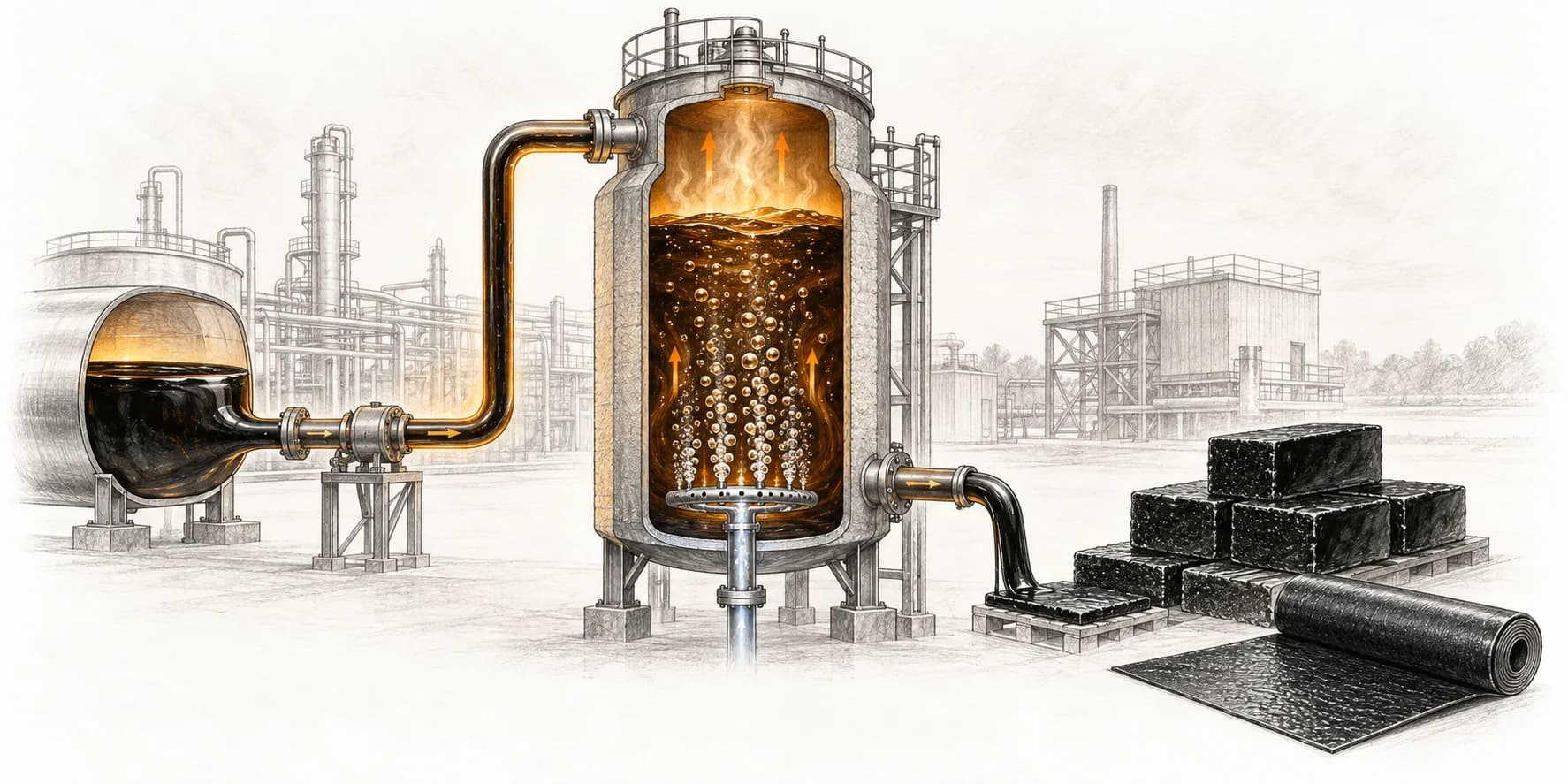
Hot-applied built-up roofing uses oxidised bitumen as the adhesive and waterproofing layer between plies of felt or reinforcement. The binder must be fluid enough to mop or spread when hot, yet firm enough not to flow down the roof on a summer afternoon. In markets that follow American practice, roofing bitumen is specified to ASTM D312, which divides it into four types by softening point. Elsewhere, roofing specifications often call for named oxidised grades such as 85/25 or 95/25. Understanding both systems helps buyers match products to the roof.
The four ASTM D312 types
| Type | Softening point, °F | Softening point, °C (approx.) | Common description | Typical slope guidance |
|---|---|---|---|---|
| I | 135 to 151 | 57 to 66 | Dead level | Up to about 2% (1/4 in. per ft), often aggregate surfaced |
| II | 158 to 176 | 70 to 80 | Flat | About 2% to 8% (1/4 to 1 in. per ft) |
| III | 185 to 205 | 85 to 96 | Steep | About 2% to 25% (1/4 to 3 in. per ft) |
| IV | 210 to 225 | 99 to 107 | Special steep | About 2% to 50% (1/4 to 6 in. per ft), and hot climates |
Slope guidance was moved out of D312 in 2000 and now sits in a separate selection guide, ASTM D6510; D312 itself states that its types are for classification and do not restrict the slope on which they are used. The slope figures above are therefore guidance, and roofing system manufacturers' instructions take precedence.
Why slope and climate drive the choice
A low softening point bitumen flows more readily, which helps it self-heal and seal on a dead-level roof under gravel, but it can slide on a slope or in strong sun. Higher softening point types resist that flow, so they suit steeper roofs, vertical flashings and hot climates. The trade-off is that harder bitumen is less flexible in cold weather. Type III is the most widely used type for general roofing; Type IV is chosen where high year-round temperatures are expected.
Heating limits in the current standard
The 2015 revision of D312 tightened the heating rules. It raised the minimum flash point to 575°F (about 302°C), set a maximum kettle temperature of 550°F (about 288°C), and requires suppliers to state the equiviscous temperature (EVT) for each lot, measured by rotational viscometer. Maximum EVTs are given for mopping and for mechanical spreaders: for Type III, 430°F (about 221°C) for mopping and 470°F (about 243°C) for mechanical application; for Type IV, 455°F (about 235°C) and 485°F (about 252°C). Applying at the EVT gives the right film thickness; overheating wastes fuel, increases fumes and can change the bitumen.
How common oxidised grades compare
Oxidised grades are named by softening point and penetration rather than by D312 type, so there is no exact equivalence. Comparing softening points only:
- 85/25 and 90/15, with softening points around 80 to 95°C, overlap the Type III range.
- 95/25, at around 90 to 100°C, sits between the upper part of Type III and the lower edge of Type IV.
- 115/15, at around 110 to 120°C, is above the Type IV range and is generally harder than roofing types.
D312 also sets other requirements, including flash point, penetration at several temperatures, ductility and solubility. A product meets D312 only if it passes all of them, so a grade with the right softening point is not automatically compliant.
Choose the roofing bitumen by slope and climate first, then check that the offered grade meets every line of the specification, not just softening point.
What to specify in a roofing enquiry
State either the D312 type or the oxidised grade required, the roof slopes and climate, the application method (mop or mechanical spreader) and whether lot EVT information is needed. Ask for a certificate of analysis showing softening point, penetration and flash point, and for the SDS. Nuroil supplies oxidised bitumen for roofing and waterproofing with a CoA for every delivery; use the quote form to send your requirements.