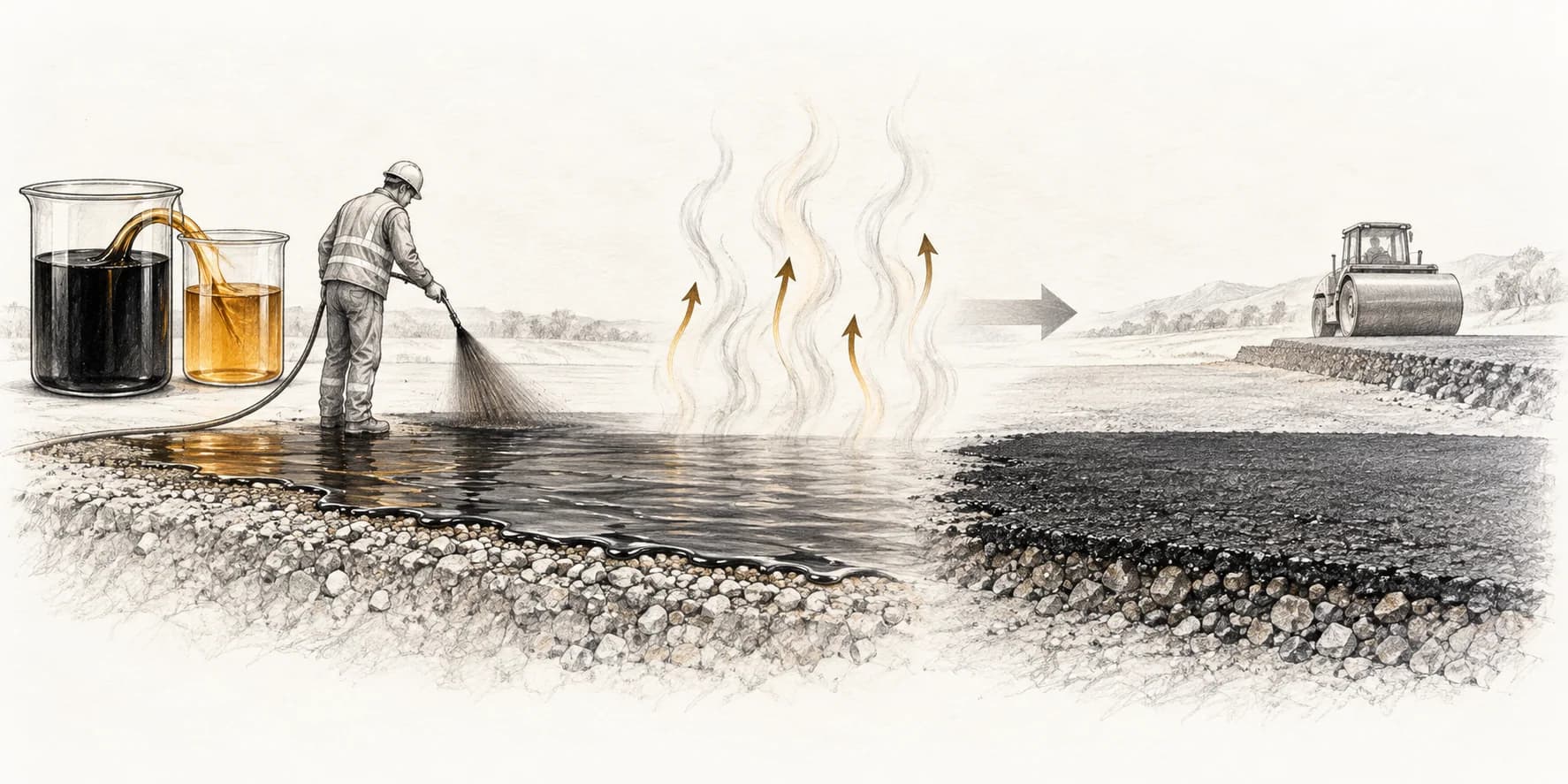
Medium curing cutbacks such as MC-30, MC-70, MC-250, MC-800 and MC-3000 are specified by a table of tests that check both the liquid product and the bitumen left behind once the solvent has gone. Understanding what each test measures helps buyers read certificates and spot products that will not behave as expected on site.
Tests on the cutback as supplied
Kinematic viscosity at 60°C
Flash point
Water content
The distillation test
A sample is distilled under controlled conditions and the volume of solvent that comes off by set temperatures is recorded. This shows how much solvent is present and how volatile it is, which governs curing speed.
| Item | MC-70 | MC-250 | MC-800 | MC-3000 |
|---|---|---|---|---|
| Distillate to 225°C (% of total to 360°C) | 0 to 20 | 0 to 10 | - | - |
| Distillate to 260°C | 20 to 60 | 15 to 55 | 35 max | 15 max |
| Distillate to 316°C | 65 to 90 | 60 to 87 | 45 to 80 | 15 to 75 |
| Residue to 360°C (% by volume, min) | 55 | 67 | 75 | 80 |
Values follow a published state highway specification based on the ASTM medium curing table; check your own contract for the governing figures. For MC-30, a residue of at least 50 per cent is typical.
Reading the table: a lighter grade has more distillate and less residue. If too much comes off at low temperature, the product will cure faster than expected and may not penetrate; if too little comes off, it may stay soft for too long.
Tests on the distillation residue
Once the solvent is removed, the remaining bitumen is tested to make sure the base binder is sound.
- Penetration at 25°C: typically 120 to 250 dmm for the residue of MC grades. This confirms the base bitumen is a soft paving grade.
- Ductility at 25°C: typically 100 cm minimum, showing that the residue is cohesive and not brittle.
- Solubility in an organic solvent: typically 99.5 per cent minimum, showing the residue is essentially pure bitumen.
Taken together, the distillation and residue results let a buyer confirm that the product was made from the right base bitumen and the right type and amount of solvent.
Other requirements
Specifications often add general clauses: the product must be homogeneous, must not separate on standing, and must not foam when heated to its application temperature. Some allow an adhesion additive for use with damp aggregates in patching mixes and add a coating test to check it works. Many also set maximum application temperatures for each grade.
Viscosity sets the grade, distillation shows the solvent, and the residue tests show the bitumen you will actually leave on the road.
What to ask for on the certificate
For each lot, ask for viscosity at 60°C, flash point, water, the full distillation profile and the residue tests, with the method used for each. Confirm the specification edition. Nuroil supplies a certificate of analysis with every delivery, and independent inspection can be arranged on request. See the cutback bitumen page or use the quote request form.