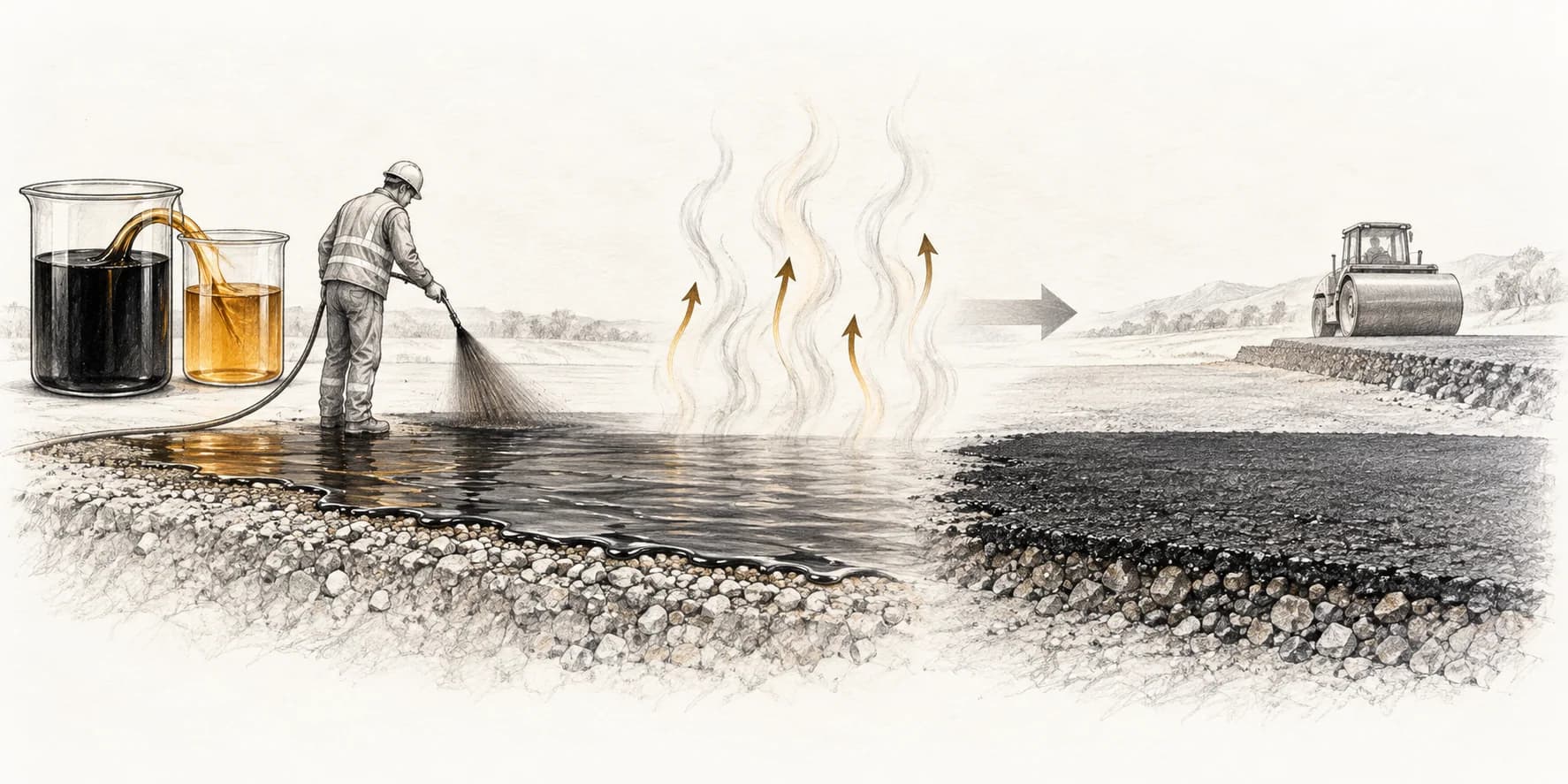
Paving bitumen on its own has a high flash point, usually well above 200°C. Cutback bitumen is different. It contains a petroleum solvent, and that solvent brings the flash point down sharply. Many cutbacks have to be warmed to spray them, and the working temperature can be close to, or above, the temperature at which vapour will ignite. This makes fire the main hazard when handling cutbacks.
How flash point varies by type
The type of solvent decides how flammable a cutback is:
- Rapid curing (RC) grades use a naphtha or gasoline-type solvent. A highway agency manual gives RC-250 a flash point of about 27°C (80°F), and one producer's safety data sheet classifies RC-250 as a flammable liquid with a Danger signal word.
- Medium curing (MC) grades use a kerosene-type solvent. Specifications set a minimum open-cup flash point of 38°C for the lightest MC grades and 66°C for MC-250 and heavier.
- Slow curing (SC) grades use low-volatility oils, with minimum flash points rising from about 66°C to over 100°C across the range.
Australian AMC cutbacks follow the same pattern: lighter primer grades carry a minimum flash point above 38°C, the heavier sealing grades above 50°C.
Why spraying temperature matters so much
For RC-250, one agency recommends applying it at about 52 to 82°C and sets a maximum of 93°C for application and storage. That range is far above the flash point, so flammable vapour will be present whenever the product is being worked. The agency's own guidance describes working with RC-250 as being in the dangerous range at all times.
Highway specifications therefore set a maximum spraying and mixing temperature for each cutback grade. For example, one state limits MC-70 to 66°C when sprayed, MC-250 to 107°C, MC-800 to 121°C and MC-3000 to 135°C. These are ceilings, not targets.
Site precautions
- Know the flash point of the exact grade on site, from its safety data sheet, and the maximum temperature allowed by the specification.
- Control heating. Use thermostatically controlled heaters, check temperature regularly, and never heat with an open flame applied to the tank shell.
- Eliminate ignition sources. No smoking, no welding or grinding nearby, and use explosion-protected lighting and electrics where vapour may gather.
- Bond and earth equipment during transfer to stop static discharge, which the safety data sheet lists as an ignition risk.
- Open hatches carefully. Solvent vapour and hydrogen sulphide can collect in the headspace of tanks and tankers during storage and transit.
- Keep water out. Water entering hot bitumen can cause violent foaming and boil-over.
- Have the right extinguishers. Safety data sheets list foam, dry powder and carbon dioxide for cutback fires, and warn against water jets on molten product.
Plan the job so that only the quantity needed for the day is heated, and let unused product cool in a closed tank rather than holding it hot overnight.
Health hazards alongside fire
Solvent vapour can cause drowsiness or dizziness, and swallowing or inhaling liquid into the lungs can be fatal. Work in the open or with good ventilation, wear gloves, eye protection and suitable clothing, and follow the first-aid section of the safety data sheet. Prevent spills from reaching drains and watercourses.
With cutbacks, the flash point is often below the working temperature, so the controls must assume flammable vapour is always present.
Safety information to request with every order
Ask for the current safety data sheet for the exact grade, a certificate of analysis showing flash point, and the recommended storage and application temperatures. Make sure the transport documents carry the correct dangerous goods classification for the product. Nuroil supplies the certificate of analysis with each delivery and the safety data sheet on request; enquiries can be made through the cutback bitumen page or contact us.