
Technical document

· PDF

Tell us who you are and the document downloads straight away. We use these details only to follow up on your requirement.

Samples & documents

What can we send you?

Tick what you need
Request a quote
Expert article3 min read7 sections

Knowledge centre · Bitumen

Why cutback prime coats fail to cure and how to fix it

Common faults with cutback bitumen prime coats, from tacky surfaces to poor penetration and pickup, with their likely causes and practical remedies.

Written by the Nuroil trade desk, Sharjah

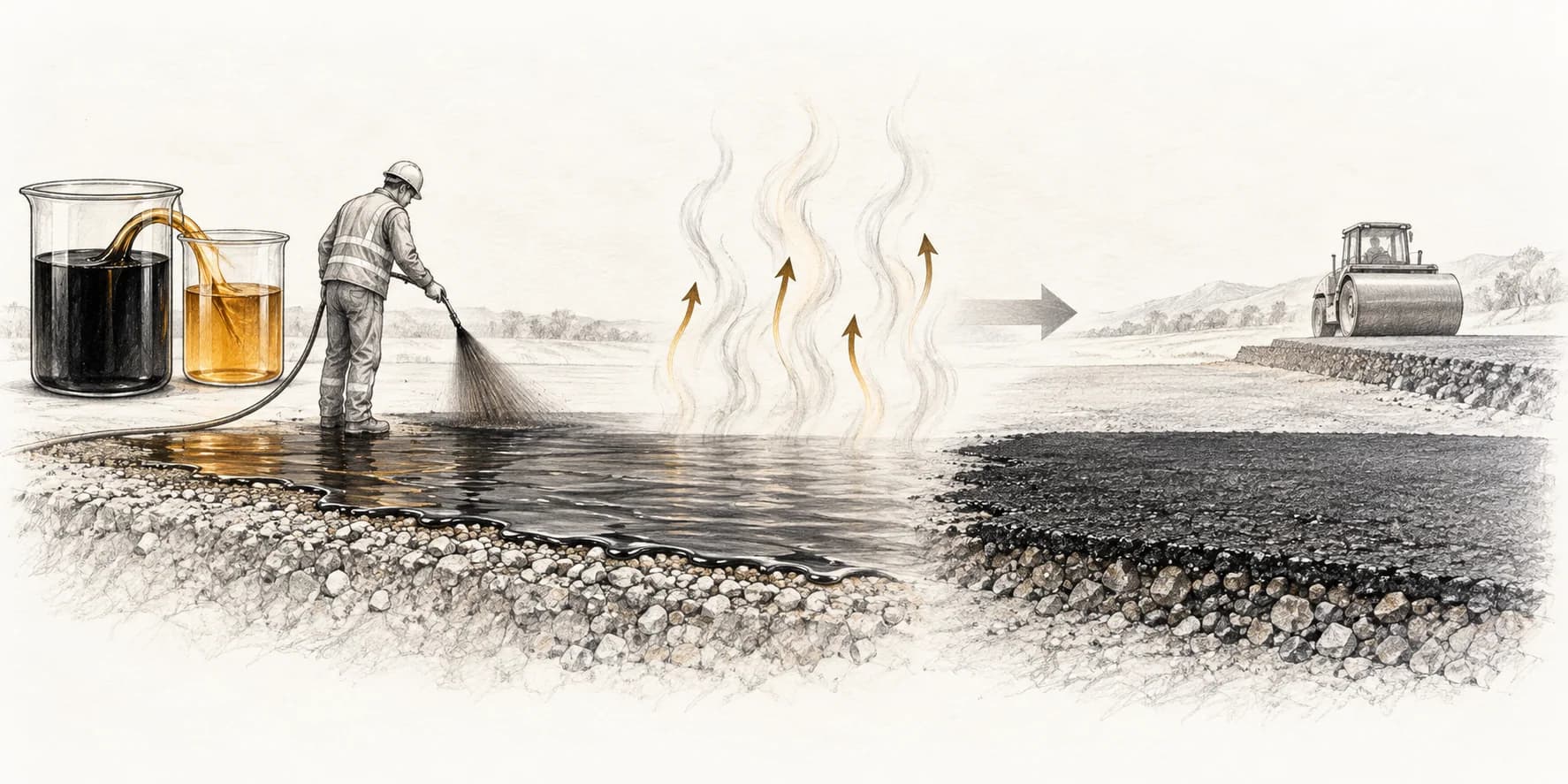
Pencil sketch of cutback bitumen curing
On this page · 8 sections
  1. 01Fault: the surface stays wet and tacky
  2. 02Remedies
  3. 03Fault: binder sits on the surface instead of penetrating
  4. 04Fault: tyres and paving equipment pick up the prime
  5. 05Fault: streaky or uneven coverage
  6. 06Fault: the cutback foams or froths in the tank
  7. 07Troubleshooting summary
  8. 08Supply points that prevent problems

A good prime coat leaves a dry, uniformly darkened base that has absorbed the binder a few millimetres deep. A bad one stays shiny and tacky, sticks to tyres, or soaks in so unevenly that the base surface is patchy. Most problems trace back to a mismatch between the cutback grade, the base, the application rate and the weather. This article sets out the usual faults and how crews correct them.

Fault: the surface stays wet and tacky

Likely causes: too much binder for the base to absorb; a grade that is too heavy for a dense base; cold, damp or still weather slowing solvent evaporation; or a base that was too wet when sprayed.

Remedies:

  • Allow longer curing. Specifications commonly set a minimum curing time and let the engineer extend it until the prime is no longer picked up.
  • Blot free binder with clean sand and sweep off the surplus once cured.
  • On later runs, reduce the rate or switch to a thinner grade, for example from MC-70 to MC-30.

Fault: binder sits on the surface instead of penetrating

01

Likely causes

a base that is very dense or has a skin of fine material; dust on the surface; or a grade that is too viscous at the temperature it was sprayed.
02

Remedies

sweep loose material off before spraying; lightly dampen a very dry, dusty base if the specification allows; choose a thinner grade; and check that the binder is at its recommended spraying temperature. Supplier data for Australian AMC primers, for example, matches the thinnest grades to low-porosity bases for this reason.

Fault: tyres and paving equipment pick up the prime

01

Likely causes

traffic or construction plant allowed on before curing; over-application in wheel paths; or hot weather softening a heavy film.
02

Remedies

keep traffic off until the engineer approves; sand the wheel paths if traffic must cross; and make sure the prime is fully cured before the asphalt or seal goes down. Specifications typically require the contractor to protect the primed surface during curing.

Fault: streaky or uneven coverage

01

Likely causes

blocked or misaligned spray nozzles; incorrect spray bar height; the binder too cold so that the fan pattern is poor; or inconsistent truck speed.
02

Remedies

check and clean nozzles, set bar height to give the designed overlap, bring the binder to the right temperature and use a calibrated distributor. A tray or mat test can confirm the actual rate.

Fault: the cutback foams or froths in the tank

01

Likely causes

water in the binder or in the tank. Highway specifications limit water in cutbacks and require that the product does not foam when heated to its application temperature.
02

Remedies

stop heating, investigate the source of water and do not continue raising temperature. Foaming hot bitumen with solvent is a serious fire and burn hazard.

Troubleshooting summary

SymptomFirst thing to checkUsual correction
Tacky after normal curing timeApplication rate and weatherExtend curing, blot with sand, lower rate
Poor penetrationBase density and cleanlinessSweep, use thinner grade
Pickup by tyresCuring time and traffic controlClose to traffic, sand wheel paths
StreaksNozzles and bar heightClean, adjust, recalibrate
FoamingWater contaminationStop heating, remove water source
Most prime coat faults come from too much binder, too heavy a grade or too little curing time.

Supply points that prevent problems

Order the grade the specification names and confirm it with a certificate of analysis showing viscosity, flash point, water content and distillation results. Keep drums sealed and out of the sun, and store bulk product at the supplier's recommended temperature. If you are unsure which grade suits your base, describe the base material and climate in your enquiry on the cutback bitumen page and Nuroil can quote the grades that fit the specification.

PRODUCTS IN THIS ARTICLE
KEEP READING

More from the Knowledge Centre.

STILL HAVE A QUESTION?

Ask the people who trade it every day.

Our trade managers answer technical and commercial questions about grades, specifications, packing and shipping.

LET’S TALK ABOUT YOUR REQUIREMENTS

Your next shipment starts here.

Request a quote