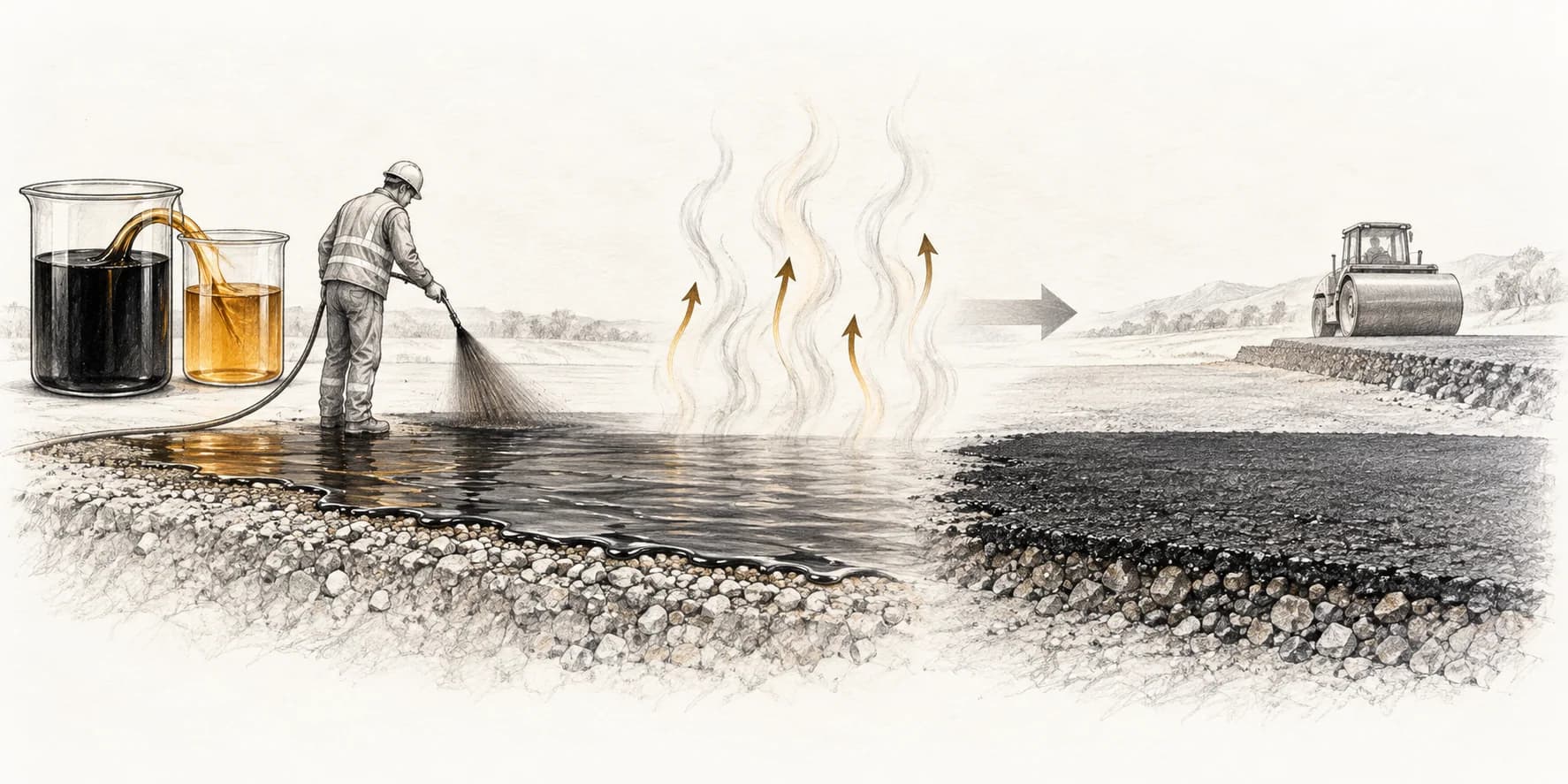
A prime coat is a thin application of low-viscosity bitumen onto a compacted granular base before the first bituminous layer goes down. Its job is to soak into the top of the base, bind loose fines, seal the surface against moisture and give the next layer something to stick to. Medium curing cutbacks MC-30 and MC-70 are the two grades most often specified for this work under ASTM-style specifications.
How the two grades differ
Both are paving bitumen thinned with a kerosene-type solvent. The grade number is the lower limit of kinematic viscosity at 60°C in centistokes, and the upper limit is twice that figure. The difference in solvent content shows up in several ways.
| Property | MC-30 | MC-70 |
|---|---|---|
| Kinematic viscosity at 60°C | 30 to 60 cSt | 70 to 140 cSt |
| Minimum residue after distillation (by volume) | About 50 per cent | About 55 per cent |
| Minimum flash point (open cup) | 38°C | 38°C |
| Relative penetration into the base | Deeper | Shallower |
| Bitumen left behind per litre | Less | More |
Values are from published state highway specifications that follow the ASTM medium curing table; the governing project specification may differ slightly.
Matching the grade to the base
The porosity and density of the base is the main factor. A tight, dense, well-compacted base with a lot of fines resists penetration, so the thinner MC-30 is more likely to soak in rather than sit on top and stay tacky. A more open base absorbs liquid readily, and MC-70 can provide more residual bitumen without running too deep.
The Australian system shows the same logic in its AMC grades: the thinnest primer is matched to low-porosity bases and progressively heavier primers to medium and high-porosity bases. Whatever the system, the principle is that the binder should penetrate a few millimetres and leave a dry, black, bonded surface.
Weather and temperature
Cutbacks cure by evaporation, so warm, dry, breezy weather speeds curing and cold, damp, still weather slows it. MC-30 is easier to spray at lower temperatures, and published specifications limit its maximum spraying temperature to well below that of heavier grades. For MC-70 one state specification sets a maximum spray temperature of 66°C. Never heat either grade above the specification maximum, because the solvent is flammable.
Rates and curing
The right application rate is the amount the base will absorb without leaving free binder on the surface. Many specifications require a trial section at the start of the work so the engineer can set the rate. Curing periods are also set by specification: one agency requires at least 48 hours before the primed surface is disturbed, with longer periods if the prime is still being picked up by tyres. Excess binder is usually blotted with clean sand.
Quick decision guide
- Dense, tight base or cool weather: lean towards MC-30.
- Open, absorbent base or warm weather: MC-70 is often suitable.
- Uncertain: run trial patches of both and check penetration depth and surface condition after curing.
- Where solvent emissions are restricted: ask whether an emulsion prime is accepted instead.
The right prime grade is the one your base will actually absorb: thinner for tight bases, slightly heavier for open ones.
What to put in the enquiry
State the grade and the specification it must meet, for example ASTM D2027 or a named highway specification, the quantity and the packing. Drums are common for smaller projects; bulk is possible where the site has suitable storage. Ask for a certificate of analysis covering viscosity, flash point, distillation and residue tests, together with the safety data sheet. Nuroil can quote MC grades through the cutback bitumen page or the quote request form.