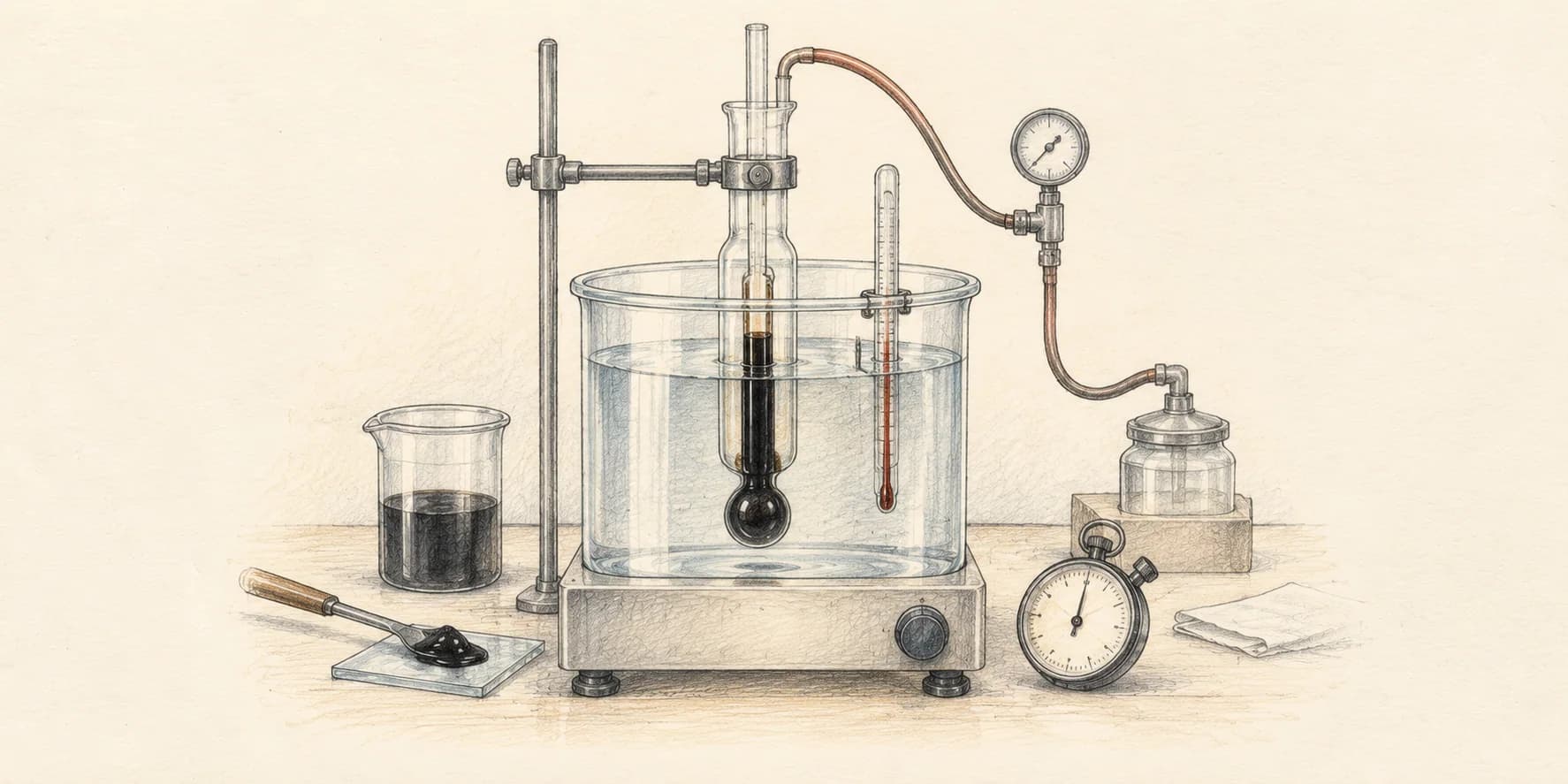
Most buyers of VG-10, VG-20, VG-30 or VG-40 know the property limits in IS 73. Fewer know that the standard also sets out how a lot is sampled and judged. These rules decide whether a shipment of drums is accepted, so they are worth understanding before a dispute arises. This guide summarises them from IS 73:2013.
What counts as a lot
In any consignment, all containers of the same category and grade from the same batch of manufacture form one lot. A shipment that combines two batches of VG-30 is therefore two lots, each judged separately. This is one reason batch numbers on drums and on the certificate of analysis matter.
How many containers to sample and test
Containers are selected at random from each lot, with the number depending on lot size:
| Lot size (containers) | Containers to select |
|---|---|
| Up to 50 | 3 |
| 51–150 | 5 |
| 151–500 | 7 |
| 501 and above | 10 |
From each selected container a representative sample is taken following the sampling method referenced by the standard (IS 1201), and each sample is stored separately.
The tests are then split between individual and composite samples:
- Individual samples are each tested for absolute viscosity at 60°C, penetration and softening point.
- A composite sample, made by mixing equal quantities of all the individual samples, is tested for the remaining properties: kinematic viscosity at 135°C, flash point, solubility and the rolling thin film oven residue tests.
The acceptance rule
For each of the three properties tested on individual samples, the laboratory calculates the mean (X) and the range (R, the difference between highest and lowest result). The lot conforms only if:
- X − 0.6R is at or above the minimum limit, and
- X + 0.6R is at or below the maximum limit.
The composite sample must also meet every remaining requirement in the property table.
In practice this means a lot can fail even when every individual result is inside the limits, if the results are widely scattered and the mean sits close to a limit. For example, if four VG-30 samples average 2500 poise at 60°C with a range of 300 poise, X − 0.6R is 2320, below the 2400 minimum, so the lot fails on viscosity. A consistent lot centred in the band passes comfortably.
IS 73 rewards consistency: a lot centred in the band with little scatter passes, a scattered lot near a limit may not.
Other requirements worth knowing
- The binder must be homogeneous and must not foam when heated to 175°C, which in practice means it must be free of water.
- Packing is as agreed between purchaser and supplier.
- Each container must be legibly and indelibly marked with the manufacturer's name or trade mark, the month and year of manufacture, the type and grade of material, and the batch number.
The rule is a simple statistical safeguard. Using the range of results as a measure of variability, it shifts the mean towards each limit by a margin that grows with scatter, so a lot is accepted only when it is likely that the material as a whole, not just the drums sampled, lies inside the band. Buyers comparing offers can therefore favour suppliers whose certificates show consistent results batch after batch.
Practical points for importers
- Ask for batch numbers on every drum or bag and on the CoA, so lots can be identified.
- Keep drums from different batches separate in the yard.
- Agree in the contract whether acceptance follows the IS 73 sampling plan, an inspection agency's plan or another method.
- If a site test disagrees with the certificate, check whether the IS 73 sampling and calculation were followed before drawing conclusions.
Ordering
When ordering VG bitumen to IS 73, state the grade, the edition, the packing and marking required, and whether third-party inspection at loading should follow the standard's sampling plan. Nuroil supplies viscosity grade bitumen with a CoA for every delivery and can arrange inspection on request; contact us to discuss your requirements.