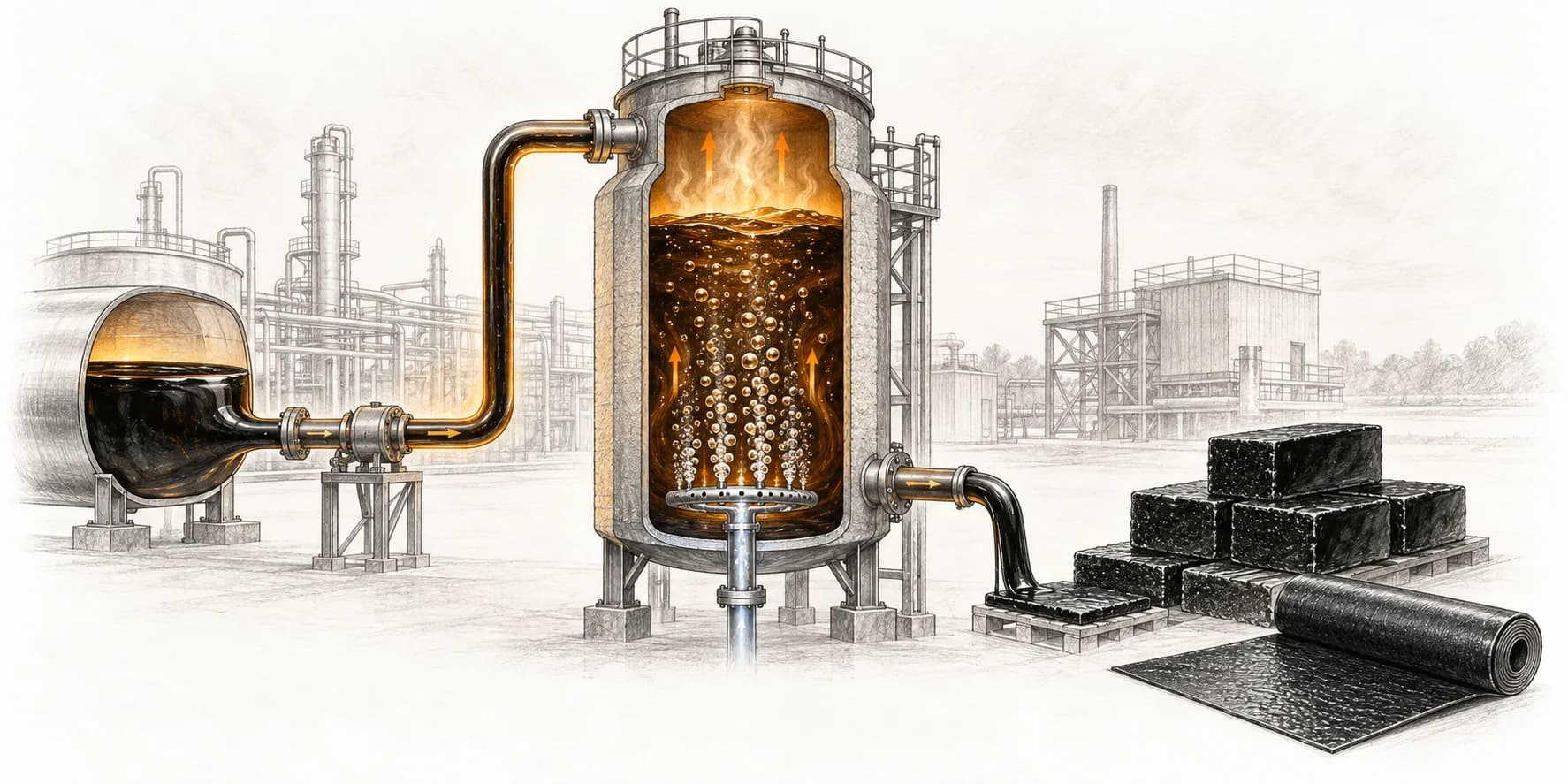
Oxidised bitumen, also called blown bitumen, starts life as the same refinery residue used to make paving bitumen. What makes it different is a long treatment in which air is bubbled through the hot bitumen. The process makes a harder, higher softening point product that is far less sensitive to temperature, which is why it is used for roofing, waterproofing, coatings and sealing compounds rather than road paving.
The blowing process
In a typical batch operation, the feedstock, usually a vacuum residue or a blend of residues, is heated to around 200 to 210°C and charged to a blowing vessel fitted with air distributors at the bottom and with heating and cooling coils. Air is blown through the bitumen while the vessel is held at roughly 240 to 300°C. The reaction gives off heat, so cooling capacity is needed to keep the temperature under control.
Blowing continues until the target softening point and penetration are reached; for hard industrial grades this can take many hours. Process fumes, a mixture of sulphur compounds, light oils and steam, are scrubbed and incinerated. Small amounts of catalysts are sometimes used to speed the reaction or adjust the properties.
What changes chemically
Bitumen is a mixture of asphaltenes, resins, aromatics and saturates. Blowing removes hydrogen and drives condensation reactions, so lighter aromatic molecules join into larger, more polar species. The asphaltene content rises markedly, often roughly doubling, while aromatics fall. The material becomes more structured and gel-like, which is the root of its higher softening point and reduced temperature susceptibility.
How the properties compare
| Property | Penetration grade (paving) | Oxidised grade |
|---|---|---|
| Grade name based on | Penetration range, e.g. 60/70 | Softening point and penetration, e.g. 85/25 |
| Softening point | Low, typically 40s to low 50s °C | High, roughly 75°C to over 110°C |
| Penetration at 25°C | Higher, e.g. 40 to 100 dmm | Lower, often 10 to 40 dmm |
| Temperature susceptibility | High: softens quickly as it warms | Low: stays firm over a wider range |
| Behaviour in cold | More flexible | Can become brittle |
| Main uses | Asphalt paving | Roofing, waterproofing, pipe coating, sealants, compounds |
The key point is the relationship between the two numbers. Blowing raises the softening point far more than it lowers penetration, so a blown bitumen with a penetration of 25 dmm can have a softening point around 85°C, whereas a paving bitumen of similar hardness would soften at a much lower temperature. This is often expressed as a higher penetration index.
Strengths and limitations
- Strengths: resistance to flow on hot or sloping surfaces, good adhesion when applied hot, water resistance and chemical stability.
- Limitations: lower flexibility and a tendency to become brittle at low temperatures, and a need for careful hot handling. Where low-temperature flexibility matters, polymer modified bitumen is often used instead.
Air blowing does not simply make bitumen harder; it makes it less sensitive to heat, which is what roofing and coating work need.
Why feedstock and process matter to buyers
The flux composition, blowing temperature, air rate and any catalyst all influence the final softening point to penetration relationship. Two products with the same grade name can therefore behave slightly differently in flexibility, fuming or ageing. Consistency from a single established producer is valuable when a waterproofing formulation or coating line has been set up around one product.
What to ask your supplier
Give the grade and the specification it must meet, the end use and the climate. Ask for a certificate of analysis for each lot with softening point, penetration and any other agreed properties, and for the SDS, which covers safe heating temperatures. Nuroil sources oxidised bitumen from established producers and supplies a CoA with every delivery; contact us to discuss grades.