Gilsonite is a hard, brittle, glossy black hydrocarbon that occurs naturally in the ground. Mineralogists call it uintaite, and it belongs to a wider family of solid natural bitumens known as asphaltites. In trade the name gilsonite is used loosely for the material in lump, granule and powder form. Unlike refinery bitumen, it is not distilled from crude oil: nature has already done the refining over millions of years.
How the veins formed
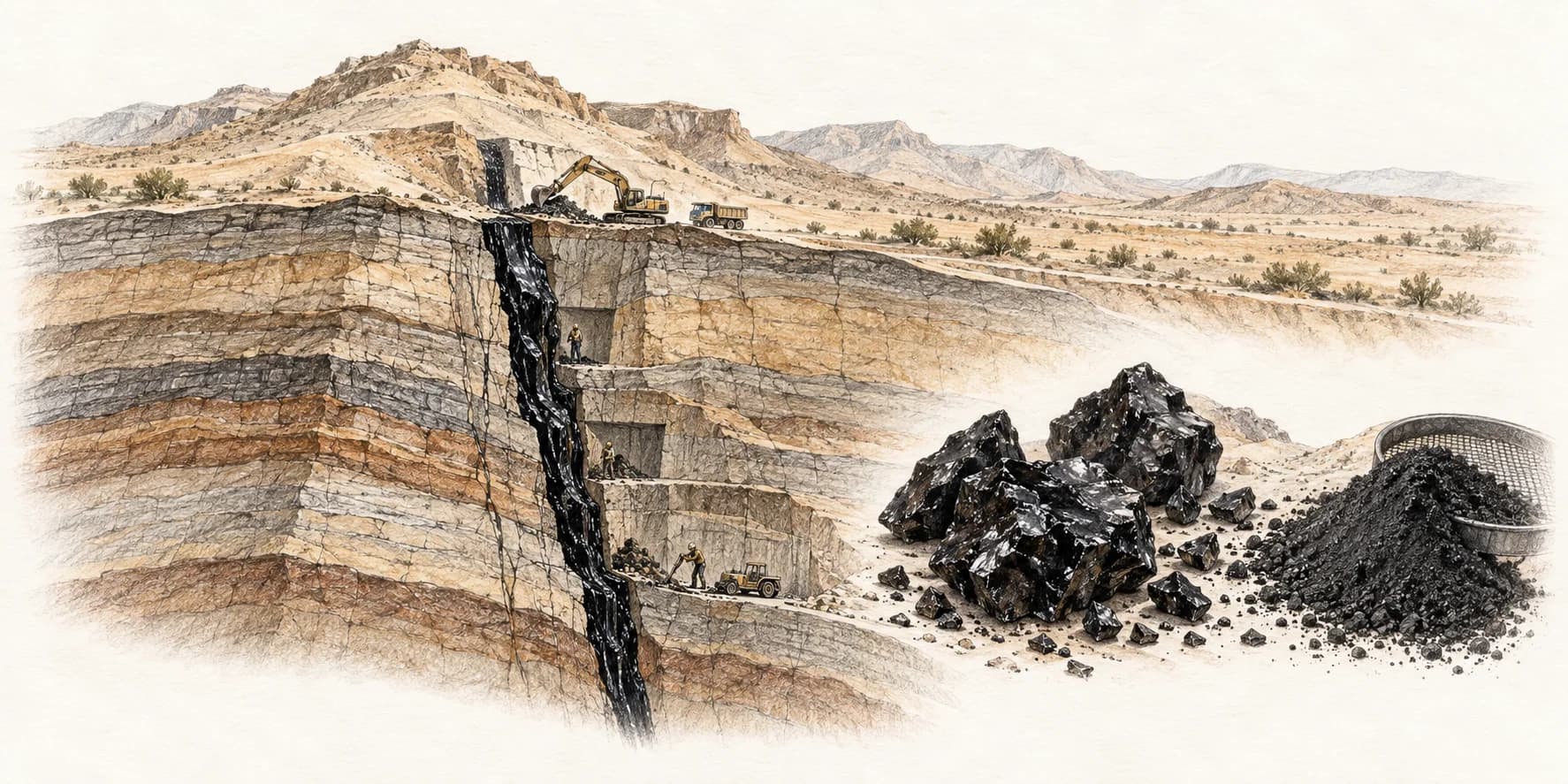
The best-studied deposits lie in the Uinta Basin of the western United States, which geological surveys describe as holding the world's largest gilsonite deposits. There, the material fills long, narrow, almost vertical veins cutting through sedimentary rock. Individual veins run for kilometres along their length, extend hundreds of metres downwards and are typically a few metres wide at most, with the widest reaching around seven metres.
Geologists trace the material back to an organic-rich oil shale layer deep in the basin. The current explanation runs in two stages:
- Fracturing. As the oil shale was buried and heated, fluids built up pressure and forced their way out, cracking the overlying and underlying rock into long, parallel fractures.
- Filling. A thick, hot, liquid hydrocarbon generated from the shale then moved into those fractures. Over time it cooled and polymerised into the solid, glassy material that is mined today.
Because each vein has its own source conditions and history, the softening point and other properties of the solid vary from vein to vein. This is one reason commercial grades are defined by test results rather than simply by the name.
Composition and physical character
Gilsonite is almost entirely hydrocarbon, with carbon making up roughly 85 per cent and hydrogen around 10 per cent, plus small amounts of nitrogen, sulphur and oxygen. It has a specific gravity close to 1.05, so it is only slightly denser than water. It breaks with a shiny, shell-like (conchoidal) fracture and gives a brown-black powder when ground.
Two properties make it commercially useful. First, it has a high softening point, often in the range of about 150 to 220 °C depending on the grade, so it stays solid where ordinary bitumen would flow. Second, it dissolves readily in aromatic and many chlorinated solvents, and blends into hot bitumen and oils, which lets it act as a hardening and binding resin.
Gilsonite compared with refinery bitumen
| Property | Gilsonite (uintaite) | Paving-grade refinery bitumen |
|---|---|---|
| Origin | Natural solid mined from veins | Residue of crude oil distillation |
| Form at room temperature | Hard, brittle, can be crushed to powder | Semi-solid, sticky, deforms under load |
| Softening point | High, roughly 150 to 220 °C | Typically well below 70 °C |
| Main role in products | Additive and modifier | Primary binder |
| Typical supply form | Lump, granules or graded powder in bags | Bulk, drums or bags as a heated liquid or solid block |
Mining and processing
Because the veins are narrow and steep, gilsonite has historically been mined underground by following the vein downwards, and the material has been worked commercially since the late nineteenth century. After extraction it is screened and crushed. Lump material may be sold as mined, while finer grades are milled to a specified particle size and sometimes sorted to give a tighter softening-point range. Processing is mechanical: no distillation or chemical refining is needed to make the basic product.
Where it is used
Gilsonite appears in a long list of products. The main ones are drilling fluids and well cements, asphalt and road binder modification, dark printing inks, paints and protective coatings, and foundry sand additives. In each case it is used for the same few properties: high softening point, compatibility with hydrocarbons, dark colour and the ability to stiffen or bind a mixture.
Gilsonite is best thought of as a natural hard resin, not a substitute for paving bitumen. It is added in small proportions to change how another material behaves.
What this means when you buy
Since vein origin influences properties, ask for a certificate of analysis with each lot showing softening point, ash, moisture and solubility, and state the particle size you need. Tell the supplier your end use (drilling, asphalt, inks or foundry) so the grade can be matched. Nuroil supplies gilsonite in lump and powder form through its gilsonite page, with a CoA on every delivery and MSDS on request. You can send your requirement through request a quote.