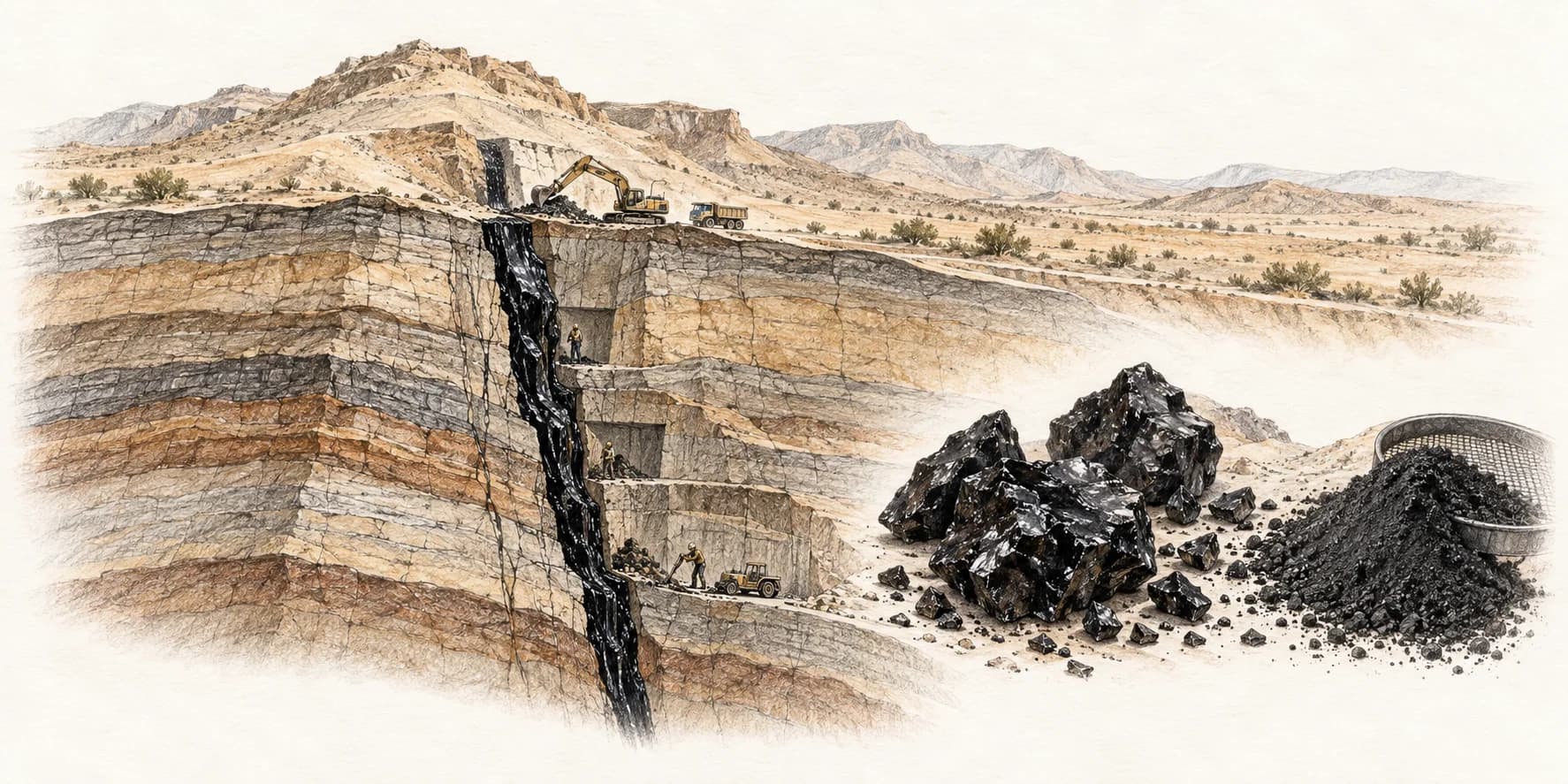
Drilling is one of the largest uses for gilsonite. The material has been used in oil and gas wells since the 1950s, both in drilling muds and in cement slurries. It does not change the chemistry of the fluid much. Instead it works physically, as fine, deformable particles that seal small openings in the rock around the wellbore.
The problem it addresses
A drilling mud has to hold up the walls of the hole, carry cuttings to the surface and keep formation fluids in place. Trouble starts when the mud, or the water in it, moves into the rock:
- Shale instability. Some shales soak up water from the mud, swell and crumble into the hole. This sloughing can widen the hole, trap pipe and cause hole collapse.
- Fluid loss. Liquid filters out of the mud into permeable rock, leaving a thick filter cake on the wall.
- Differential sticking. A thick filter cake and pressure difference can hold the drill string against the wall.
- Lost circulation. Mud escapes into fractures or very permeable zones.
How gilsonite helps
Gilsonite particles are hard at surface temperature, but as they approach their softening point downhole they become plastic. Under the pressure of the mud column they squeeze into micro-fractures, pore throats and the filter cake itself, forming a thin, low-permeability seal. Because gilsonite is a hydrocarbon, this seal resists water entering water-sensitive shale. Industry papers report that it can reduce borehole collapse in sloughing shales and improve the quality of the filter cake, making it thinner and slicker.
In well cementing, gilsonite is used as a lightweight additive and to help bridge weak or fractured zones so the cement slurry stays in the annulus rather than being lost to the formation.
Water-based and oil-based muds
| Mud type | How gilsonite is used | Practical point |
|---|---|---|
| Oil-based and synthetic-based | Partly dissolves or swells in the base fluid; helps control high-temperature filtration | Disperses readily without special treatment |
| Water-based | Dispersed as fine particles that plug micro-fractures and pores | Gilsonite repels water, so it is supplied pre-treated with surfactant or blended with a wetting agent |
| Cement slurries | Lightweight bridging additive | Grade and particle size matched to the slurry design |
Untreated gilsonite floats on water and tends to clump. For water-based systems the industry uses water-wettable grades in which the particles are coated or blended with surfactants so they mix into the mud and stay dispersed.
Choosing the grade
The key choice is softening point relative to the temperature at the depth of interest. If the softening point is far above formation temperature, the particles stay rigid and seal poorly. If it is well below, they can melt and smear without forming an effective plug, or be lost from the system. Drilling-grade material commonly has a softening point in the region of about 165 to 205 °C, with lower softening grades sometimes used for cooler sections. Mud engineers also consider:
- Particle size, matched to the pore and fracture sizes expected.
- Treatment level, decided by the mud programme and pilot testing.
- Compatibility with the other mud additives and the base fluid.
- Foaming in water-based systems, which some surfactant-treated grades can increase and which may need a defoamer.
Gilsonite seals the rock face physically. The softening point must suit the downhole temperature, or the material will either stay rigid or simply melt away.
Limits to keep in mind
Gilsonite is one tool among many for wellbore stability. It does not replace good mud weight control, inhibitive chemistry or proper hole cleaning. Much published performance data comes from product literature and laboratory tests, so pilot tests with the actual mud and formation conditions remain the sensible way to set dosage.
Buying gilsonite for drilling
Specify the mud system (water-based or oil-based), the softening point range, whether a water-wettable treated grade is needed, particle size, packing (usually 25 kg bags on pallets for rig use) and the quantity per well or campaign. Ask for a CoA per lot and the MSDS. Nuroil supplies gilsonite for drilling and other uses through its gilsonite page, and you can send details via request a quote.